
Female pattern hair loss: causes and treatment options
Quick answer
Female pattern hair loss (androgenetic alopecia) causes gradual thinning at the crown and parting, usually without a receding hairline. It tends to run in families and often becomes more noticeable around the menopause. Minoxidil is the main licensed treatment, and a clinician can also check for other causes, such as iron deficiency or thyroid problems, before starting treatment.
What is female pattern hair loss?
Female pattern hair loss, also called female androgenetic alopecia, is the most common cause of gradual hair thinning in women. It follows a recognisable pattern: hair becomes progressively finer and sparser along the midline parting, then more diffusely thin across the top of the scalp.
It looks different from male pattern baldness. The hairline at the front rarely moves back, and complete baldness is very unusual. Instead, the overall volume reduces and the scalp can become more visible through the hair, particularly in bright light or when the hair is wet.
Dermatologists often describe the severity using a simple scale that grades how wide the parting has become and how much scalp shows through, which helps track change over time rather than relying on memory alone.
What causes it?
Female pattern hair loss usually runs in families, and genetics is thought to be the main factor. Hair follicles that are genetically sensitive gradually shrink over time in a process called miniaturisation, producing shorter, finer strands with each growth cycle until some follicles stop producing visible hair altogether.
Hormonal changes can make it more noticeable. Many women first notice thinning around the perimenopause and menopause, when falling oestrogen levels appear to unmask an underlying genetic tendency. Conditions linked to higher androgen levels, such as polycystic ovary syndrome, can also contribute, sometimes alongside other signs like acne or excess facial or body hair.
Age itself plays a part too, since hair density naturally declines over the decades even without a strong family history. Stress, illness and poor sleep do not cause female pattern hair loss on their own, but they can make existing thinning more noticeable by adding a temporary shedding phase on top of it.
Could it be something else?
Not all hair thinning in women is female pattern hair loss, and it is worth ruling out other causes before assuming that is what is happening.
Telogen effluvium causes more sudden, diffuse shedding, often three to four months after a trigger such as childbirth, a high fever, severe stress, rapid weight loss or starting or stopping certain medicines. Unlike pattern hair loss, it usually recovers once the trigger has passed, though the two conditions can overlap and make each other look worse for a while.
Iron deficiency and thyroid problems (both an underactive and an overactive thyroid) are also well recognised causes of hair thinning in women, and both are checked with a simple blood test. Patchy hair loss with clearly defined bald areas suggests a different condition, alopecia areata, rather than pattern hair loss, and is worth having examined separately, as is any scarring, redness or scaling of the scalp itself.
How is it diagnosed?
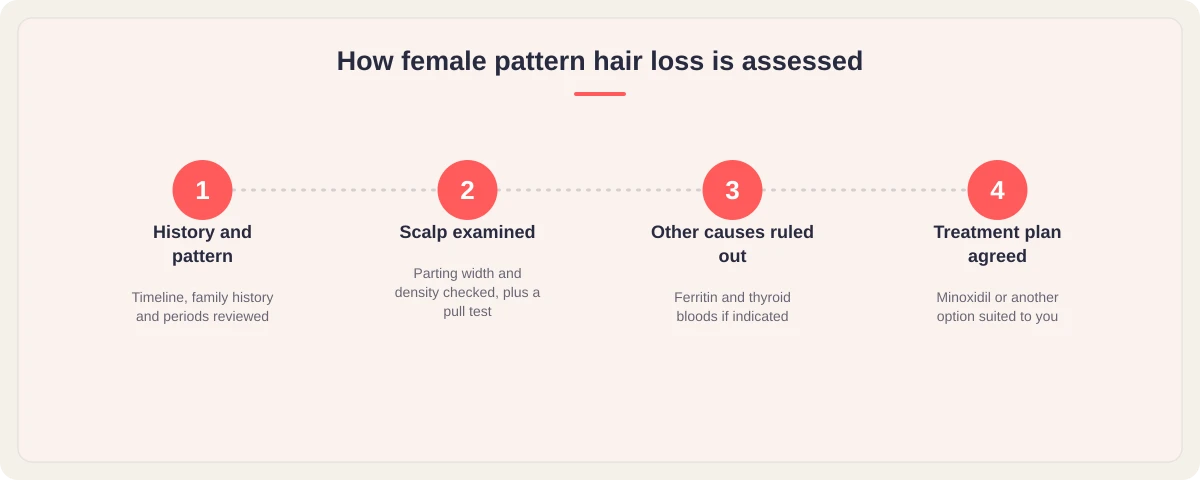
There is no single test for female pattern hair loss. A clinician usually starts by asking about the pattern and timeline of the thinning, your family history, your periods and any other symptoms, then examines the scalp to look at the parting width and hair density. A gentle pull test, where a small section of hair is tugged lightly to see how many strands come away, can help distinguish active shedding from stable thinning.
Blood tests, most commonly ferritin (iron stores) and thyroid function, are often used to rule out other treatable causes before or alongside starting treatment, since female pattern hair loss can coexist with them.
Getting a clear diagnosis matters because the right treatment, and how quickly you should expect to see a difference, depends on which type of hair loss is actually happening.
minoxidil">Minoxidil: the main licensed treatment
Minoxidil applied directly to the scalp is the main evidence-based treatment for female pattern hair loss. The 2% strength is licensed specifically for women; a 5% strength is sometimes used under the guidance of a clinician, though it is not licensed for women and can be more likely to cause unwanted facial hair growth at the hairline where it spreads if applied carelessly.
Minoxidil works by prolonging the growth phase of the hair cycle. It can slow further thinning and, in some women, partially restore density, but it typically takes three to six months of consistent daily use before any change is visible, and longer to judge the full effect. A short-lived increase in shedding is common in the first few weeks as older hairs are pushed out to make way for new growth, which can be alarming but usually settles.
Scalp irritation and dryness are the most common side effects, and applying it to a dry scalp rather than wet hair can reduce this. Results are not permanent in the sense of a one-off cure: the benefit is only maintained for as long as you continue using it, and shedding usually resumes a few months after stopping.
Other options a clinician may discuss
Low-dose oral minoxidil, taken as a tablet rather than applied to the scalp, is an emerging option that some specialists now consider, usually when the topical version is not tolerated or has not helped enough.
Medicines that reduce the effect of androgens on the scalp, such as spironolactone, are sometimes used, more often when there are other signs of higher androgen levels, such as with polycystic ovary syndrome. These are specialist decisions, not routine first-line treatment, and need monitoring for side effects and suitability.
Finasteride, though used in men, is not recommended for women who could become pregnant because of a risk to a developing baby, and is only occasionally considered after the menopause under specialist supervision. It is not a treatment a pharmacy or GP would offer routinely for female pattern hair loss.
What to realistically expect
Female pattern hair loss is a slow, progressive condition if left untreated, but it is manageable rather than something that needs to be simply accepted. Treatment aims to slow or stabilise the thinning and, for some women, improve density, rather than restore hair to how it looked years earlier.
Because change happens gradually, many clinicians suggest taking photographs of the parting every few months, in the same light and from the same angle, to track progress objectively, since day-to-day differences can be hard to judge in the mirror.
Gentle hair care will not reverse pattern hair loss on its own, but it can reduce additional strain on hair that is already thinning. Tight hairstyles, frequent heat styling and harsh chemical treatments can add breakage on top of pattern thinning, so easing off these where practical is often suggested. Root-lifting or volumising products, a shorter layered cut, or a scalp-toning powder for the parting are common, low-risk ways to manage the appearance of thinning while any treatment has time to work.
When to speak to a pharmacist or GP
It is worth seeking advice if thinning is sudden or patchy rather than gradual, if you notice scalp redness, scaling or itching, if hair loss comes with irregular periods, acne or excess hair growth, or if you are simply unsure what type of hair loss you are dealing with.
A pharmacist or GP can arrange the right blood tests, examine the scalp, and help you decide whether minoxidil or another approach is appropriate for your particular situation.
Frequently asked questions
Is female pattern hair loss the same as male pattern baldness?
No. Both are forms of androgenetic alopecia, but the pattern differs. Women typically develop diffuse thinning at the parting and crown while the front hairline stays largely intact, and complete baldness is very rare, unlike the receding hairline and crown balding seen in men.
Does minoxidil regrow hair or just stop it getting worse?
Both are possible, but responses vary. Most women who respond see slower shedding and some see a genuine increase in density, usually after three to six months of daily use. It works only for as long as you keep using it.
Can I use finasteride if I'm a woman with hair loss?
It is not recommended for women who could become pregnant, since it can affect a developing baby, and is only occasionally used after the menopause under specialist supervision. A clinician can explain the licensed alternatives for women.
Could my hair loss be caused by something other than genetics?
Yes. Iron deficiency, thyroid problems, recent illness, childbirth, crash dieting and some medicines can all cause hair shedding that looks similar at first glance. Blood tests can help tell these apart from female pattern hair loss.
Is female pattern hair loss permanent?
Left untreated it tends to progress gradually over years, but it is not usually a fixed, unchangeable state. Treatment can slow progression and improve density for many women, though it needs to be continued to maintain any benefit.
Will the NHS treat female pattern hair loss?
Pattern hair loss is generally considered a cosmetic issue, so minoxidil is typically bought privately rather than prescribed on the NHS. Your GP will still investigate and treat any underlying medical cause, such as thyroid disease or iron deficiency, if one is found.