
HIV testing explained: window periods, self-tests and what to expect
Quick answer
Most HIV tests are highly accurate once the window period has passed: 45 days for a clinic or lab blood test, 90 days for a self-test. Testing is free on the NHS via a GP, sexual health clinic or a home kit. A reactive self-test result always needs confirming with a follow-up lab test before it counts as a diagnosis.
Why HIV testing matters
HIV rarely causes symptoms that are obvious enough to notice, particularly in the weeks and months after exposure. Some people do get a short flu-like illness two to six weeks after infection, with a fever, sore throat or rash, but many people notice nothing at all. It is entirely possible to feel completely well and still be living with the virus, sometimes for years, while it gradually affects the immune system in the background.
Regular testing is the only reliable way to know your status, whether you are sexually active with new or multiple partners, have shared injecting equipment, or simply want the reassurance of a clear result before starting a new relationship. Testing is routine, confidential and, in the UK, free, whichever route you choose.
An early diagnosis matters because treatment started promptly is far more effective at protecting long-term health than treatment started late, after the virus has already caused more damage to the immune system. Knowing your status also means you can take informed steps to avoid passing the virus on to anyone else, and get support and monitoring in place early rather than by chance.
Understanding the window period
The window period is the gap between a possible exposure and the point at which a test can reliably detect the virus. Straight after exposure, there is not yet enough antigen or antibody in the blood for a test to pick up, so testing too early can give a falsely reassuring result even if you have genuinely been exposed.
For a standard laboratory or clinic blood test, known as a combined antigen/antibody test, current UK testing guidance puts the window period at 45 days for a fully conclusive result. This type of test looks for both the p24 antigen, which appears earlier, and antibodies, which take a little longer to develop, which is why it can close the window sooner than older antibody-only tests.
Self-tests use simpler point-of-care technology that detects antibodies alone, so the window period for a self-test is longer, at 90 days. During the window period itself it is still possible to pass the virus on to someone else even though a test taken at that point would come back negative.
If you test before the relevant window period has passed, treat a negative result as provisional rather than final, and plan a repeat test once the window has closed to be certain.
Self-testing, self-sampling and clinic tests
There are three main ways to test for HIV in the UK, and it helps to understand the difference before choosing one.
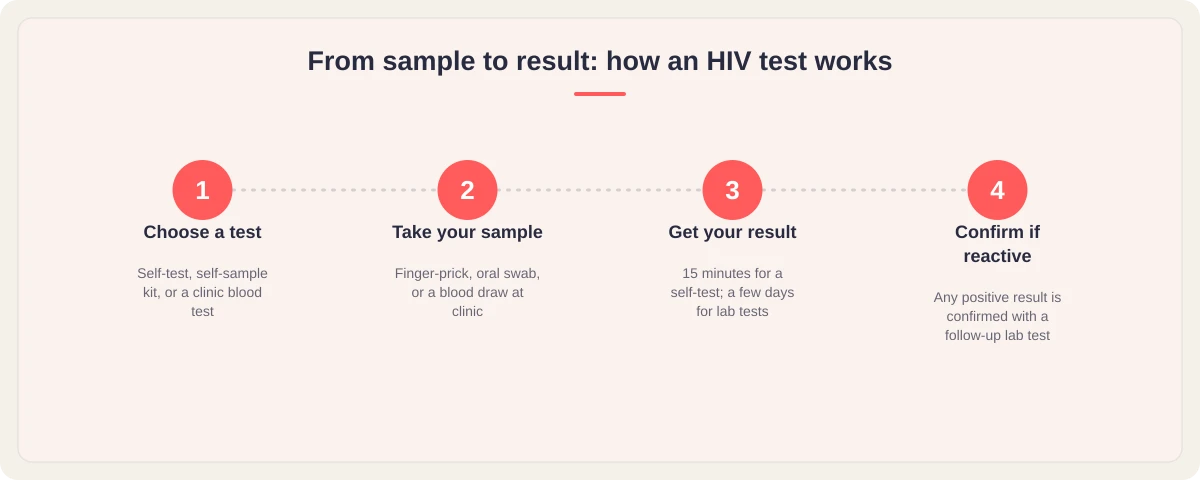
A self-test is one you carry out entirely yourself at home, from taking a finger-prick blood sample or oral swab through to reading the result, usually within around 15 minutes. It suits anyone who wants privacy and an immediate result without waiting for post or an appointment.
A self-sampling kit is similar in that you collect your own sample at home, but you post it to a laboratory rather than reading it yourself, with results usually sent back by phone or text within a few days. Because it is processed in a lab rather than read by eye, it can offer the same reliability as a clinic test without needing to attend in person.
A clinic test is carried out face to face at a sexual health clinic, GP surgery or testing centre, where a nurse or clinician takes the sample and explains the result to you directly. It suits anyone who wants support on hand, for example if they think they may have had a recent high-risk exposure, want other STI checks done in the same visit, or simply prefer to talk things through.
How to get tested in the UK
HIV testing is free on the NHS, whichever route you choose. Sexual health (GUM) clinics and many GP surgeries offer testing as part of a routine appointment, and most areas also run free walk-in or drop-in testing services with no referral needed. Free self-test and self-sampling kits can also be ordered online through NHS-linked services and posted to your home in discreet packaging, with results kept confidential throughout.
If you would rather talk something through first, for example if you are not sure which type of test suits your situation, want to understand a recent exposure, or are thinking about ongoing prevention such as PrEP, a pharmacy consultation with a clinician is a straightforward way to get clear, judgement-free guidance before you test or between appointments elsewhere.
What your result means
A negative result taken after the relevant window period has passed is reassuring and means no further action is usually needed, other than continuing to test periodically if your circumstances put you at ongoing risk.
A reactive or positive result from a self-test or self-sampling kit is not, on its own, a diagnosis. Every reactive result is followed up with a confirmatory laboratory test, using a different method, and only that confirmatory result is used to formally diagnose HIV. If you do receive a reactive result, clinics are set up to see you quickly, explain exactly what happens next, and start the confirmation process without unnecessary delay or waiting lists.
Modern antiretroviral treatment is highly effective at controlling the virus, protecting long-term health and allowing people diagnosed with HIV to live full, healthy lives. Once treatment brings the level of virus in the blood down to an undetectable level and keeps it there, it is understood that the virus cannot be passed on through sex, a principle widely referred to as undetectable equals untransmittable.
If you've had a recent possible exposure
If you think you may have been exposed to HIV in the last few days, for example after unprotected sex or sharing injecting equipment, testing straight away is not the right first step, since it would fall well within the window period and could give a falsely reassuring result. Instead, post-exposure prophylaxis (PEP) is a short course of medicine, typically taken for around 28 days, that can substantially reduce the risk of infection if started soon enough after exposure.
PEP needs to begin as soon as possible, and always within 72 hours of exposure, with earlier being more effective, so contact your nearest sexual health clinic or A&E directly rather than waiting for a routine appointment. Once the immediate risk has passed, a follow-up HIV test is still needed once the window period has closed, to confirm the outcome.
If you are likely to be at ongoing risk of exposure going forward, for example through your relationships or lifestyle, a clinician can also talk you through PrEP, which is taken regularly before potential exposure to reduce the risk of picking up HIV in the first place. This is a different medicine, used in a different way, from the after-the-event course used for PEP, and is worth discussing as part of a wider consultation about your sexual health.
Frequently asked questions
How soon after a possible exposure can I test for HIV?
A clinic or lab blood test is considered conclusive from 45 days after exposure, while a self-test needs 90 days to be fully reliable. Testing earlier is possible but a negative result before this point should be treated as provisional.
Can I test for HIV at home in the UK?
Yes. Free self-test kits, which you read yourself within around 15 minutes, and self-sampling kits, which you post to a lab, are both available through NHS-linked services, alongside testing at sexual health clinics and GP surgeries.
Is a positive self-test result definitely HIV?
No. A reactive result from a self-test or self-sampling kit is always followed up with a confirmatory laboratory test, and only that result is used to make a diagnosis.
How often should I get tested for HIV?
This depends on your individual circumstances. Many sexual health services suggest annual testing for sexually active adults, and more frequent testing, such as every three to six months, for those at higher ongoing risk.
What should I do after a recent high-risk exposure?
Contact a sexual health clinic or A&E as soon as possible, since post-exposure prophylaxis (PEP) can reduce the risk of infection but only works if started within 72 hours of exposure.
What is the difference between PEP and PrEP?
PEP is a short course taken after a specific possible exposure to reduce the risk of infection and must start within 72 hours. PrEP is taken regularly beforehand by people at ongoing risk, to reduce the chance of picking up HIV in the first place.