
How much does TRT cost in the UK?
 Reviewed by the My London Pharmacy clinical team, Yvonne Lim, Pharmacist Independent Prescriber
·27 August 2026
·11 min read
Reviewed by the My London Pharmacy clinical team, Yvonne Lim, Pharmacist Independent Prescriber
·27 August 2026
·11 min read
Quick answer
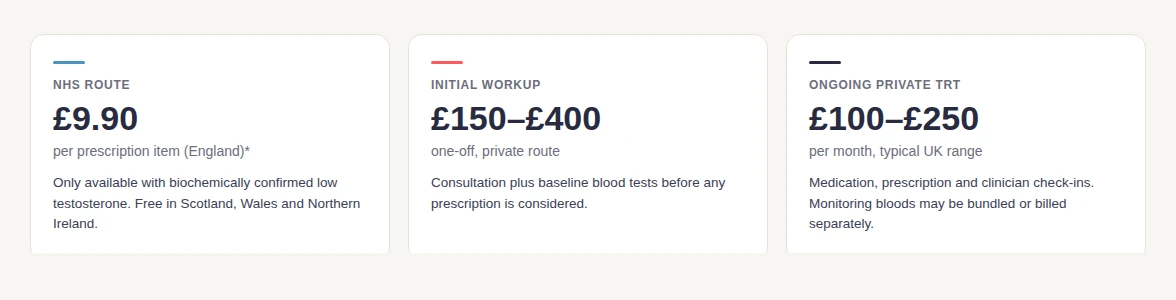
UK TRT cost depends on the route. NHS prescriptions cost £9.90 per item in England (free in Scotland, Wales and Northern Ireland), but only once low testosterone is biochemically confirmed. Private programmes typically run £100 to £250 a month, with an initial workup of consultation and blood tests commonly £150 to £400. The exact figure depends on the formulation, how much clinician contact is included, and whether monitoring bloods are bundled in.
TRT cost at a glance
Testosterone replacement therapy (TRT) is one of the more cost-confusing corners of UK men's health. Headline prices vary between providers, the NHS route is narrower than people expect, and a "monthly cost" sometimes hides testing fees that only show up later. Here is the shape of it before the detail.
NHS vs private: what you actually get
The NHS does prescribe TRT, but eligibility is narrow. Guidance reflected in the BNF frames TRT as treatment for clinically confirmed male hypogonadism, not a lifestyle option for men with low-normal levels or symptoms alone. In practice, NHS pathways generally want two early-morning total testosterone readings below the lab reference range, taken on separate days, alongside consistent symptoms, before treatment is considered.
If you meet that bar, NHS TRT is about as cheap as it gets: the standard prescription charge, currently £9.90 per item in England, or nothing at all in Scotland, Wales and Northern Ireland, or if you hold a valid exemption. Monitoring bloods on the NHS are funded too.
How fast is each route?
Speed is where the NHS and private routes really diverge, and it is often the deciding factor for men who are already fairly confident low testosterone is behind their symptoms.
The NHS route starts with a GP appointment and initial bloods, and only leads to an endocrinology referral if those results and your symptoms meet the threshold. From there, endocrinology waiting times vary a lot by area: some parts of the UK see patients within 6 to 8 weeks, but a 3 to 4 month wait for a first appointment is common in much of England, and 9 to 12 months is realistic in the highest-demand areas, including parts of Northern Ireland. Add the GP appointment and repeat bloods before that, and the full NHS journey from "I think something's wrong" to a prescription can easily run several months.
Private providers can usually turn the same journey around in days once your bloods are back: consultation, baseline bloods, a follow-up review of the results, and a prescription if hypogonadism is confirmed. That speed is a large part of what the higher private cost is actually paying for, alongside the clinician time and monitoring already covered above.
What a private TRT programme actually includes
A properly run private programme is not one transaction, it is three: an initial workup, a recurring medication supply, and ongoing monitoring. A reputable provider will break these out clearly rather than quoting a single headline number.
Initial consultation and baseline workup
Before anything is prescribed, a clinician takes a history, reviews your symptoms and orders baseline bloods, typically including morning total testosterone (often repeated on a separate day), LH and FSH, full blood count and haematocrit, and PSA where age-appropriate. This stage commonly costs £150 to £400, depending on how many markers are tested and whether the consultation is bundled in.
Treatment options and monthly cost
Once hypogonadism is confirmed and treatment agreed, the recurring fee usually covers the medication, prescribing, dispensing and a routine check-in. Private programmes typically sit in a £100 to £250 monthly band, and the formulation you use is one of the biggest things that moves you up or down that range:
- Topical TRT (gel). Applied once daily to the skin. Levels stay fairly steady day to day, and dosing is easy to adjust, but it needs to dry fully before skin-to-skin contact with a partner or children to avoid transfer.
- Short-acting injections (such as testosterone enantate or Sustanon). Given roughly every 1 to 3 weeks, either self-administered or at a clinic. Levels can dip before the next dose, which some men notice as a "rollercoaster" effect.
- Long-acting injections (such as Nebido). Given roughly every 10 to 14 weeks once you are established on treatment, which suits men who prefer fewer appointments, at the cost of less flexibility if the dose needs adjusting.
Beyond formulation, how often a clinician reviews you and whether monitoring bloods are folded into the monthly fee or billed separately are the other two levers that move the price.
Ongoing monitoring
Monitoring is not optional. TRT can raise haematocrit, so UK guidance expects periodic checks of testosterone, haematocrit, PSA and general symptoms, typically at 3 months, 6 months, then every 6 to 12 months. Where this is billed separately, expect roughly £60 to £120 per round, adding somewhere in the region of £200 to £500 across a year. A price that looks unusually low almost always means monitoring has been left out of the headline figure, and any programme that skips it entirely is one to avoid.
How UK TRT providers compare
Prices below are the providers' own published UK rates as of August 2026, shown so you can see where a typical private programme sits. They can and do change, so treat this as a starting point for comparison rather than a live quote, and confirm current pricing directly with any provider before committing.
| Route | From | What it typically includes |
|---|---|---|
| NHS (if eligible) | £9.90 per item* | Medication and NHS-funded monitoring, once hypogonadism is confirmed. |
| My London Pharmacy | Confirmed at consultation | A clinician reviews your bloods and history and confirms your personal cost before you commit to anything. |
| Voy | £99/month | Injectable and oral treatment from £99/month, topical from £129/month; medication, monitoring bloods and clinician support quoted as included. |
| Leger Clinic | ~£95/month | Published as an annual package (around £1,140 to £1,485 a year depending on year one or two), rather than a simple monthly fee. |
*NHS prescriptions are free in Scotland, Wales and Northern Ireland. Private figures are each provider's own advertised starting price and may not include every cost, check what is and is not bundled before comparing.
The spread between providers is real, but the lowest headline number is not always the lowest year. A £99/month plan that bills monitoring separately can end up costing more over 12 months than a £180/month plan that includes it. The question worth asking is never just "what's the monthly fee", it's "what's the total cost of a properly monitored year".
What changes the monthly price
A few factors consistently move private TRT cost up or down:
- Formulation. Gels, injections and longer-acting depot preparations have different unit costs and dosing intervals.
- How often you see a clinician. Monthly reviews tend to sit higher than quarterly ones.
- Whether monitoring is bundled. Some providers fold blood tests into the monthly fee, others invoice them separately.
- Delivery and dispensing. Postage, packaging and how medication is dispensed can add a small amount either way.
Will insurance cover any of it?
Most UK private medical insurance policies do not routinely cover TRT, particularly when it is framed around general wellbeing rather than a confirmed diagnosis. Some policies will fund an initial endocrinology assessment if hypogonadism is genuinely suspected, but ongoing treatment is usually self-funded. If you have insurance, it is worth calling your provider before your first consultation and asking specifically about endocrine assessment and blood test codes, rather than simply "does this cover TRT", which tends to get a default no.
Privacy and discretion
For a lot of men, discretion matters as much as cost or speed. A private online route means the whole process, consultation, blood test arrangement, and any resulting prescription, can be handled without taking time off to sit in a GP waiting room or explain why you are there. Consultations are confidential and are reviewed by a clinician, not shared with anyone else unless you choose to.
Medication is dispensed and delivered in plain, unmarked packaging with no indication of the contents on the outside, and your health information is handled under the same data protection standards that apply to any UK healthcare provider. If discretion is a priority for you, it is a reasonable thing to ask about directly, alongside the cost questions below, since exact delivery and confidentiality practices do vary between providers.
Questions worth asking before you sign up
Before starting any private programme, a reputable provider should be able to answer these without hesitation:
- What exactly is included in the monthly fee, medication, prescribing, dispensing, clinician contact?
- Are baseline and ongoing monitoring bloods bundled in, or billed separately?
- How often are blood tests repeated, and which markers are covered?
- What is the realistic 12-month total, including monitoring, not just the headline monthly figure?
- What happens if you want to pause or stop, is there a notice period or an off-boarding cost?
If the answer to any of these is vague, especially around monitoring, that tells you something before you have spent a penny.
Is the cost worth it?
That depends entirely on whether TRT is the right treatment for you in the first place, which is a clinical question, not a pricing one. The essential first step is proper testing to confirm whether low testosterone is genuinely behind your symptoms, because many of the same symptoms have other, more treatable causes. Starting on price alone, without that confirmation, risks paying for a treatment that was never going to help.
Our clinical team can talk you through testing, confirm your suitability, and set out your actual cost clearly before you commit to anything, subject to a clinical assessment.
Frequently asked questions
How much does TRT cost per month in the UK?
Private UK TRT programmes typically cost between £100 and £250 a month, depending on the formulation, how much clinician contact is included, and whether monitoring blood tests are bundled in or billed separately. On the NHS, you pay the standard prescription charge of £9.90 per item in England if you are eligible, or nothing in Scotland, Wales and Northern Ireland.
Is TRT available free on the NHS?
TRT is only prescribed on the NHS once hypogonadism is biochemically confirmed, usually with two morning blood tests showing persistently low testosterone alongside symptoms. It is not available for low-normal levels or general wellbeing goals. Where it is prescribed, you pay the standard prescription charge in England, or nothing in Scotland, Wales and Northern Ireland.
Why is private TRT more expensive than an NHS prescription?
The medication is only part of the cost. Private fees also cover clinician time, baseline and follow-up blood tests, prescribing and regulated dispensing, and ongoing safety monitoring, all of which the NHS provides too but funds differently.
What is included in the initial TRT workup cost?
A typical UK workup includes a consultation and baseline blood tests, usually covering testosterone, related hormones such as LH and FSH, full blood count and haematocrit, and often PSA where age-appropriate. This commonly costs between £150 and £400 depending on the provider and how many markers are tested.
Does health insurance cover TRT in the UK?
Most UK private medical insurance policies do not routinely cover TRT. Some may fund an initial endocrinology assessment where hypogonadism is suspected, but ongoing treatment is usually self-funded, so it is worth checking directly with your insurer before starting.
Are cheaper TRT providers worth it?
Not if the lower price means skipping baseline testing or ongoing monitoring. TRT can affect haematocrit, prostate health, cardiovascular risk and fertility, so a reputable provider will always include proper testing and follow-up as part of the cost, not as an optional extra.
How much faster is private TRT than the NHS?
Private providers can usually take you from consultation to prescription within days once your bloods are back. NHS endocrinology waits vary widely by area, from around 6 to 8 weeks in some places to 3 to 4 months in much of England, and up to 9 to 12 months in the highest-demand areas, on top of the initial GP appointment and bloods.
Is TRT treatment kept private and confidential?
Yes. Online consultations are confidential and reviewed only by your clinician, and medication is dispensed and delivered in plain, unmarked packaging with no indication of the contents. Exact delivery and confidentiality practices vary between providers, so it is reasonable to ask directly if this matters to you.