

Insulin pen needles: choosing the right size and travelling safely
Quick answer
Most adults and children are best suited to a short, 4mm pen needle regardless of BMI, as recommended by the Forum for Injection Technique UK. Keep in-use insulin at room temperature away from heat and light, carry a prescriber's letter when travelling, and always dispose of needles in a proper sharps container.
Why needle length matters
Insulin is designed to be injected into the layer of fat just under the skin, known as the subcutaneous tissue, not into muscle. If a needle is too long for someone's build, there is a greater chance the injection lands partly or fully in muscle. Insulin absorbed from muscle can act faster and less predictably than intended, which can make blood glucose harder to control and occasionally leads to unexpected low readings.
For a long time, standard practice assumed that taller or larger people needed a longer needle to reach the right depth. Current UK guidance from the Forum for Injection Technique, known as FIT UK, has moved away from that assumption. A short needle is now considered appropriate for the great majority of people, whatever their body mass index, because the subcutaneous fat layer is a similar thickness across most adults regardless of size.
Getting the length right matters just as much as remembering the injection itself. It is one of the simplest technique changes that can make day-to-day dosing more consistent, and it is something worth reviewing periodically rather than assuming the needle you started on years ago is still the best fit, particularly if your weight or muscle mass has changed since diagnosis.
Choosing the right pen needle size
FIT UK guidance considers a 4mm needle the safest default length for adults and children alike. At this length, most people do not need to pinch up a skin fold before injecting and can use a straight, 90-degree angle, which makes the technique easier to repeat consistently at every injection.
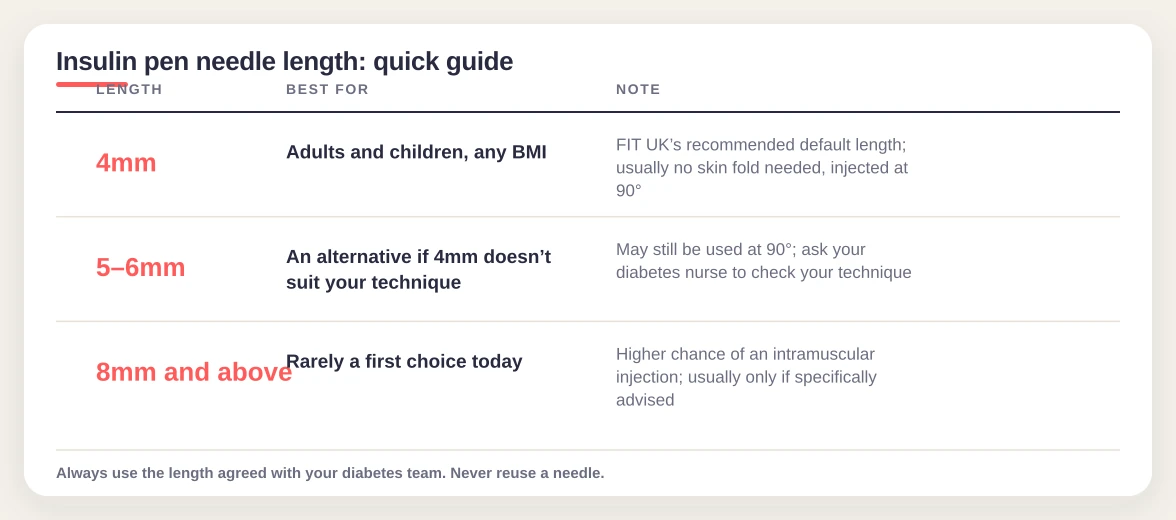
Longer needles, from 5mm up to 12mm, are still manufactured and occasionally used, for example if someone finds a particular pen easier to handle with a different needle, or their diabetes team has a specific clinical reason to recommend one. There is no clinical reason for children or teenagers to use a needle longer than 6mm.
Needle diameter, often described as the gauge, also affects comfort: a thinner needle generally feels less noticeable going in, though it can take a little longer to deliver a larger dose. Most people settle on a size within a few tries, and it is not something you need to work out alone; your pharmacist or diabetes nurse can talk through the options at your next appointment.
Whatever the length, each pen needle is intended for single use only. Reusing a needle can blunt the tip, make the injection more uncomfortable, and increase the risk of infection or of insulin leaking back out of the injection site instead of being absorbed properly.
If you are not sure which needle you have been using, the packaging and the needle itself are usually marked with the length in millimetres, and your pharmacist can help you check.
Rotating your injection sites
Injecting into the same small patch of skin repeatedly can lead to lipohypertrophy: firm, thickened areas under the skin where insulin is absorbed unevenly and less reliably. This can make doses less predictable even when the needle length and technique are otherwise correct.
Rotating between different injection areas, such as the abdomen, the front and outer thighs, the buttocks and the upper arms, and moving the exact spot within each area between injections, helps keep absorption consistent over time and protects the skin from repeated damage. A simple approach many people find useful is to work across an imaginary grid within one area before moving to the next, so the same point is not used again for a few weeks.
If you notice lumps, dimpling, bruising or unexplained changes in how well your insulin seems to be working, mention it at your next diabetes review. A practice nurse, diabetes specialist nurse or the pharmacy team can check your technique and injection sites and suggest adjustments.
Storing your insulin safely
Unopened insulin should be kept in the fridge, generally between 2°C and 8°C, and should never be allowed to freeze. Insulin that has frozen should be thrown away, as freezing damages the protein structure permanently and it will not work as expected even after thawing.
Once a pen or vial is in use, most insulins can be kept at normal room temperature, away from direct sunlight and heat sources such as radiators, sunny windowsills or a car dashboard on a warm day. The exact length of time an in-use pen remains suitable varies by product, so always check the patient information leaflet that comes with your specific insulin, or ask your pharmacist if you are unsure.
Insulin that looks cloudy when it should be clear, has changed colour, or contains visible particles or clumps should not be used. If anything about the appearance of your insulin looks different from usual, speak to your pharmacy team before your next dose rather than assuming it is still fine.
Travelling with insulin
Insulin, pens, needles and related supplies are permitted in hand luggage under UK aviation security rules, and it is sensible to keep them with you rather than in checked baggage. This protects the insulin from extreme temperatures in the hold and means your supplies are not at risk if luggage is delayed or lost.
It is worth asking your GP practice or diabetes team for a letter confirming your condition and the equipment you carry. This is not usually essential, but it can make security checks quicker, particularly if you are travelling with several pens, needles, a blood glucose meter or a continuous glucose monitor.
Pack more insulin and supplies than you think you will need for the length of the trip, and consider splitting them across more than one bag in case one goes astray. If you are heading somewhere very hot or very cold, check the storage advice for your specific insulin, since a hotel room fridge or an insulated travel case may be worth arranging in advance. Long-haul travel across time zones can also affect your dosing schedule; your diabetes team can help you plan this before you go.
Safe sharps disposal
Used needles, lancets and other sharps should never go into a household waste or recycling bin, as they pose a risk to anyone who handles the rubbish afterwards. Your GP surgery or the pharmacy team can arrange a proper sharps bin, and many local councils run a collection or drop-off scheme once it is full.
When you are away from home, a small, purpose-made travel sharps container is the safest option; ask your pharmacist about one before you set off, as they are inexpensive and widely available. If you are caught without one, a firm-lidded container kept clearly labelled and well out of reach of anyone else is only ever a short-term measure until you can dispose of it properly through a pharmacy or council scheme.
When to speak to your pharmacist or diabetes team
It is worth checking in with your diabetes team or pharmacy if your current needle length does not feel comfortable, if you notice bruising or lumps developing at your injection sites, or if your blood glucose readings have become harder to predict despite a consistent routine.
It is also a good time to ask questions if you are due to travel, if you are unsure how long an opened pen can be kept once you are away from your usual fridge, or if you simply want a refresher on rotating sites and safe disposal. Our pharmacy team can help with the everyday practicalities around diabetes pens and needles, including making sure you have the right size and supplies in place, subject to suitability.
Frequently asked questions
What is the safest insulin pen needle length?
Current UK guidance from the Forum for Injection Technique (FIT UK) recommends a 4mm needle as the safest default for adults and children, regardless of BMI, as it makes an intramuscular injection much less likely.
Can I reuse an insulin pen needle?
No. Each pen needle is designed for single use. Reusing one can blunt the tip, make injections more uncomfortable, and raise the risk of infection or an uneven dose.
How should I store insulin that I am currently using?
Most in-use insulin pens can be kept at room temperature, away from direct heat and sunlight, for a period set out in the patient leaflet for that specific product. Unopened insulin should stay in the fridge and must never be frozen.
Can I take insulin and needles through airport security?
Yes. Insulin, pens and needles are permitted in hand luggage under UK aviation rules. A letter from your GP or diabetes team confirming what you are carrying can make security checks quicker.
What should I do with used needles when I am travelling?
Carry a small travel sharps container, available from your pharmacy, and dispose of it properly once you get home or at a suitable collection point. Never put used needles in a general waste bin.