
NMN and resveratrol supplements: what the evidence actually shows
Quick answer
NMN and resveratrol are marketed as longevity supplements. Small human trials show NMN raises blood NAD+ levels, but neither ingredient has proven anti-ageing benefits. Resveratrol is a standard UK food supplement; NMN is classed as an unauthorised novel food here. Neither is NHS-recommended, and both need checking against your other medicines first.
What are NMN and resveratrol?
NMN (nicotinamide mononucleotide) and resveratrol are two of the most talked-about ingredients in the "longevity supplement" market, capsules and powders sold on the promise of supporting healthy ageing from the inside. Neither is a licensed medicine and neither is available on an NHS prescription; both are sold, where permitted, as food supplements.
NMN is a compound the body makes naturally and uses to produce NAD+ (nicotinamide adenine dinucleotide), a molecule involved in energy production and cell repair that gradually declines with age. Resveratrol is a plant compound found in small amounts in red grapes, berries and red wine, best known from early laboratory research into so-called "longevity genes" called sirtuins.
The two are often sold together, or alongside NAD+ itself, on the idea that raising NAD+ levels or activating sirtuins could slow some effects of ageing. That idea comes largely from cell and animal studies; whether it holds up in people is a separate question, and the one this guide focuses on.
Interest in this category has grown quickly online, driven partly by high-profile figures discussing their own supplement routines. That popularity says something about demand, but nothing about whether a given ingredient actually does what the marketing around it suggests, which is why it's worth separating the two.
How they're meant to work in the body
The theory behind NMN is fairly simple: NAD+ levels fall as we get older, so topping up one of its building blocks might restore some of what's lost. Once absorbed, NMN is converted into NAD+, and several small human studies have measured a rise in blood NAD+ after people take it. NAD+ itself is involved in hundreds of processes inside cells, including how they generate energy and repair damaged DNA, which is why interest in keeping levels up has grown as the population ages.
Resveratrol's proposed mechanism is different. Early research suggested it activates sirtuin proteins linked to extended lifespan in some organisms, and other studies have looked at its antioxidant and anti-inflammatory effects on blood vessels, blood sugar and cholesterol. Some of the excitement around resveratrol also traces back to the idea that it might explain part of the so-called "French paradox", the observation that a diet relatively high in saturated fat didn't seem to translate into higher rates of heart disease in parts of France with high red wine consumption. That link was always circumstantial rather than proven.
Both ideas are biologically plausible and have some support from laboratory and animal research. The gap, consistently, is between what happens in a petri dish or a mouse given a very high concentrated dose and what happens in a person taking a standard supplement capsule over months or years.
What the evidence actually shows
NMN's human evidence is still early but growing. A handful of small clinical trials, together covering a few hundred participants, have found that regular NMN supplementation raises NAD+ levels in the blood within a matter of weeks, generally with good short-term tolerability. What these trials haven't shown is whether a higher NAD+ level actually translates into a meaningful health benefit: slower ageing, better muscle function, or anything else people take it for. The studies are short, the numbers involved are small, and long-term safety data doesn't yet exist.
Resveratrol has been studied for longer, over two decades, but the picture is less encouraging. Its bioavailability is poor: very little of an oral dose reaches the bloodstream intact, so the amounts shown to have effects in cell studies don't necessarily apply to a standard supplement capsule. Human trials looking at markers like blood sugar, cholesterol and blood pressure have produced mixed results, and some of the most-cited early research has faced questions over reproducibility.
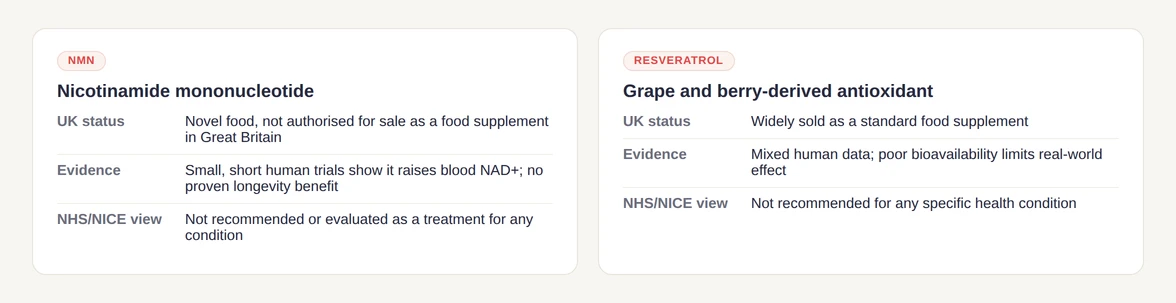
Taken together, neither ingredient currently has robust human evidence for extending lifespan, reversing signs of ageing or preventing a specific disease, and the NHS does not recommend either for any health condition.
Is it legal to get NMN or resveratrol in the UK?
Resveratrol has a long history as a food supplement in the UK and is straightforward to obtain over the counter, subject to standard supplement regulations.
NMN's position is more complicated. It's classed as a "novel food", a category for ingredients without a significant history of use in food before 1997, which means it needs safety authorisation before it can legally be sold as a food supplement in Great Britain. That authorisation is not currently in place, so products marketed as NMN supplements sit in a regulatory grey area: widely sold online, but without the same oversight as an authorised supplement or a licensed medicine.
Neither ingredient can lawfully be marketed with specific health claims, such as claiming it treats a condition or reverses ageing, because no such claims are authorised for either substance in the UK.
Safety, interactions and who should be cautious
Short-term studies suggest NMN and resveratrol are generally well tolerated at the doses tested, with mild digestive symptoms the most commonly reported issue. But being well tolerated in a short trial is not the same as being safe for everyone over years of use, and neither ingredient has the long safety record of an established vitamin.
Resveratrol can interact with blood-thinning medication and may affect how the body processes certain drugs broken down by the liver, so it's worth checking with a pharmacist or GP before starting it if you take regular prescription medicine. Anyone who is pregnant, breastfeeding, or living with a liver or kidney condition should be especially cautious with either supplement, and quality varies considerably between brands, since food supplements are not tested to the same standard as medicines before sale.
Other longevity ingredients sold alongside them
NMN and resveratrol rarely appear on their own. They're commonly stacked with other compounds marketed under the same longevity banner, including spermidine (found naturally in foods such as wheat germ and mushrooms), quercetin, fisetin and pterostilbene, a close relative of resveratrol with somewhat better absorption. As with NMN and resveratrol, most of the interest in these ingredients comes from cell or animal research, and human evidence is limited, inconsistent, or simply not there yet for most of the specific claims made about them.
A long ingredient list on a supplement label isn't the same as a long list of proven benefits. If a product combines several unproven ingredients at once, it becomes harder, not easier, to know what (if anything) is doing something, and harder still to spot which ingredient might be behind a side effect.
Should you take a longevity supplement?
If you're already eating a varied diet, staying active, sleeping reasonably well and not smoking, current evidence doesn't show that adding NMN or resveratrol will meaningfully add to that. The habits with the strongest evidence for healthy ageing remain the least exciting ones: regular movement, a balanced diet, good sleep, not smoking and keeping on top of routine health checks.
If you're curious about supporting NAD+ levels with some clinical oversight rather than an unregulated online purchase, our team also offers Liposomal NAD+ Capsules as part of a wider health assessment, so any decision is made alongside your existing health history and medication rather than a label on a website.
Whatever you're considering, tell your GP or pharmacist about any supplement you take regularly, particularly if you're on other medication, being investigated for a health condition, or due to have surgery, since some supplements can interfere with tests or treatment.
Frequently asked questions
Does NMN actually increase NAD+ levels?
Small human trials suggest it does, with blood NAD+ levels rising within weeks of regular use. What isn't yet shown is whether that rise leads to a noticeable health benefit; the trials are short and the long-term picture is still unclear.
Is resveratrol safe to take every day?
It's generally well tolerated in the doses used in research, but it can interact with blood-thinning medicines and some drugs processed by the liver. Check with a pharmacist or GP first if you take regular prescription medication.
Is NMN legal in the UK?
NMN is classed as a novel food in the UK, meaning it needs safety authorisation before it can legally be sold as a food supplement here. That authorisation isn't currently in place, even though NMN products are widely available online.
What's the difference between NMN and NAD+ supplements?
NMN is a building block the body converts into NAD+ after you take it. Some products supply NAD+ more directly, for example as an injection or capsule, rather than relying on the body to make the conversion itself.
Can I take NMN or resveratrol with my regular medication?
Possibly, but not automatically. Resveratrol in particular can interact with certain medicines, including blood thinners. Tell your GP or pharmacist about any supplement you're taking so they can check it against your current treatment.