
PSA test explained: what a raised result means and what happens next
Quick answer
PSA is a blood marker made by the prostate. Typical upper limits rise with age, but exercise, infection, recent ejaculation or an enlarged prostate can raise it too. A raised result is not a diagnosis on its own; it prompts further checks with a clinician.
What is a PSA test?
Prostate specific antigen (PSA) is a protein made by both healthy and cancerous cells in the prostate gland. A small amount normally leaks into the bloodstream, and a PSA test simply measures how much of it is there, from a standard blood sample taken at a GP surgery, clinic or with a private testing service.
It is not a test for prostate cancer on its own. It is a general marker of prostate activity: it can be raised by cancer, but also by several harmless and common causes covered below. That is why a single number is never read in isolation. A clinician interprets it alongside your age, symptoms, family history and, sometimes, a physical examination, rather than treating it as a yes-or-no answer.
The test itself is straightforward, a standard blood draw with no special preparation beyond the timing advice in this guide, and results are usually available within a few days. What takes longer, and matters more, is what happens with the number afterwards.
What counts as a normal PSA level by age?
There is no single "normal" PSA figure that applies to everyone. PSA tends to rise gradually with age as the prostate naturally enlarges, so UK laboratories commonly use age-specific reference ranges rather than one fixed cut-off.
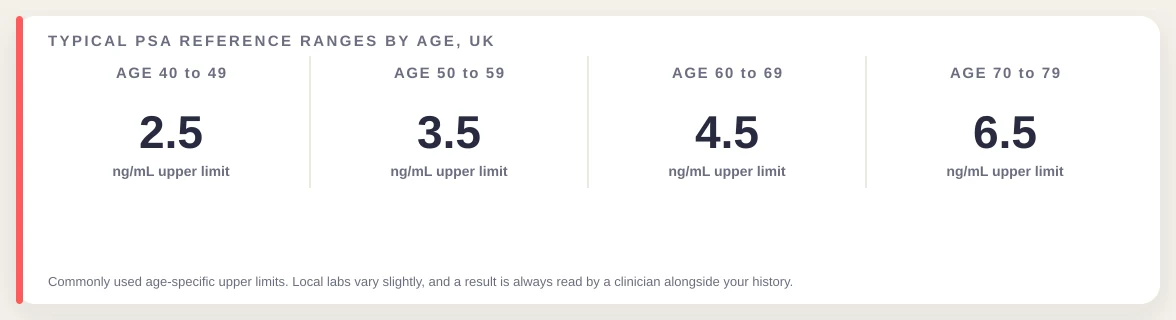
These figures are a starting point for interpretation, not a pass or fail line. A result just above the typical range for your age is common and often turns out to have a benign explanation; a result within range does not rule prostate cancer out completely either, since prostate cancer can occasionally develop without raising PSA very much. What matters is the number in context: how it compares with your age band, whether it has changed since a previous test, and what else is going on for you, considered by a clinician who knows your history rather than read in isolation.
Some labs also look at how quickly PSA has risen over time (sometimes called PSA velocity) rather than a single reading, which is one reason a repeat test is often more informative than a one-off result.
What else can raise a PSA level besides cancer?
A raised PSA is far more often explained by something other than cancer. Common, non-cancerous causes include:
- An enlarged prostate (benign prostatic hyperplasia), which becomes more common with age and is not cancer
- A urine infection or prostatitis (inflammation or infection of the prostate)
- Recent ejaculation, particularly within the 24 to 48 hours before the test
- Vigorous exercise, especially cycling, shortly before the test, which can put pressure on the prostate
- A recent digital rectal examination, catheter, cystoscopy or other prostate procedure
Because of this, clinicians often advise avoiding ejaculation and strenuous exercise for a day or two before testing, and will usually wait a period after a urine infection or prostate procedure has settled before retesting, so the result reflects your baseline as closely as possible rather than a temporary spike.
It is also worth knowing that PSA can be lowered by certain medicines used for an enlarged prostate or hair loss, such as finasteride, which can roughly halve the reading. If you take one of these, it is worth mentioning it when you have a PSA test so the result can be interpreted correctly.
Who can get a PSA test, and when should you consider one?
Any man aged 50 or over can ask their GP for a PSA test on the NHS, even without symptoms, after discussing the benefits and limitations with a healthcare professional, this is sometimes called the informed choice programme. Risk rises earlier for some groups: Black men and men with a father or brother who has had prostate cancer are generally advised to consider talking to a GP about testing from age 45, since both are associated with a higher lifetime risk.
This informed-choice approach exists because PSA testing has real trade-offs. It can catch a slow-growing cancer years before symptoms appear, but it can also flag borderline results that lead to further tests for a cancer that would never have caused problems in your lifetime. Neither outcome is guaranteed, which is why the decision to test, particularly without symptoms, is meant to be yours to make once you understand both sides, not something applied automatically.
Outside of age-based informed choice testing, a GP will also arrange a PSA test if you have symptoms that could relate to the prostate, such as new urinary symptoms (needing to urinate more often, especially at night, a weaker flow, or difficulty starting or stopping), blood in the urine, or unexplained lower back, hip or pelvic discomfort. Many of these symptoms have common, non-cancer causes, an enlarged prostate or a urine infection among them, but they are always worth having checked rather than left unexplained.
What happens after a raised PSA result?
A raised PSA is a prompt for further assessment, not a diagnosis. Depending on the result and your history, a clinician may repeat the test after a few weeks to see whether the level has settled on its own, perform a physical examination of the prostate, or refer you on for an MRI scan and, if the scan raises concern, a targeted biopsy.
If your GP refers you for suspected prostate cancer, this now falls under the NHS Faster Diagnosis Standard, which aims to confirm or rule out cancer within 28 days of an urgent referral being received by the hospital. Most men referred this way do not turn out to have cancer, but the pathway exists to give a clear, timely answer either way rather than leaving you waiting without information.
Throughout this process, it helps to have someone explain each step and what a given result does and does not mean, since the terminology (raised, borderline, stable, rising) can feel confusing without context. Asking directly what a result means for you specifically, rather than comparing it to a general range, is usually the most useful question to bring to any appointment.
NHS or private PSA testing: what's the difference?
An NHS PSA test, arranged through your GP, is free and includes a conversation about whether testing is right for you before you go ahead, along with a clear route into further NHS care if a result needs following up. It remains the right route if you already have symptoms that need assessing.
A private PSA test can be a convenient option if you would rather not wait for a routine GP appointment, want a baseline reading to track over time, or want testing on your own schedule, for example around a family history of prostate cancer or simply as part of a wider health check. Our clinical team offers PSA and wider men's health testing with every result reviewed by a clinician, so a raised figure comes with context and a clear next step rather than a number on a screen with no explanation. If you are unsure whether testing is right for you, or when you should have one, that is a reasonable first question to ask, and any advice is tailored to your health and history, subject to suitability.
Frequently asked questions
What is a normal PSA level?
There is no single normal figure. UK labs typically use age-specific upper limits, roughly 2.5 ng/mL for ages 40 to 49, 3.5 for 50 to 59, 4.5 for 60 to 69, and 6.5 for 70 to 79, but these are a guide for interpretation rather than a strict pass or fail threshold.
Does a raised PSA mean I have prostate cancer?
No. Most raised PSA results are not caused by cancer. Infection, an enlarged prostate, recent ejaculation or vigorous exercise can all raise the level temporarily. A raised result simply means further assessment is worthwhile.
Can I get a PSA test without symptoms?
Yes. Any man aged 50 or over can request an NHS PSA test after an informed discussion with their GP, even without symptoms. Men with a higher baseline risk, including Black men and those with a family history of prostate cancer, are usually advised to consider this conversation from age 45.
What should I do before a PSA test?
Where possible, avoid ejaculation and strenuous exercise, particularly cycling, for around 48 hours beforehand, and let the person testing you know if you have had a urine infection, prostate procedure or catheter recently, or if you take medicines such as finasteride, as these can all affect the result.
How quickly are raised PSA results followed up on the NHS?
If your GP refers you for suspected prostate cancer, the NHS Faster Diagnosis Standard aims to confirm or rule out a cancer diagnosis within 28 days of the hospital receiving the referral.