
What your cholesterol test results mean
Quick answer
A cholesterol test measures total cholesterol, LDL, HDL, non-HDL cholesterol and triglycerides in mmol/L. General UK guidance aims for total cholesterol below 5.0 mmol/L and LDL below 3.0 mmol/L, though your own target depends on your wider cardiovascular risk, so a clinician reviews your result alongside your health history rather than the number alone.
What a cholesterol test actually measures
A cholesterol test, sometimes called a lipid profile, measures the fats carried in your blood rather than giving a single figure. Most results include total cholesterol, HDL cholesterol, LDL cholesterol, non-HDL cholesterol and triglycerides, each telling a slightly different part of the story.
HDL is often described as the "good" cholesterol because it helps carry excess cholesterol back to the liver, where it is broken down and removed from the body. LDL, by contrast, is the "bad" cholesterol: when there is too much circulating, it can build up in the artery walls over time. Non-HDL cholesterol is simply your total cholesterol minus HDL, so it captures LDL together with other similar particles in one figure, which is why many UK labs now report it alongside, or instead of, LDL on its own. Triglycerides are a different type of fat entirely, linked more closely to diet, alcohol and body weight, and are usually measured at the same time.
Some results also include a total cholesterol to HDL ratio, dividing your total figure by your HDL. This single number is sometimes used as a summary of overall risk, though it is only ever one part of the picture a clinician builds up about you.
How and where you can get tested
A cholesterol test is a simple blood test. For a basic check, most people do not need to fast beforehand: you can eat and drink normally. If a full lipid profile including triglycerides has been requested, you may occasionally be asked not to eat for a number of hours first, so it is worth checking the instructions you are given rather than assuming either way.
On the NHS, cholesterol is checked as part of the NHS Health Check offered to adults aged 40 to 74, and again whenever your GP has a specific clinical reason to test, such as monitoring an existing condition or medicine. Growing numbers of community pharmacies now offer cholesterol checks too, often alongside a blood pressure reading, which can be a convenient way to keep track between GP appointments. A private test is another option if you would like a result without waiting for an appointment, want a fuller panel than a routine check includes, or simply want reassurance outside of the standard screening schedule.
What counts as a healthy result
There is not one single "normal" cholesterol level that applies to everyone; general guidance for healthy adults gives a useful starting point, but your own ideal range depends on your wider health picture.
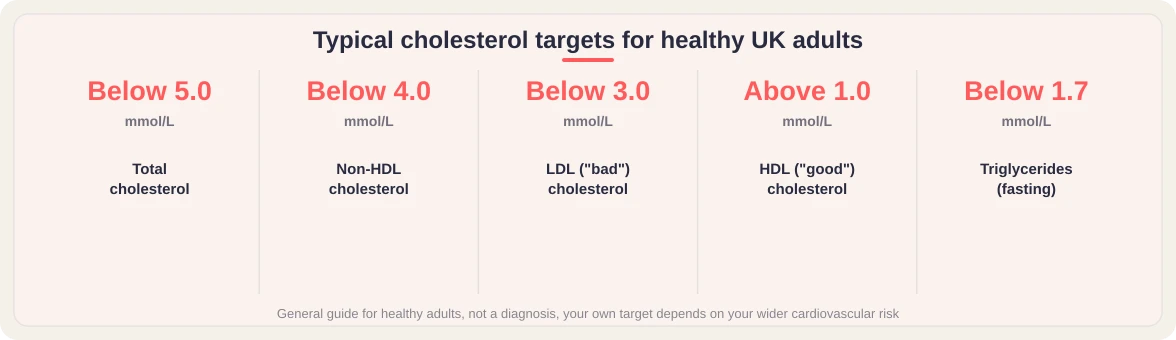
These figures are commonly used as a general guide for adults without other risk factors. For HDL cholesterol, higher is generally considered better rather than there being an upper limit, since it is the "good" cholesterol; a level below the typical target is the one usually flagged. For total cholesterol, non-HDL, LDL and triglycerides, lower is usually considered better, and it is a result above the guide figure that is more likely to prompt a conversation about next steps.
Because these are population-level guides rather than personal targets, the same raw number can mean different things for different people, which is why a result is best read alongside the context a clinician can add.
Why your target may be different from someone else's
The general targets above are aimed at otherwise healthy adults. If you already have heart or circulatory disease, type 1 or type 2 diabetes, chronic kidney disease, or a strongly raised cholesterol level that runs in your family, your clinician is likely to work to a stricter target, often aiming for an LDL cholesterol below 2.0 mmol/L and a total cholesterol below 4.0 mmol/L rather than the standard figures.
This is because cholesterol is only one input into your overall cardiovascular risk, alongside your age, blood pressure, smoking status, family history and other factors. Many GPs use a formal risk calculator alongside your cholesterol results to estimate your longer-term risk of heart disease or stroke, rather than acting on the cholesterol number in isolation. Two people with an identical LDL result can end up with quite different advice, because everything else about their health picture is different.
Your clinician will usually explain not just which target applies to you, but why, so you understand the reasoning rather than just the number you have been given. If your circumstances change, for example a new diagnosis, a change in family history you become aware of, or starting a medicine that can affect cholesterol, your target may be reviewed and adjusted at that point too.
What happens if your result comes back raised
A raised result does not automatically mean you need medicine. For many people, the first step is simply understanding which part of the profile is raised, how it fits with your overall risk, and whether a repeat test some weeks later confirms the pattern, since a single reading can be affected by recent illness, hydration or other short-term factors.
Where lifestyle changes such as diet and activity are the main focus, your clinician will usually suggest a follow-up test after a few months to see whether your numbers have moved. If your overall cardiovascular risk is higher, whether because of the cholesterol result itself, your family history, or other factors together, treatment such as a statin may be discussed as one option alongside lifestyle changes rather than instead of them. Our guide to when statins are considered for high cholesterol covers how that decision is made in more detail.
Whatever your result, it is worth having it explained by someone who can see the whole picture rather than reading the number alone, since the same figure can mean different things for different people.
Lifestyle factors that influence your numbers
Diet, activity levels, alcohol and smoking all influence your cholesterol profile, though not always in the same direction. Reducing saturated fat and increasing fibre, particularly from oats, beans, and fruit and vegetables, is commonly associated with lower LDL cholesterol, while regular physical activity tends to raise HDL cholesterol as well as helping to lower triglycerides.
Smoking is particularly associated with lower HDL cholesterol, and stopping is one of the more consistent ways to improve it. Alcohol has a more mixed relationship with cholesterol depending on how much and how often it is drunk, and carrying more weight around the waist is often linked with a less favourable overall lipid profile, particularly higher triglycerides. None of these factors act alone, and how much difference any one change makes varies from person to person, which is another reason a repeat test after a few months is more informative than guessing.
These changes work alongside any treatment your clinician recommends rather than replacing the need for testing and follow-up. Even modest, sustained changes to diet and activity are commonly reflected in a repeat lipid profile, which is one reason your clinician may suggest trying this route first when your overall risk allows for it.
How often you should be retested
How often you are retested depends on your starting point. If you are on treatment for high cholesterol, your clinician will usually recommend checking your levels again some months after starting or changing a medicine, then periodically after that to confirm things are stable. If lifestyle changes are the main plan, a follow-up test after a few months is typical, to see whether those changes have made a measurable difference before deciding on next steps.
For adults without a specific risk factor, cholesterol is often reviewed as part of the NHS Health Check every five years between the ages of 40 and 74, though you can ask your GP or a private clinician for a test sooner if you have a family history of high cholesterol or heart disease, or if anything about your health changes in the meantime.
Frequently asked questions
Do I need to fast before a cholesterol test?
Not usually. For a standard cholesterol check you can eat and drink normally beforehand. If a full lipid profile including triglycerides has been requested, you may occasionally be asked to fast for several hours first, so it is worth checking the instructions given for your particular test.
What is a good cholesterol level in the UK?
For healthy adults, general guidance points to a total cholesterol below 5.0 mmol/L, non-HDL below 4.0 mmol/L, LDL below 3.0 mmol/L, HDL above 1.0 mmol/L, and triglycerides below 1.7 mmol/L. If you have an existing condition such as heart disease or diabetes, your clinician may work to a stricter target.
What does a raised non-HDL cholesterol result mean?
Non-HDL cholesterol is your total cholesterol minus HDL, so it captures LDL together with other similar particles in one figure. A raised result suggests more of these particles are circulating than the general guide range, and is usually discussed alongside your wider cardiovascular risk rather than on its own.
Can I get a cholesterol test at a pharmacy?
Many community pharmacies now offer cholesterol checks, often alongside a blood pressure reading, which can be a convenient way to keep track between GP appointments. A private blood test is another option if you would like a fuller panel or a result without waiting for an appointment.
Does a raised result mean I automatically need a statin?
No. A raised result is usually the start of a conversation, not an automatic prescription. Your clinician will look at the pattern over more than one reading, your overall cardiovascular risk and your lifestyle before discussing whether treatment is appropriate for you specifically.
How often should I have my cholesterol checked?
For adults without a particular risk factor, cholesterol is often reviewed every five years as part of the NHS Health Check between ages 40 and 74. If you are being monitored for an existing result or a medicine, your clinician will usually suggest a specific follow-up schedule instead.