
AMH test: what your ovarian reserve result means
Quick answer
An AMH (anti-Mullerian hormone) test is a blood test that gives an idea of how many eggs you have left, known as ovarian reserve. Results are read against ranges for your age. NICE guidance is clear that AMH predicts how you might respond to fertility treatment such as IVF, not your chance of conceiving naturally.
What an AMH test actually measures
Anti-Mullerian hormone (AMH) is produced by the small, developing follicles in your ovaries, the tiny fluid-filled sacs that each contain an immature egg. The more follicles you have left, the more AMH circulates in your blood, so a reading gives doctors an estimate of your remaining egg supply, often called ovarian reserve.
Egg supply is set before birth and declines gradually from then on, with the pace of that decline varying from person to person. AMH is used as a proxy for this supply because, unlike counting eggs directly, it can be measured from a simple blood sample rather than requiring imaging or an invasive procedure.
Unlike some reproductive hormones, AMH stays fairly stable across your menstrual cycle, which is why the test can usually be booked on any day rather than at a specific point in your period. It is a single blood sample, sent off for laboratory analysis, with no fasting or special preparation needed beforehand, and most people feel nothing more than the usual brief discomfort of a blood draw.
In the UK, results are typically reported in picomoles per litre (pmol/L), though some private clinics and international sources use nanograms per millilitre (ng/mL) instead. If you are comparing results from different providers, check which unit is being used before drawing any conclusions, since mixing the two can make a perfectly normal result look alarming or vice versa.
Why people choose to have an AMH test
Most people who request an AMH test are either planning a pregnancy and want a general sense of their fertility picture, considering IVF or egg freezing and need a baseline before treatment starts, or have noticed irregular periods and want to understand what might be behind them alongside other tests.
Some people also test simply to inform future family planning, for example when deciding how long to wait before trying to conceive, or whether to look into egg freezing while they are still relatively young. Used this way, the result is one input into a personal decision rather than a diagnosis of any kind.
It is worth being clear from the outset that an AMH test is not a pregnancy test, a guarantee of fertility, or a replacement for trying to conceive naturally if that is your current plan. It is one piece of information among several that a clinician can use to build a fuller picture, usually alongside your age, cycle history and sometimes an antral follicle count scan.

Interpreting your result: why age matters so much
A single AMH number means very little on its own. The same result can be entirely unremarkable in someone in their late thirties and comparatively low in someone in their mid-twenties, because egg supply naturally declines with age for everyone. This is why a clinician will always read your result against ranges set for your age band, rather than against a single universal cut-off.
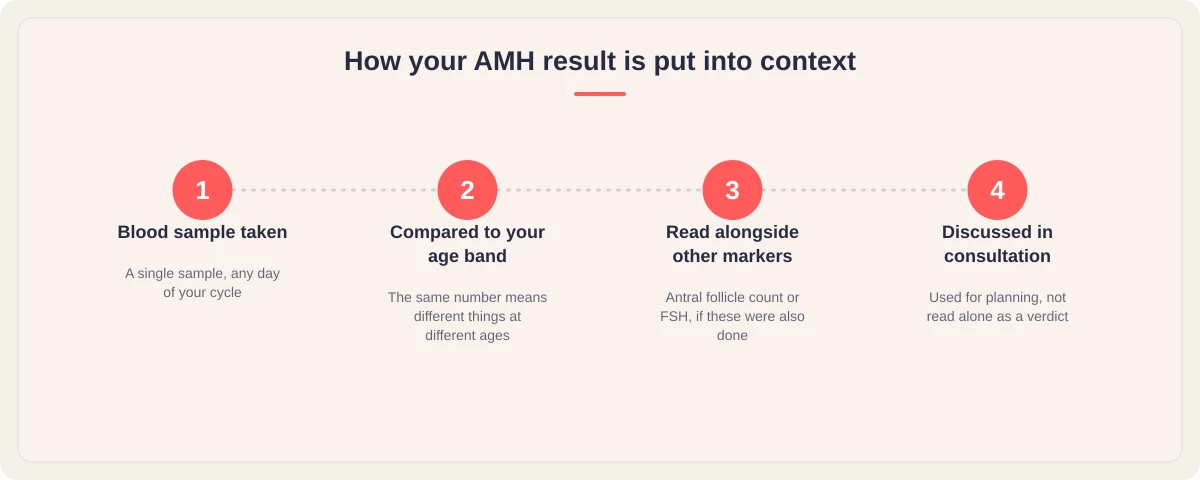
Results are usually grouped into broad bands: low, within the expected range for your age, or high. Where an antral follicle count scan or FSH test has also been done, a clinician will look at these together, since each gives slightly different information and no single test tells the whole story on its own.
What AMH can, and can't, tell you
This is the part that is most often misunderstood, so it is worth being precise about it. UK guidance from NICE does not support using AMH to predict whether, or how quickly, someone will conceive naturally. Where AMH testing is genuinely useful is in estimating how your ovaries are likely to respond to the hormone injections used in IVF, which is why fertility clinics request it before treatment, and in giving context alongside other findings when periods are irregular.
AMH also only reflects the quantity of eggs remaining, not their quality. A lower-than-average result does not mean the eggs you do have are unhealthy, and a higher-than-average result does not guarantee that the eggs available are all viable. Egg quality is influenced mainly by age and cannot currently be measured directly by a blood test.
Because of these limits, a low AMH result on its own is not a diagnosis of infertility, and a normal or high result is not a guarantee of future pregnancy. It is one data point for a clinician to weigh up, not a verdict to act on alone.
What a lower-than-expected result can mean
A result below the typical range for your age usually points to a reduced number of remaining follicles. Possible explanations include the natural decline in reserve that happens with age, previous ovarian surgery, certain cancer treatments, smoking, or, less commonly, an underlying condition affecting the ovaries. Sometimes no clear cause is found, and that is not unusual.
If your result comes back low, a sensible next step is a conversation with a clinician about what it does and does not change for you: whether you are actively trying to conceive now, considering it in future, or thinking about options such as egg freezing. For some people this means acting sooner rather than waiting; for others it changes very little in the near term, particularly if they are not planning a pregnancy soon. Either way, this is a decision best made with full context rather than from a number alone, and a low result is a reason to seek advice, not a reason to panic.
It is also worth remembering that plenty of people with a below-average AMH result go on to conceive, sometimes without any treatment at all. The figure describes a tendency, not a fixed outcome.
What a higher-than-expected result can mean
A higher-than-average AMH reading is often linked to polycystic ovary syndrome (PCOS), where a larger number of small follicles are present in the ovaries. On its own, a high result is not a diagnosis, and PCOS is usually confirmed by looking at symptoms such as irregular periods, alongside an ultrasound scan and other blood tests, rather than AMH alone.
A high result is not something to be concerned about by itself, though it may prompt a clinician to ask further questions about your periods, skin and other symptoms to check whether PCOS or a related condition is worth investigating further. In the context of fertility treatment, a high AMH can also mean your ovaries are likely to respond strongly to stimulation medication, which a clinic will factor into how your treatment dose is planned to reduce the risk of over-response.
How and where to get tested in the UK
AMH testing is not routinely offered on the NHS outside of a fertility clinic pathway, so most people access it through a private blood test, a fertility clinic assessment, or as part of IVF preparation once a referral has been made. Results are usually available within a few working days, and the blood draw itself takes only a few minutes at a clinic or a home finger-prick kit in some services.
If you choose a private test, make sure it is processed by an accredited UK laboratory and that the result comes with reference ranges for your age group, since a number without context is not useful on its own. A consultation to talk through what the result means for you, rather than just a number on a page, is the more valuable part of the process, and this is where questions about timing, next steps and any further testing should be raised.
If you are already under a fertility clinic, your AMH result will usually be interpreted by that team as part of a wider assessment, which is generally more useful than testing in isolation and trying to interpret a number alone.
Frequently asked questions
Does a low AMH mean I can't get pregnant naturally?
No. AMH reflects egg quantity, not quality, and UK guidance does not support using it to predict natural conception. Many people with a low result conceive without any treatment. It is more relevant to how your ovaries may respond to IVF stimulation.
Does it matter what day of my cycle I test on?
Not usually. AMH stays fairly stable across the menstrual cycle, which is one of the reasons it is a convenient test compared with hormones that need to be checked on a specific cycle day.
Can hormonal contraception affect my AMH result?
Yes, it can lower the reading slightly while you are taking it, particularly the combined pill. If you are on hormonal contraception, mention this when discussing your result, as it may be worth retesting after stopping if the figure will inform a major decision.
Is AMH testing available on the NHS?
It is not routinely offered on the NHS outside a fertility clinic pathway. Most people access it privately or as part of an NHS or private fertility assessment once referred.
How often should AMH be retested?
There is no fixed schedule for most people, since levels change gradually with age. A clinician may suggest retesting after a year or two if the first result is being used to inform ongoing fertility planning, or sooner if you start a fertility treatment pathway.
What other tests are usually done alongside AMH?
An antral follicle count, a type of ultrasound scan that counts visible follicles, and sometimes FSH and oestradiol blood tests are commonly used together with AMH to build a fuller picture of ovarian reserve.