
Cystitis or UTI: how to tell the symptoms apart and when to get treatment
Quick answer
Cystitis is a bladder infection and is the most common type of UTI, with stinging when you wee, needing to go often, and cloudy or strong-smelling urine. Back pain, fever, chills or feeling generally unwell can mean the infection has reached the kidneys, which needs prompt treatment rather than self-care.
Cystitis and UTI: what is actually the difference?
A urinary tract infection (UTI) is the general term for an infection anywhere in the urinary system, which runs from the kidneys down through the ureters, bladder and urethra. Cystitis is the name for a UTI that is confined to the bladder, and it is by far the most common type: most people who say they have "a UTI" mean cystitis.
So cystitis is a UTI, but not every UTI is cystitis. A less common but more serious pattern is an upper UTI, where the infection has travelled up to one or both kidneys (sometimes called pyelonephritis). Telling the two apart matters because a straightforward bladder infection can usually be managed with a short course of antibiotics from a pharmacist or GP, while a kidney infection needs prompt medical assessment and, often, a longer course of treatment.
Typical cystitis (bladder) symptoms
Cystitis tends to cause symptoms that are uncomfortable but localised to the bladder and urethra. The most recognisable signs are:
- A stinging or burning sensation when you wee
- Needing to wee more often than usual, sometimes passing only a small amount each time
- A sudden, strong urge to go, even shortly after you have just been
- Urine that looks cloudy, dark, or has a strong smell
- A dull ache or pressure low in the tummy or pelvis, around the bladder
- In some cases, a small amount of blood in the urine
These symptoms usually come on over a day or two, and most people feel otherwise well in themselves, without a raised temperature or feeling generally unwell.

Signs the infection may have reached the kidneys
An upper UTI (kidney infection) shares the bladder symptoms above, but adds signs that the infection has spread further and is affecting the whole body, not just the bladder. These include:
- Pain in one or both sides of your back, just below the ribs (loin pain)
- A high temperature, or shivering and chills
- Feeling generally unwell, shaky or exhausted, out of proportion to a simple bladder infection
- Nausea or vomiting
- Confusion, particularly in older adults, which can be the main sign in this age group
Anyone with these symptoms, or with cystitis symptoms that are getting rapidly worse rather than better, should seek same-day medical advice. Kidney infections are treated seriously because they carry a higher risk of the infection spreading into the bloodstream if left untreated.
Side-by-side symptom comparison
The table below summarises how a straightforward bladder infection tends to present compared with an infection that has reached the kidneys.
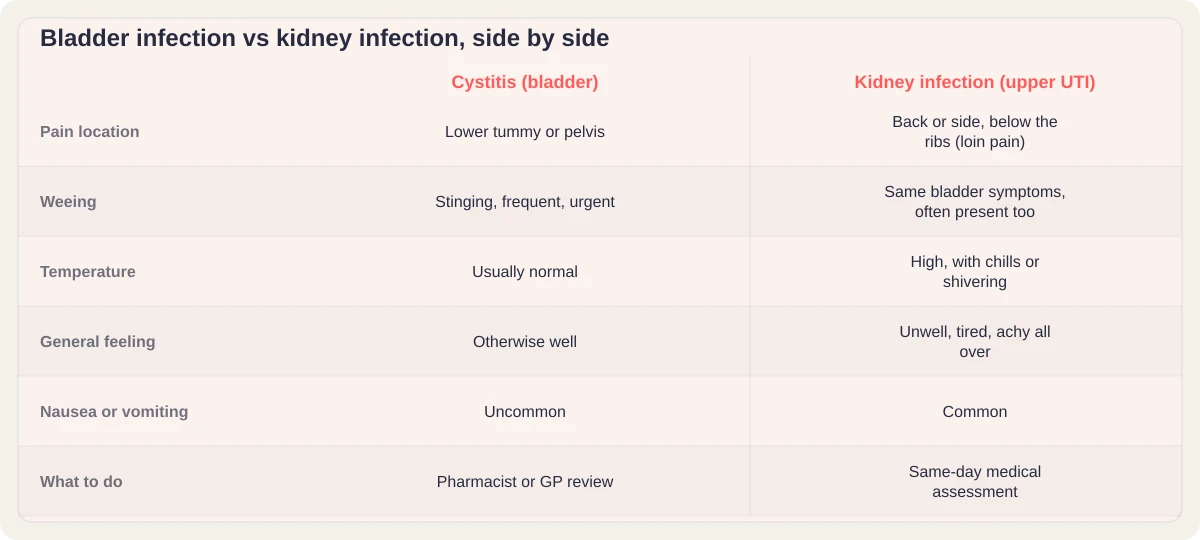
If you are ever unsure which category your symptoms fall into, it is safer to be assessed than to guess. A pharmacist can usually tell the two apart quickly from your symptoms and a simple urine test.
Who gets cystitis, and why it happens
Cystitis is far more common in women, largely because the urethra is shorter, making it easier for bacteria from the bowel to reach the bladder. Other factors that raise the risk include sexual activity, the menopause (falling oestrogen changes the vaginal and urinary environment), pregnancy, and anything that stops the bladder emptying fully, such as constipation or an enlarged prostate in men.
Most cases are caused by E. coli, a bacterium that lives harmlessly in the bowel but can cause infection if it reaches the urinary tract. Wiping from back to front, staying well hydrated, and weeing after sex are commonly suggested habits, though evidence for how much they actually prevent cystitis is mixed; they are reasonable to try but are not guaranteed to stop infections recurring.
Diabetes, a weakened immune system, and the use of a catheter can also raise the risk of UTIs generally, partly because they can affect how well the bladder empties or how the body fights off bacteria. People with any of these factors who develop UTI symptoms are usually advised to seek review a little sooner rather than waiting to see if things settle, since infections can take hold more easily.
How cystitis and UTIs are treated in the UK
A short course of antibiotics is the usual treatment for a confirmed bladder infection. In the UK, the most commonly used options are Nitrofurantoin 100mg MR Capsules for Women or Trimethoprim 200mg for Women, typically taken for three days for an uncomplicated infection, though men are usually prescribed a slightly longer course such as Nitrofurantoin 100mg MR Capsules for Men or Trimethoprim 200mg for Men because male UTIs are treated as more complex by default.
Alongside antibiotics, paracetamol can help with discomfort, and drinking enough fluids may ease symptoms, though it will not clear the infection on its own. A kidney infection is usually treated with antibiotics too, but the choice of antibiotic, dose and length of course differs, and some cases need assessment in person or, occasionally, in hospital if someone cannot keep fluids down or is becoming more unwell.
Mild cystitis symptoms in otherwise healthy, non-pregnant women sometimes settle without antibiotics, but a pharmacist consultation can confirm whether antibiotics are appropriate rather than waiting it out and risking the infection spreading.
When cystitis keeps coming back
Recurrent cystitis, generally defined as two or more infections in six months or three or more in a year, is worth raising with a clinician rather than simply treating each episode in isolation. Depending on the pattern, options can include a low preventative dose of antibiotics, a single dose taken after sex if that is a clear trigger, non-antibiotic approaches such as D-mannose or vaginal oestrogen after the menopause, and checking for an underlying cause such as incomplete bladder emptying.
A urine sample sent to a laboratory (rather than tested only with a dipstick) is more likely to be used once infections start recurring, as it can identify exactly which bacteria are involved and which antibiotics they are sensitive to. This matters because repeated short courses of the same antibiotic can, over time, make that antibiotic less effective against the bacteria causing your infections, which is one of several reasons a change of approach is sometimes recommended for recurrent cases rather than simply repeating the same course each time.
Blood in the urine that does not clear after treatment, or persistent symptoms despite finishing a course of antibiotics, should always be followed up rather than assumed to be "just another UTI", as they occasionally point to something else that needs investigating.
When to get help straight away
Most bladder infections can be safely managed with pharmacist advice or a short telephone or online consultation. Seek same-day medical attention if you have back or loin pain, a fever, chills, vomiting, or feel significantly unwell, as these can indicate a kidney infection. Pregnant women with any UTI symptoms should always be assessed promptly, as untreated UTIs in pregnancy carry additional risks. Men with UTI symptoms should also be assessed, since male UTIs are less common and are treated as potentially more complex.
Frequently asked questions
Can cystitis turn into a kidney infection if left untreated?
Yes, in some cases an untreated bladder infection can spread upwards to one or both kidneys. This is why prompt treatment of cystitis symptoms, and urgent review if back pain or fever develop, is recommended rather than waiting to see if it clears on its own.
How can I tell if it's cystitis or something else, like thrush?
Cystitis typically causes stinging when you wee and a frequent urge to go, without the itching or discharge seen with thrush. If symptoms overlap or you are not sure, a pharmacist can usually distinguish between the two from your symptoms and, if needed, a urine test.
Do I need a urine test to confirm cystitis?
Not always. Pharmacists and GPs often diagnose straightforward cystitis from symptoms alone, especially in women with a classic pattern. A urine test (sometimes sent to a lab) is more likely to be used for recurrent infections, pregnancy, men, or when symptoms do not fit the usual pattern.
Is cranberry juice an effective treatment for cystitis?
Cranberry products are not a treatment for an active infection and will not replace antibiotics once cystitis has set in. Evidence for cranberry juice preventing future infections is mixed and generally weak, so it should not be relied on in place of proper assessment of recurrent symptoms.
Can men get cystitis?
Yes, though it is far less common than in women. Because male UTIs are less frequent, they are usually treated as potentially more complex and assessed rather than managed with the shortest standard antibiotic course used for women.
How quickly should antibiotics start working for a UTI?
Most people notice symptoms easing within one to two days of starting the right antibiotic. If there is no improvement after 48 hours, or symptoms get worse, this should be reviewed promptly in case a different antibiotic is needed or the infection has spread.