
Foundayo, the new once-daily weight-management tablet approved in the UK
 Reviewed by the My London Pharmacy clinical team, Zaynab Ali, Pharmacist Independent Prescriber
·14 August 2026
·10 min read
Quick answer
Foundayo (orforglipron) is a new once-daily tablet for weight management and type 2 diabetes, approved by the MHRA on 10 August 2026, the first approval in Europe. It comes in six strengths, can be taken with or without food, and is expected to reach UK services in the coming weeks. It is prescription-only, with suitability assessed by a clinician.
What is Foundayo (orforglipron)?
Foundayo is the brand name for orforglipron, a new once-daily film-coated tablet developed by Eli Lilly for weight management and type 2 diabetes. On 10 August 2026 the MHRA, the UK's medicines regulator, authorised it for use in the UK, the first approval anywhere in Europe, following approval in the United States earlier this year.
What makes it genuinely notable is the format. Most established prescription medicines used in medically supervised weight management are weekly injectable treatments. Foundayo is a conventional tablet, taken once a day like an ordinary medicine, with no injections involved at any stage. For many people who have considered clinical support with their weight but felt put off by needles, that is a significant practical change.
Foundayo is a prescription-only medicine. This guide is patient education, not a recommendation: whether any weight-management treatment is appropriate for you is a decision made by a clinician after an individual consultation, subject to suitability.
How does orforglipron work?
Orforglipron works by mimicking one of the body's natural gut hormones, part of a group known as incretins, which is released after eating. This hormone acts on appetite centres in the brain, slows how fast the stomach empties, and helps the pancreas release insulin when blood sugar rises. The practical effect for most people is feeling satisfied with smaller portions, experiencing fewer cravings, and steadier blood-glucose levels through the day.
This is the same principle behind the established injectable medicines used in medically supervised weight management. What is new is the chemistry: orforglipron is what chemists call a small molecule rather than a peptide. Peptides are broken down by stomach acid, which is why most medicines in this class have to be injected. A small molecule survives digestion, which is why orforglipron can be swallowed as a simple daily tablet, and also why it is expected to be easier to manufacture at scale than the injectable treatments.
The six strengths, at a glance
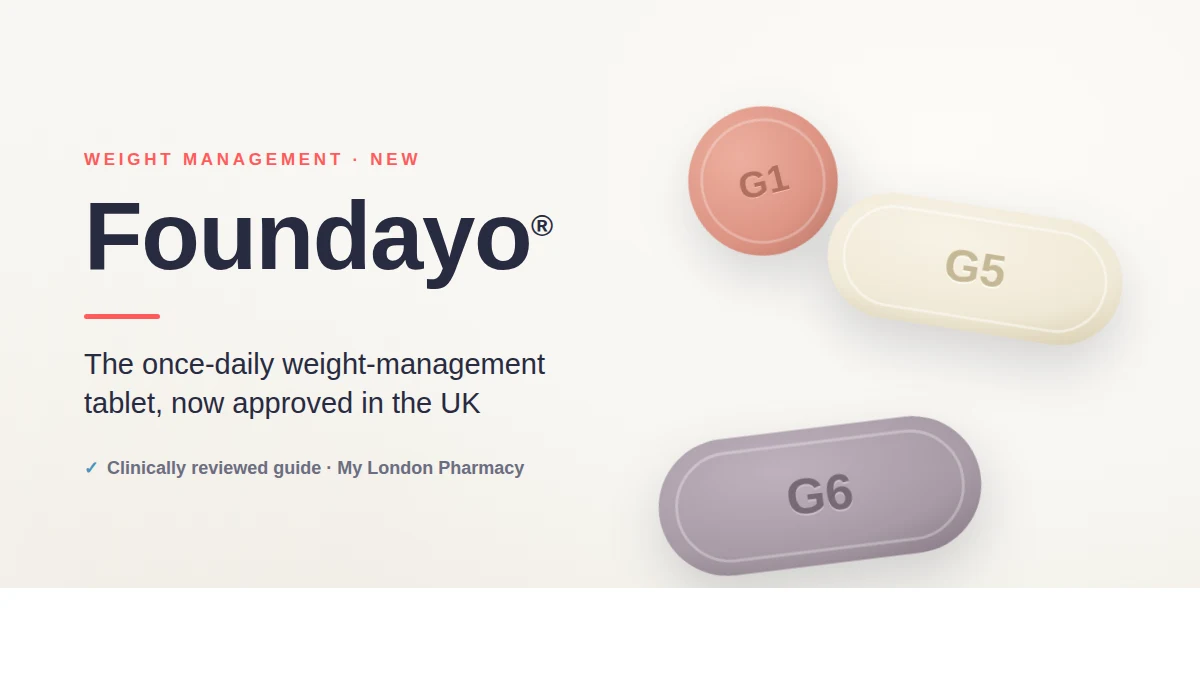
Foundayo is licensed in the UK in six once-daily strengths, supplied in packs of 30 film-coated tablets. The three lower strengths are small round tablets and the three higher strengths are larger oval tablets; each is debossed with its own code (G1 to G6) and each pack is colour-coded to its strength.
Treatment does not start at the top of the ladder. As with other medicines of this kind, prescribing begins at a low strength and is stepped up gradually under clinical guidance, giving the body time to adjust at each stage. The strength you settle on, and how fast you move between strengths, is set by your prescriber based on how you respond and how well you tolerate each step, always subject to suitability.
What the weight-management studies showed
UK approval rests on one of the larger phase 3 programmes seen in this area of medicine. The headline weight-management trial enrolled just over 3,000 adults living with obesity, or with excess weight plus a related health condition, and followed them for 72 weeks alongside diet and physical activity support.
Results were dose-dependent: the higher the strength reached, the greater the average reduction, with around 12% of body weight lost on average at the highest dose studied compared with roughly 1% with placebo. A companion trial in adults who have both excess weight and type 2 diabetes, historically a group in which weight is harder to shift, showed an average reduction of around 10% at the highest dose, against about 2% with placebo. The results have been published in a leading peer-reviewed medical journal and presented at international obesity and diabetes congresses.
Two caveats matter, and a good clinician will raise both. First, averages hide a spread: some people respond strongly, others more modestly, and a small proportion respond little. Second, the benefit built up gradually over many months of consistent use alongside dietary and lifestyle changes, and the evidence across this class of medicine is that stopping treatment tends to see weight gradually return. Foundayo is therefore best thought of as ongoing treatment for a long-term condition, supported by regular clinical review, not a short course.
What the type 2 diabetes studies showed
The diabetes arm of the programme studied around 560 adults with type 2 diabetes over 40 weeks. From an average starting HbA1c of about 8%, HbA1c being the standard measure of longer-term blood-glucose control, participants taking orforglipron saw reductions of roughly 1.3 to 1.5 percentage points, comfortably ahead of placebo, with many reaching the HbA1c targets used in UK practice. Weight also fell as a secondary outcome, by up to around 7.5% at the higher doses over those 40 weeks.
For people managing both type 2 diabetes and their weight, that combination, meaningful glucose improvement and clinically relevant weight reduction from a single daily tablet, is what makes this medicine a genuinely significant addition to UK options, and it is why the licence covers both uses. Whether it is the right choice against the established alternatives is an individual clinical decision.
Side effects and safety, what the data show
The side-effect profile in the trials will look familiar to anyone who has read about this class of medicine, and it is dominated by digestive effects: nausea, constipation, indigestion and vomiting. In the weight-management trial, roughly one in three participants on the higher doses reported nausea at some point, and around one in four reported constipation or vomiting, mostly graded mild to moderate, most noticeable while the dose was being stepped up, and settling for most people as the body adjusted. About one in ten participants at the highest dose stopped treatment because of side effects, compared with a small percentage on placebo.
That is exactly why the six-strength ladder exists. Starting low and increasing gradually is deliberate, it is how these effects are kept manageable, and it is also why treatment belongs inside a supervised service with scheduled reviews rather than something to navigate alone. Our guide to managing nausea during weight-management treatment covers practical strategies for the settling-in period.
Medicines of this type are not suitable for everyone, for example during pregnancy or breastfeeding, or with certain medical histories such as some thyroid and pancreatic conditions, and they can interact with other medicines. This is exactly what a prescribing clinician assesses before any treatment is considered. If you ever experience severe or persistent symptoms on any weight-management medicine, contact a clinician promptly.
What makes it different from existing options?
Two things: it is a tablet, and it is an unusually convenient one.
A daily tablet in this class does already exist, but because it is a peptide that stomach acid breaks down, it comes with strict rules: it must be taken on an empty stomach when you wake, with only a few sips of water, followed by a wait of at least 30 minutes before eating or drinking anything else. Many people find that routine difficult to sustain day after day.
Because orforglipron is not a peptide, none of that applies. Foundayo can be taken at any time of day, with or without food, and with no restrictions on fluids. There are no sharps to store or dispose of, no cold storage to plan around when travelling, and a missed dose is simply picked up the next day rather than requiring the timing arithmetic of a weekly schedule. For anyone who has found the practicalities of existing treatments a barrier, needle discomfort, fridge space, travel logistics, or a fasting routine that never quite fitted their mornings, those small frictions add up to a real difference in how sustainable treatment feels.
Who is Foundayo licensed for?
The UK licence covers two groups of adults. For weight management, it covers adults with a BMI of 30 or above, or a BMI between 27 and 30 alongside at least one weight-related health condition such as high blood pressure, high cholesterol or obstructive sleep apnoea, always alongside a reduced-calorie diet and increased physical activity. For type 2 diabetes, it covers adults whose blood glucose is not adequately controlled on their current treatment.
A licence describes who a medicine can be prescribed for, not who it should be. Suitability still depends on your full health picture, other conditions you live with, medicines you already take, and your medical history, which is why an individual clinical assessment always comes first. If you are wondering whether clinical support is right for you at all, our guide on whether a weight-management consultation is right for you is a good place to start.
When will it be available in the UK, and what about cost?
Approval is the first step, not the same as availability. Foundayo is expected to reach UK services in the coming weeks, initially through private clinics and pharmacy services, as has been the pattern with other weight-management treatments. UK pricing has not yet been announced by the manufacturer, though because a small-molecule tablet is simpler to produce and distribute than an injectable peptide, there is reasonable expectation of competitive pricing once supply settles.
On the NHS side, NICE, the body that decides what the NHS routinely funds, has an appraisal scheduled for 18 November 2026. Until that process concludes, Foundayo will not be routinely available on the NHS, so a private prescription following a clinical consultation is likely to be the main route at launch.
Because it is a new medicine, early demand is likely to be high and initial stock may be limited. Speaking to a clinician now is a sensible first step: it establishes whether treatment is appropriate for you at all, and which option fits your circumstances, whether that is Foundayo once it arrives, or one of the established options available today.
Speaking to a clinician about your options
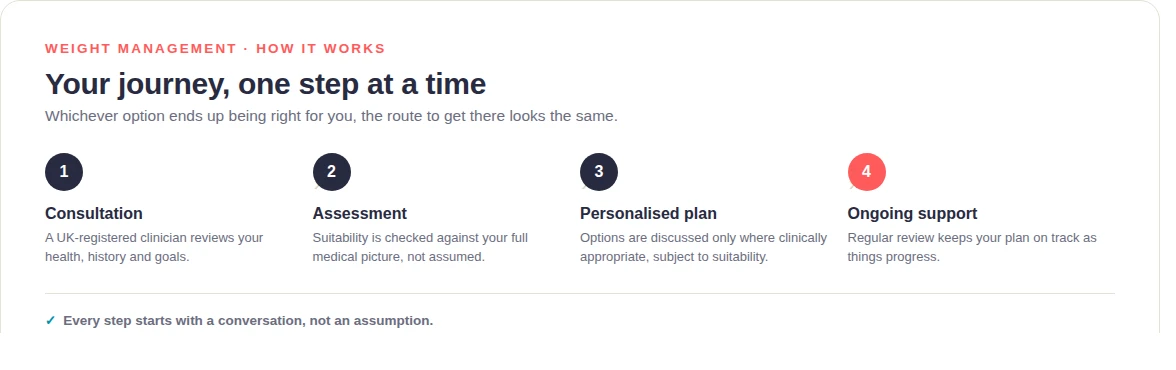
Our clinical team offers a doctor-led, medically supervised weight management service. It begins with a clinical consultation covering your health, medical history, current medicines and goals, so a clinician can advise on the options that may genuinely suit you, always after assessment, and always subject to suitability.
If Foundayo turns out to be right for you once it is available, your clinician will talk you through what treatment involves, how the strength is built up through the dose ladder, and how your progress will be monitored. If a different option, or lifestyle-led support alone, is the better fit, they will say so. There is no pressure to proceed and nothing is assumed in advance; the first step is simply a conversation about where you are now and what you would like to achieve.
Frequently asked questions
Is Foundayo available on the NHS?
Not yet. NICE, the body that decides what the NHS routinely funds, has an appraisal scheduled for 18 November 2026. Until that concludes, access is expected to be through private clinical services, following a consultation and subject to suitability.
What strengths does Foundayo come in?
Six once-daily strengths: 0.8 mg, 2.5 mg, 5.5 mg, 9 mg, 14.5 mg and 17.2 mg film-coated tablets, in packs of 30. Treatment starts at a low strength and is stepped up gradually under clinical guidance.
Do you have to fast or restrict food with Foundayo?
No. Unlike the existing daily tablet option in this class, Foundayo can be taken at any time of day, with or without food and with no restrictions on fluids. That convenience is its main practical difference.
How much weight did people lose in the studies?
In the main 72-week trial, adults on the highest dose studied lost around 12% of their body weight on average, compared with roughly 1% with placebo. Individual results varied, and the benefit built gradually alongside diet and lifestyle changes.
What are the most common side effects of orforglipron?
Mostly digestive effects, nausea, constipation, indigestion and vomiting, usually mild to moderate and most noticeable while the dose is being increased gradually. Starting low and stepping up slowly helps most people adjust.
Can I switch to Foundayo from my current weight-management medicine?
Possibly, but never on your own. Switching between treatments involves dose and timing decisions that need clinical oversight, so raise it with your prescribing clinician first.