
Full blood count (FBC): what your results mean
Quick answer
A full blood count (FBC) measures the red cells, white cells and platelets in a blood sample, giving a broad picture of your general health. It can point towards anaemia, infection or inflammation. Results sit within a reference range, and a value slightly outside it is common and not always significant.
What is a full blood count (FBC)?
A full blood count, often shortened to FBC, is one of the most commonly requested blood tests in the UK. It looks at the cells that make up your blood: red cells, white cells and platelets, and reports on their number, size and other characteristics.
An FBC does not diagnose a specific condition on its own. Instead, it gives a clinician a broad picture of your general health and can point towards areas that need a closer look, such as anaemia, infection or inflammation.
The test itself is straightforward. A small sample of blood is taken from a vein, usually in your arm, and sent to a laboratory for analysis. You might have an FBC through your GP practice, a hospital appointment, or a private blood test service, and the sample is processed in broadly the same way wherever it is taken.
Because it is quick to arrange and covers so much ground, an FBC is often one of the very first tests a clinician reaches for, whether you have come in with specific symptoms or are having a general health review.
What a full blood count measures
A standard FBC report includes several linked measurements. The main ones are:
- Haemoglobin (Hb): the oxygen-carrying protein in red blood cells. A low result is the main marker used to identify anaemia.
- Red blood cell count (RBC), MCV and MCH: the number and size of red cells, which help work out the likely type of anaemia if haemoglobin is low.
- Haematocrit (packed cell volume): the proportion of your blood made up of red cells, which usually moves in the same direction as haemoglobin.
- White blood cell count (WBC): the total number of cells involved in fighting infection, plus a breakdown by type such as neutrophils and lymphocytes.
- Platelets: the cells responsible for clotting. Both low and raised platelet counts can be picked up this way.
Each measurement is reported alongside a laboratory reference range, the range most healthy people fall within, so your result can be compared at a glance. Reference ranges can differ slightly between men and women, and between adults and children, which is why your report is always read against the range set for you rather than a single fixed number.
Some reports also include a mean platelet volume or red cell distribution width. These are secondary measurements that add detail once a main marker is already flagged, rather than something to focus on in isolation.

Why you might be asked to have one
An FBC is often requested as part of a routine health check, but it is also one of the first tests used to investigate specific symptoms. Common reasons include:
- Ongoing tiredness or unusual weakness
- Breathlessness or noticeable bruising
- Unexplained weight change or loss of appetite
- Signs of infection that are not settling as expected
- Monitoring an existing condition or certain medicines
Because it covers several types of blood cell in one sample, an FBC is often the starting point before more specific tests are arranged. If a pattern in your results suggests, for example, that low iron is behind your tiredness, a clinician can then arrange a more targeted test, such as a ferritin or vitamin B12 level, to confirm it.
An FBC is also used to keep an eye on things over time. If you take a medicine that can affect blood cells, or you are being monitored after treatment for a previous blood-related issue, your clinician may ask for repeat FBCs at set intervals so any change can be picked up early rather than after it has become noticeable through symptoms.
How to read your FBC results
Your report will usually show each measurement next to a reference range, with results outside that range flagged, often marked "H" for high or "L" for low.
Reference ranges are a guide rather than a strict cut-off. Laboratories can use slightly different ranges, and a result just outside the range is common and does not automatically mean something is wrong. What tends to matter more is the overall pattern across several markers, and whether that pattern fits with your symptoms and history.
As a general guide:
- A low haemoglobin result may point towards anaemia, which has several possible causes, including low iron or low vitamin B12.
- A raised white cell count can reflect an infection or inflammation, or less commonly, other causes that a clinician will want to explore.
- A low white cell count can sometimes follow a viral illness, or be linked to certain medicines, and is usually rechecked rather than acted on immediately.
- A low or high platelet count can happen for many reasons, from a recent infection to certain medicines, and is usually followed up with a repeat test.
It helps to keep a copy of your results over time if you can, since a clinician comparing this result with previous ones often learns more than from a single snapshot. A steady, gradual change is usually treated differently to a sudden one.
What happens if a result is outside the normal range
A single abnormal marker rarely leads straight to a diagnosis. A clinician usually works through a few steps to understand what is behind it before deciding what, if anything, needs to happen next.
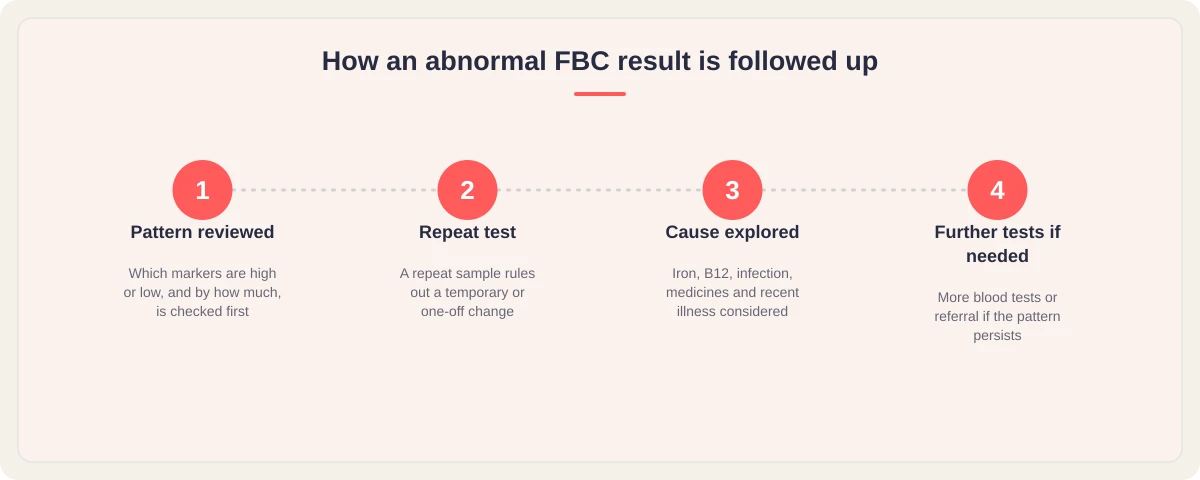
Your symptoms, medical history, current medicines and any recent illness are considered alongside the pattern of results, since this combination often narrows down the likely cause more than any single number on its own. If the picture is not clear, or a result is significantly outside the range, further tests or a referral may be arranged.
Many mildly abnormal results settle once a temporary cause, such as a recent infection, has passed, which a repeat test helps to confirm.
Where a cause is found, such as low iron behind a low haemoglobin, treatment can usually be started or adjusted with a repeat FBC arranged afterwards to check that your levels are moving in the right direction. Where no clear cause is found, ongoing monitoring at sensible intervals is often the safest next step.
Turnaround time and whether you need to fast
A standard FBC does not usually require fasting, so you can eat and drink normally beforehand unless you have been told otherwise, for example because other tests are being taken from the same sample and one of those does require it.
Staying well hydrated beforehand can make the sample easier to take, and wearing a top with sleeves that roll up easily helps too. The blood draw itself usually takes less than a minute, and most people feel a brief pinch rather than lasting discomfort.
NHS turnaround times are typically a few working days, though this can vary between laboratories and services depending on demand. A private blood test may offer a faster turnaround where that matters to you, and results are usually explained by a clinician rather than left for you to interpret alone.
When to seek help sooner
Contact your GP promptly if you notice unexplained bruising or bleeding, an ongoing fever, or breathlessness that is getting worse, rather than waiting for a routine appointment.
Similarly, if you feel persistently unwell, unusually pale, or increasingly tired without an obvious explanation, it is worth being seen rather than putting it down to a busy period or poor sleep.
If your results come back outside the normal range, a clinician can talk you through what they might mean for you and what, if anything, should happen next. Bring along any previous results you have, since comparing them over time is often more useful than looking at one report alone.
Frequently asked questions
Do I need to fast before a full blood count?
No. A standard FBC does not require fasting, so you can eat and drink as normal beforehand, unless your clinician has asked for other tests to be taken from the same sample that do require it.
How long do full blood count results take?
NHS results are typically available within a few working days, though this varies by laboratory and service. The person taking your sample can tell you what to expect.
What does a low haemoglobin result mean?
A low haemoglobin result usually points towards anaemia. There are several possible causes, including low iron, low vitamin B12 or folate, and ongoing blood loss, so further tests are often needed to find out why.
What does a raised white cell count mean?
A raised white cell count often reflects your body responding to an infection or inflammation. It can also be linked to certain medicines or, less commonly, other conditions, which is why a clinician looks at the whole picture rather than this number alone.
Can a full blood count diagnose cancer?
No, an FBC cannot diagnose cancer on its own. It can sometimes show a pattern that prompts further investigation, but a diagnosis always needs additional tests and specialist assessment.
Is one abnormal result on my FBC something to worry about?
Not usually. Slight variations outside the reference range are common and often settle on their own or reflect a temporary cause. A clinician will usually consider a repeat test and the overall pattern rather than a single figure in isolation.