
Hormonal belly: why it happens and what can help
 Reviewed by the My London Pharmacy clinical team
·4 November 2026
·7 min read
·Reviews on Trustpilot
Quick answer
A hormonal belly describes fat settling around the middle rather than the hips, often linked to falling oestrogen, rising cortisol and age-related muscle loss around perimenopause. Hormones rarely act alone: sleep, stress, diet and activity all play a part. Strength training, stress management and, for some, HRT can help ease the underlying symptoms.
What is a 'hormonal belly'?
'Hormonal belly' is not a medical diagnosis. It is a term people use to describe weight that settles around the middle rather than the hips or thighs, and it tends to come up most often during perimenopause and menopause, though it can happen at other life stages too. Many women notice their shape changing even when the number on the scales barely moves: clothes that used to fit around the waist feel tighter, while the rest of the body looks much the same.
The phrase is useful shorthand because it points to something real. Where the body stores fat is influenced by hormones, and when those hormones shift, so can your shape. But 'hormonal' does not mean 'hormones alone'. Age, muscle loss, sleep, stress and day-to-day habits are usually acting together, which is why there is rarely a single fix.
It is also worth separating how your clothes fit from what the scales say. A hormonal belly is often about where fat sits rather than how much of it there is, so two women who weigh roughly the same amount can look quite different around the middle depending on their hormone levels, muscle mass and genetics. This is one reason waist measurement is sometimes more informative than weight alone when people describe this kind of change.
Why hormones affect where fat is stored
Oestrogen plays a part in where the body prefers to store fat. While levels are higher, fat tends to be stored around the hips and thighs. As oestrogen falls during perimenopause and menopause, fat storage shifts towards the abdomen, including around internal organs (sometimes called visceral fat). This is a change in distribution rather than a change in total body fat for everyone, which is why the waist can expand even without significant weight gain overall.
Insulin sensitivity can also change around this time, meaning the body may need to produce more insulin to manage blood sugar after meals. Higher insulin levels encourage the body to store more fat, particularly around the middle. None of this happens in isolation: falling oestrogen, changing insulin sensitivity and the natural muscle loss that comes with age tend to move together, and each one makes the others a little more noticeable.

Cortisol, stress and 'stress belly'
Cortisol is the body's main stress hormone, and it has a direct effect on where fat is stored. When cortisol is raised for long periods, whether from ongoing life stress, poor sleep or both, the body tends to lay down more fat around the abdomen rather than elsewhere. This is sometimes called a 'stress belly', and it can overlap with and intensify the changes already happening because of perimenopause.
Sleep and stress are closely linked to cortisol too. Poor sleep raises cortisol the next day, and raised cortisol can make it harder to fall and stay asleep, so the two can feed into each other. Perimenopause itself often disrupts sleep through night sweats and hot flushes, which means stress, poor sleep and hormonal change can end up reinforcing one another around the middle of the body.
Other causes that can look like a hormonal belly
Not every change in waist size is down to perimenopause or stress. Natural ageing brings gradual muscle loss from the late 30s onwards, and because muscle burns more energy than fat at rest, losing it lowers the number of calories the body uses each day, even if eating habits stay the same. A less active lifestyle, whether through a desk job, reduced exercise or general busyness, adds to this.
A few other causes are worth ruling out, especially if the change is sudden, significant, or comes with other symptoms. An underactive thyroid can slow metabolism and cause weight gain, often alongside tiredness and feeling cold. Polycystic ovary syndrome (PCOS) is linked to central weight gain and insulin resistance in some women, often alongside irregular periods or skin and hair changes. Certain medicines, including some steroid tablets, can also cause weight to settle around the middle. Some digestive issues, such as ongoing bloating, can also make the abdomen look and feel larger without reflecting a true change in fat.
If any of these apply to you, it is worth mentioning to a pharmacist or GP rather than assuming hormones around menopause are automatically to blame. A short conversation and, where needed, a blood test can usually tell the difference between a thyroid issue, PCOS, a medicine side effect and the more general hormonal and lifestyle changes described above.
What can help: practical steps
There is no single step that reliably reduces a hormonal belly on its own, but several things make a real difference when combined, and the evidence for most of them is strongest when they are kept up consistently rather than tried briefly.
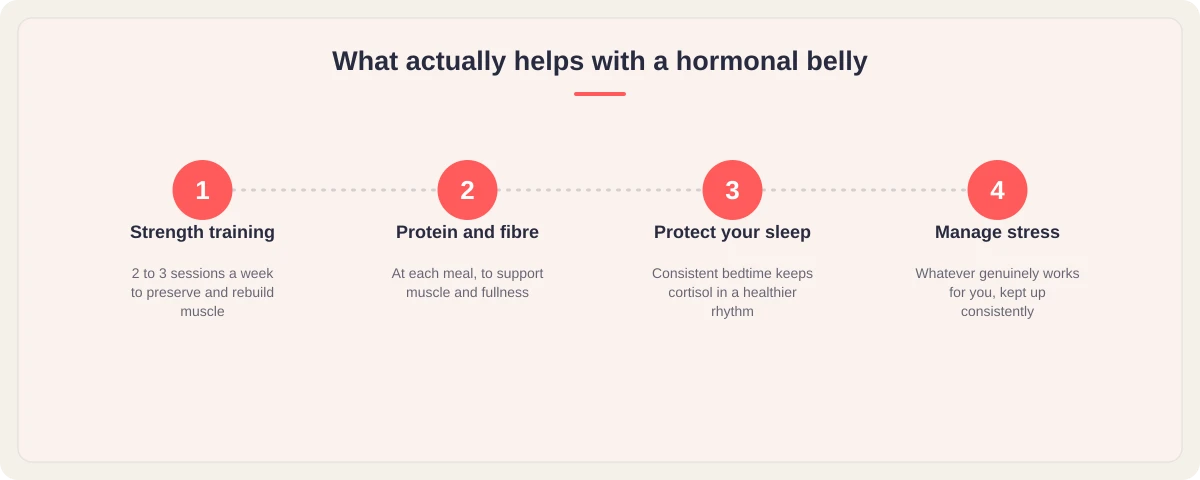
Strength training two to three times a week helps preserve and rebuild muscle, which supports metabolism as you age. Getting enough protein and fibre at meals supports muscle maintenance and helps with fullness, which can make other changes easier to sustain. Protecting sleep, through a consistent bedtime and winding down before bed, helps keep cortisol in a healthier daily rhythm. Managing stress through whatever genuinely works for you, whether that is walking, breathing exercises or simply protecting some downtime, also helps keep cortisol from staying raised. Cutting back on alcohol can help too, since it affects sleep quality and is itself a source of extra calories.
Could HRT help?
Hormone replacement therapy (HRT) is not a weight-loss treatment and is not prescribed for that purpose. Current evidence does not show that HRT itself causes abdominal fat to reduce directly. What it can do is ease some of the perimenopausal symptoms, particularly poor sleep and hot flushes, that make it harder to keep up the habits described above. For some women, improving sleep and reducing night sweats indirectly makes strength training, eating well and stress management easier to sustain.
HRT typically combines an oestrogen, such as Oestrogel Pump, with a progestogen like Utrogestan 100mg capsules, to protect the womb lining in women who still have a uterus. The right combination, dose and delivery method depends on your symptoms, medical history and preferences, and suitability should always be assessed properly rather than assumed.
When to speak to a pharmacist or GP
It is worth getting checked if weight gain around the middle is rapid, significant, or came on over a short period rather than gradually. The same goes if it comes with other symptoms such as persistent tiredness, feeling unusually cold, irregular periods, excessive thirst, or noticeable changes in skin or hair, since these can point to a thyroid problem, PCOS or another condition that benefits from proper testing rather than lifestyle changes alone.
If you are in your 40s or 50s and night sweats, hot flushes, mood changes or disrupted sleep are part of the picture, it is reasonable to ask about perimenopause and whether HRT could be appropriate for you. A pharmacist or GP can take a proper history, arrange blood tests where needed, and talk through whether lifestyle measures, HRT, or further investigation make the most sense for your situation.
Try not to wait for things to become unmanageable before asking for help. Perimenopause can last several years, and getting an early, accurate picture of what is driving the changes you are seeing means you can put the right support in place sooner rather than muddling through on guesswork.
Frequently asked questions
Is a hormonal belly the same as general weight gain?
Not exactly. A hormonal belly describes a change in where fat is stored (more around the middle) rather than necessarily how much fat there is overall. Some women notice their waist changing even when their total weight stays fairly stable.
Can a hormonal belly be reduced through diet alone?
Diet plays a part, particularly protein and fibre intake, but it rarely works in isolation. Strength training to preserve muscle, good sleep and stress management tend to matter just as much, especially around perimenopause.
Does HRT reduce belly fat?
HRT is not a weight-loss treatment and there is no good evidence it directly reduces abdominal fat. It may help indirectly by easing symptoms like poor sleep, which can make healthy habits easier to maintain.
Can stress alone cause a hormonal belly?
Ongoing stress raises cortisol, which encourages the body to store fat around the middle, so stress can be a meaningful contributor on its own. It often combines with other factors such as perimenopause and poor sleep.
When should I see a doctor about a hormonal belly?
See a pharmacist or GP if weight gain around the middle is sudden or significant, or if it comes with symptoms such as tiredness, feeling cold, irregular periods or excessive thirst, so other causes can be properly checked.