How much is a private prescription in the UK?
 Clinically reviewed by the My London Pharmacy clinical team
·18 November 2026
·7 min read
·Reviews on Trustpilot
Quick answer
There is no single price. An NHS prescription in England costs £9.90 per item, free in Scotland, Wales and Northern Ireland, while a private prescription costs the medicine itself plus any consultation or prescriber fee, which varies by provider. For a low-cost medicine, paying privately can sometimes work out cheaper than the NHS charge.
The NHS prescription charge, and who does not pay it
In England, the standard NHS prescription charge is £9.90 per item for 2026/27, unchanged for a second year running after the government froze it. The charge applies per item dispensed, so a prescription with three different medicines on it costs £29.70 in total, not £9.90 for the whole form.
Prescriptions are free at the point of dispensing in Scotland, Wales and Northern Ireland, regardless of age or income, so this charge only applies if you live in England or are prescribed through an England-based service. It has not always been this way: England used to charge for prescriptions too, before each nation set its own policy separately.
A long list of people in England do not pay the charge at all. This includes children under 16, young people in full-time education under 19, anyone aged 60 or over, and people who are pregnant or have had a baby in the last 12 months with a valid maternity exemption certificate. Certain long-term conditions, such as some forms of diabetes, epilepsy and cancer, qualify for a medical exemption certificate, and people on a low income may qualify for help through the NHS Low Income Scheme. Each exemption works on an honesty-basis declaration at the pharmacy counter, backed by a certificate you apply for in advance, so it is worth checking well before you need your next prescription rather than at the till.
What a private prescription actually is
A private prescription is simply a prescription written by a prescriber working outside the NHS charging system, rather than through it. The prescriber might be a private GP, an independent pharmacist prescriber, or a clinician working for an online pharmacy service. The medicine itself is usually identical to the NHS version; what changes is who writes it and how it is paid for.
Because it sits outside the NHS scheme, a private prescription is not covered by the fixed £9.90 charge, and it is not covered by an NHS prepayment certificate or any NHS exemption either. You pay the pharmacy or service directly, in full, every time.
A private prescription can usually be taken to any pharmacy that is willing to dispense it, not only the one attached to the service that issued it, although prices and stock can vary between pharmacies for the same item. It is worth asking what your options are before you pay, particularly if a pharmacy's price for the medicine itself seems high.
What you're actually paying for: the medicine, plus a fee
A private prescription price is usually made up of two parts. The first is the cost of the medicine itself, which the pharmacy sets based on what it pays its wholesaler plus its own margin, so the same medicine can be priced slightly differently from one pharmacy to another.
The second part is a prescriber or consultation fee. This covers the clinician's time reviewing your symptoms or medical history and deciding whether the medicine is appropriate for you, which is a legal and clinical step that has to happen before any private prescription can be issued. With an online pharmacy service, this fee is often bundled into a single upfront price alongside the medicine, so you see one total figure rather than separate charges.
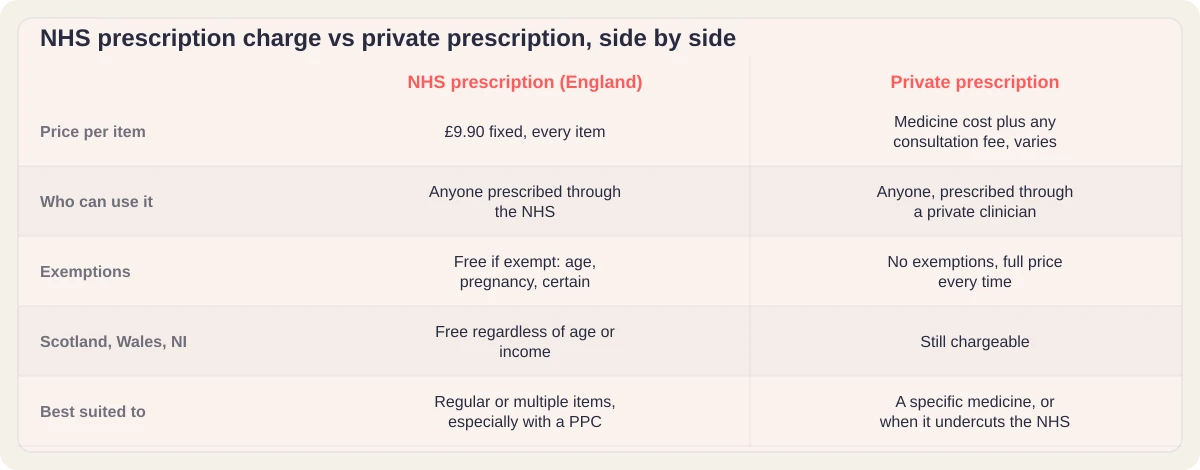
Because there is no national fee scale for private prescriptions, the total can vary noticeably between providers for the same medicine, which is why it is worth checking the full price before you commit rather than assuming it will match roughly what the NHS charges.
Common reasons people choose a private prescription
Most people who use a private prescription are not avoiding the NHS route for no reason. Common situations include needing a medicine faster than the next available GP appointment allows, travelling abroad and needing travel vaccines or antimalarials ahead of a trip, or wanting a discreet, convenient way to access treatment for a sensitive condition without an in-person appointment.
Some people also use a private route for a specific product or brand their NHS prescriber would not routinely prescribe for their circumstances, even though a clinically similar alternative is available on the NHS. In all of these cases, the medicine itself still has to be appropriate and safe for you, which is why a proper clinical assessment happens first, whichever route you choose.
When a private prescription can work out cheaper than the NHS
For a single, low-cost generic medicine, the ingredient cost alone can sometimes be less than the £9.90 NHS charge, particularly if the private service has a low or no separate consultation fee for a repeat item. In that situation, paying privately for that one item can come out cheaper than using an NHS prescription.
This mainly applies to occasional, single-item use. If you take several regular medicines, or need the same medicine every month, the maths usually swings the other way, because the NHS charge can be capped with a prepayment certificate while a private price is paid in full every time.
Prepayment certificates: when they are worth it
An NHS prescription prepayment certificate (PPC) lets you pay a fixed amount upfront to cover all your NHS prescriptions for a set period, however many items you need. For 2026/27, a 3-month PPC costs £32.05 and a 12-month PPC costs £114.50, both unchanged from the previous year.
Because a 3-month PPC costs roughly the same as three and a bit single NHS charges, it is worth buying one as soon as you expect to need more than three prescription items in three months. A separate 12-month HRT PPC, priced at £19.80, covers all hormone replacement therapy prescriptions for a year and is worth considering for anyone on ongoing HRT.
How an online pharmacy private prescription works
Most online pharmacy services follow a similar pattern. You complete a short online consultation about your symptoms, medical history and current medicines, which a clinician then reviews. If the medicine is suitable for you, a private prescription is issued and the medicine is dispensed and posted out, usually within a day or two.
A reputable service shows you the full price, medicine plus consultation fee, before you commit, so there are no charges added later. If a medicine is not appropriate for you, a properly run service will say so rather than dispensing it anyway, which is one of the main differences between a regulated pharmacy service and an unregulated website selling medicines without any clinical check.
A few things worth checking before you pay
Before paying for a private prescription online, check that the service is registered with the General Pharmaceutical Council (GPhC) or the Care Quality Commission, and that it discloses the prescriber's name and registration. A genuine service will always ask about your medical history first, rather than simply dispensing a named medicine with no questions asked.
It is also worth comparing the total price, medicine and fee together, against at least one other provider if you have time, since a lower headline medicine price sometimes hides a higher consultation fee, and the other way round. Asking whether the price shown is the full and final cost, with no extra dispensing or delivery charge added at checkout, avoids an unwelcome surprise once you reach payment.
Frequently asked questions
How much is an NHS prescription in England?
The standard NHS prescription charge is £9.90 per item for 2026/27, the second year running the charge has been frozen. It is charged per item, not per prescription form, so several medicines on one prescription are each charged separately.
Are prescriptions free in Scotland, Wales and Northern Ireland?
Yes. Scotland, Wales and Northern Ireland do not charge for NHS prescriptions, regardless of age or income. The £9.90 per-item charge only applies in England.
Is an NHS prescription prepayment certificate worth it?
If you expect to need more than three prescription items in three months, a 3-month PPC at £32.05 or a 12-month PPC at £114.50 usually works out cheaper than paying the charge each time.
How much does a private prescription cost?
There is no fixed price. It is made up of the cost of the medicine itself plus any consultation or prescriber fee, both of which vary by pharmacy or service, so the total can differ from one provider to the next for the same medicine.
Can a private prescription be cheaper than an NHS one?
Sometimes, for a single, low-cost medicine where the ingredient price is less than the NHS charge. For multiple or regular items, an NHS prescription, especially with a prepayment certificate, is usually the cheaper option.
Who is exempt from the NHS prescription charge?
Children under 16, young people in full-time education under 19, people aged 60 or over, those who are pregnant or have recently had a baby, and people with certain long-term conditions or on a low income can all qualify for free NHS prescriptions in England.