
Malarone vs doxycycline: which malaria tablets should you choose?
Quick answer
Both Malarone and doxycycline prevent malaria effectively when taken correctly. Malarone needs only a week after your trip and suits shorter breaks, while doxycycline is taken for four weeks after return, often costs less, and covers longer trips. Your health, itinerary and destination decide which is more suitable, a clinician can confirm before you travel.
How Malarone and doxycycline prevent malaria
Malarone and doxycycline are two of the most commonly prescribed antimalarial tablets for UK travellers, and both work well when taken as directed, but they act in different ways. Malarone combines two medicines, atovaquone and proguanil, which together interrupt the malaria parasite's development at an early stage, before it can multiply in the liver or bloodstream.
Doxycycline is an antibiotic that works differently: it stops the parasite reproducing once it reaches the bloodstream, and it has the side benefit of covering some other travel-related infections too. Neither tablet is a vaccine, and neither offers complete protection on its own, they reduce risk substantially but are always used alongside bite-avoidance measures such as repellent, covering up and sleeping under a net where advised.
There are other antimalarial options too, such as mefloquine or chloroquine-proguanil, but Malarone and doxycycline are the two most frequently recommended for UK travellers because they suit the resistance patterns seen in most popular destinations and tend to be well tolerated. Which of the two a clinician suggests, or whether another option fits your trip better, depends on exactly where you are going, since malaria parasites in some regions have developed resistance to certain medicines.
Dosing and timing: before, during and after your trip
The biggest practical difference between the two tablets is how long you take them for after you get home, and it is often the deciding factor for travellers choosing between them.
Malarone is started one to two days before you enter a malaria area, taken once a day with food for the whole trip, and continued for just seven days after you leave. Doxycycline follows a similar start, one to two days before arrival, once a day with food, but it needs to be continued for a full four weeks after you leave the area, since it works at a later stage of the parasite's lifecycle.
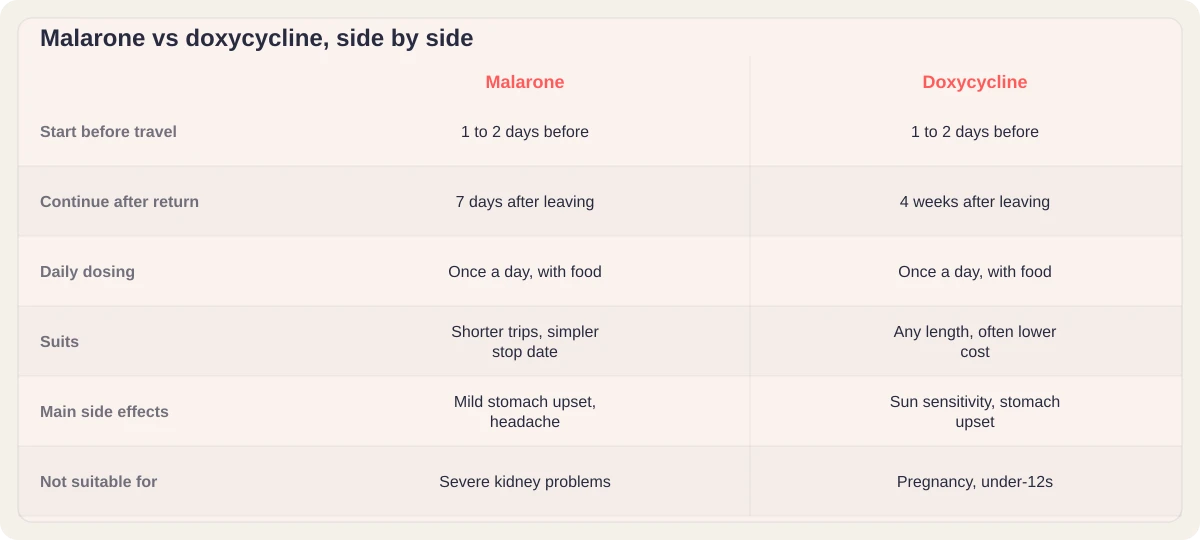
For a short trip, that week-long tail on Malarone can make it the simpler option logistically. For a longer trip, or one where cost matters over many weeks, doxycycline's lower price per tablet often balances out the longer course.
Side effects: what to expect from each
Most people tolerate either tablet well, but the pattern of side effects differs enough to matter for some travellers. With Malarone, the most commonly reported effects are mild stomach upset, headache and occasional vivid dreams, and because it has fewer interactions with alcohol and sun exposure, some travellers find it easier to live with day to day.
Doxycycline's main side effect to plan around is increased sun sensitivity, your skin can burn more easily, so daily sunscreen matters more than usual on a doxycycline-covered trip. It can also cause stomach upset or, less often, irritation of the gullet if taken lying down or without enough water, taking it with food and a full glass of water, sitting upright, reduces this risk considerably. Both tablets are usually well tolerated overall; persistent or severe symptoms should be reported to a clinician rather than you simply stopping treatment mid-trip.
Who should avoid each option
Neither tablet suits everyone, which is exactly why a short consultation before you travel matters more than picking a tablet off a packet. Malarone is generally avoided in people with severe kidney problems, since it is cleared through the kidneys, and it is not usually recommended during the first trimester of pregnancy.
Doxycycline is not suitable in pregnancy or while breastfeeding, and it is not given to children under 12, because of its effects on developing bone and teeth. A history of certain antibiotic sensitivities, or medicines that interact with tetracyclines, can also steer the choice toward Malarone instead. Your full medical history, current medicines and the countries on your itinerary all feed into which tablet, if either, a clinician will recommend.
It is also worth mentioning any regular medicines at your consultation, since doxycycline can interact with some antacids, iron and calcium supplements if taken too close together, and Malarone's absorption can be affected by certain anti-sickness medicines. None of these interactions usually rule a tablet out altogether, but they can change how or when you take it, which is easier to plan for in advance than to work out while you are already travelling.
Choosing between them for your trip
In practice, the right choice usually comes down to a handful of practical questions rather than one tablet being universally better. How long is the trip, and does a shorter post-return course (Malarone) or a lower overall cost (doxycycline) matter more to you? Will you be in strong sun for long periods, where doxycycline's sun sensitivity becomes more of a day-to-day consideration? Do you have kidney problems, are you pregnant, or do you have a child travelling with you, each of which can rule one option out?
The malaria risk at your specific destination also shapes the recommendation, since resistance patterns and risk levels vary by country and even by region within a country, which is part of why a destination-specific travel health assessment is recommended rather than relying on general advice alone.
Beyond tablets: other ways to reduce your risk
Antimalarial tablets are only one part of a sensible prevention plan. Mosquitoes that carry malaria bite mainly between dusk and dawn, so covering arms and legs, using a DEET-based repellent on exposed skin in the evening, and sleeping under a permethrin-treated net where accommodation does not have reliable screening or air conditioning all meaningfully reduce your risk alongside tablets.
No tablet or combination of measures removes risk completely, which is why recognising symptoms matters too: fever, chills, headache, muscle aches or flu-like illness starting during your trip or in the months after you return should be treated as a reason to seek medical attention promptly and to mention your travel history, malaria can take weeks to show symptoms after exposure.
Getting antimalarial tablets before you travel
Both Malarone and doxycycline are prescription-only in the UK, so the first step is a travel health consultation, ideally four to six weeks before you leave, though a shorter window can usually still be accommodated. A clinician will ask about your itinerary, how long you are travelling for, your medical history and any medicines you already take, then confirm which antimalarial, if any, is appropriate and work out the dosing schedule around your travel dates.
Our clinical team offers malaria prevention consultations that cover this assessment, prescribing the right tablet for your trip once suitability is confirmed. If you are also looking at other aspects of travel health, our guides on reducing jet lag and traveller's diarrhoea cover other common issues that come up on the same kind of trip.
Frequently asked questions
Can I take malaria tablets while pregnant?
Doxycycline is not suitable in pregnancy, and Malarone is not usually recommended in the first trimester. If you are pregnant, trying to conceive, or breastfeeding and need to travel to a malaria area, speak to a clinician, other options or extra precautions may be considered depending on your destination and the level of risk.
What happens if I miss a dose?
Take it as soon as you remember unless it is almost time for the next dose, in which case skip the missed one rather than doubling up. Missing several doses, especially the ones after you leave the malaria area, can leave you unprotected during the period when symptoms are most likely to appear, so try to keep to the schedule as closely as possible.
Can I switch from doxycycline to Malarone partway through a trip?
Switching mid-trip is sometimes possible but should only be done with clinical advice, since the two tablets work differently and simply swapping without guidance can leave gaps in protection. If a side effect is causing problems, contact a clinician rather than stopping or changing tablets on your own.
Do malaria tablets protect against other mosquito-borne illnesses?
No. Antimalarial tablets are specific to malaria and do not protect against dengue, Zika or other mosquito-borne infections, which is why bite-avoidance measures, repellent, covering up, nets, remain important even when you are taking tablets correctly.
How soon before travel should I start antimalarial tablets?
Both Malarone and doxycycline are usually started one to two days before you enter a malaria area, though booking a consultation four to six weeks ahead gives time to discuss suitability, arrange a prescription and ask any questions before you need to start the course.