
Man flu: is it real? What the evidence says
 Clinically reviewed by the My London Pharmacy clinical team
·19 November 2026
·6 min read
·Reviews on Trustpilot
Quick answer
Man flu is not just a joke. A 2017 BMJ review found some evidence that men can experience worse symptoms from certain respiratory viruses, possibly linked to testosterone's effect on immune response, though the evidence is limited. Individual differences matter far more than sex alone, and most colds and flu are managed the same way regardless of who has them.

Where the phrase 'man flu' comes from
"Man flu" is a tongue-in-cheek British phrase for the idea that men complain more, or suffer more dramatically, when they catch an ordinary cold. It is usually used to tease, suggesting the symptoms are exaggerated rather than genuinely worse.
The phrase has been around for decades, but it only became a talking point in medical circles after researchers started asking whether there might be a grain of truth in it. That question led to a now well-known review of the existing evidence, published in the BMJ's annual Christmas edition, a slot the journal reserves for lighter but still peer-reviewed research.
What the research actually found
In 2017, researcher Kyle Sue published a review in the BMJ looking at existing studies on sex differences in respiratory infections. The review found some evidence that men may experience more severe symptoms from certain viral respiratory infections than women, and suggested this could be partly linked to how testosterone affects the immune system.
The idea is that oestrogen may support a stronger immune response to some viruses, while testosterone can have a dampening effect, which could in theory leave men less able to fight off the same infection as quickly. The review also noted that men may be hospitalised with flu and some other infections more often than women in some data sets, and pointed to similar patterns in a handful of animal studies, where male mice cleared certain respiratory viruses more slowly than females given the same dose.
Importantly, the author was clear that the evidence is limited, drawn from a small number of studies, and not enough to settle the question definitively. It is a plausible biological explanation worth more research, not proof that every man's cold is worse than every woman's. Plenty of other factors, including overall health, smoking, stress, underlying conditions and how quickly someone rests, affect how badly an infection hits, and these vary far more between individuals than between sexes.
It is also worth separating biology from behaviour. Some researchers have pointed out that reporting and help-seeking differ too: men may describe or rate their own symptoms differently, and some studies rely on self-reported severity rather than objective measures like temperature or viral load. That makes it hard to say with certainty how much of any difference is truly biological and how much reflects how people talk about being unwell.
Cold or flu: which one are you dealing with
Whether or not sex plays a role in severity, it helps to know whether you actually have a cold or flu, since they are treated differently. The comparison below sets out the main differences.
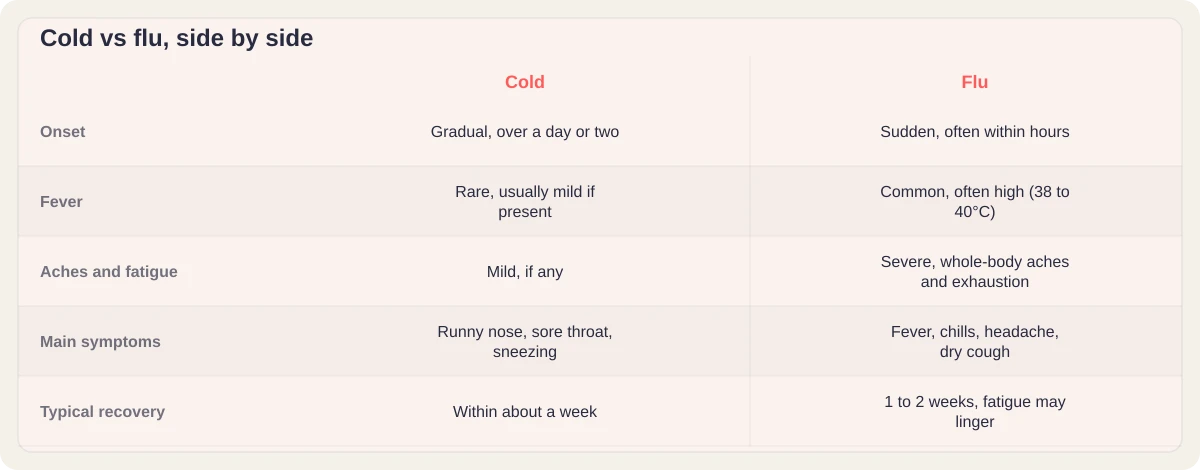
Colds tend to come on gradually and stay centred on the nose and throat, while flu arrives suddenly with fever and whole-body aches that often mean a day or more in bed. Neither pattern is absolute, and the same virus can affect two people quite differently, so how you feel matters more than fitting your symptoms neatly into one category.
What genuinely helps recovery
Regardless of who is unwell, the basics of recovery are the same. Resting properly, rather than pushing through a normal day, gives the immune system the best chance to deal with the infection. Drinking plenty of fluids helps prevent dehydration, which can make tiredness and headaches worse, and warm drinks in particular can soothe a sore throat and help loosen a blocked nose.
Paracetamol or ibuprofen can ease fever, aches and a sore throat if they are suitable for you, and a pharmacist can advise on dose and whether they are appropriate alongside any other medicines you take. Warm drinks, honey and lozenges soothe a cough or sore throat, and a decongestant can help a blocked nose for short periods, though it should not be used for more than a few days in a row.
None of these treatments clear the infection faster. They make the days you are unwell more bearable while your immune system does the work, and that is true whether you are the one with the cold or caring for someone who is. It is also worth pacing your return to normal activity once you start to feel better, rather than going straight back to a full day at work or the gym, since pushing too hard too soon can leave tiredness lingering for longer.
Reducing the chances of catching or passing it on
Colds and flu both spread through droplets released when someone coughs or sneezes, and through touching contaminated surfaces before touching the face. Regular hand washing, using and binning tissues promptly, and wiping down shared surfaces at home or work all reduce how far the virus travels.
Staying away from others while you have a fever, particularly anyone more vulnerable to complications, helps protect the people around you. This matters as much for men as for women: whatever role biology plays in symptom severity, everyday hygiene habits make the biggest difference to whether an infection spreads through a household or office in the first place.
When flu needs a clinician
Most colds and flu settle on their own within one to two weeks. Contact a GP or NHS 111 if symptoms are not improving after about a week, you have a very high temperature, or you feel considerably worse rather than better as the days pass.
Seek urgent help, or call 999, for difficulty breathing, chest pain, coughing up blood, or sudden confusion. People with long-term conditions, older adults, pregnant women and young children are more vulnerable to complications and should seek advice sooner rather than waiting to see if symptoms pass.
Antivirals and the flu vaccine
For flu specifically, an antiviral medicine may be considered for people at higher risk of complications, or during periods when flu is circulating widely, ideally started within 48 hours of symptoms beginning. They are not needed by most otherwise healthy adults, who recover well with rest and symptom relief.
Antibiotics have no effect on colds or flu, since both are caused by viruses rather than bacteria, and taking them unnecessarily does not speed up recovery. The annual flu vaccine, offered through the NHS to those most at risk, remains the most effective way to reduce the chance of a serious case in the first place, and it is worth checking your eligibility each autumn.
If you are unsure whether antiviral treatment could be appropriate for you, or you simply want advice on managing symptoms, a short consultation with a clinician can help you decide on the right next step.
Frequently asked questions
Is man flu a real thing?
There is some evidence, from a 2017 BMJ review, that men may experience more severe symptoms from certain respiratory viruses, possibly linked to testosterone's effect on the immune system. The evidence is limited, though, and individual health and habits matter more than sex alone.
Why might men get worse symptoms from a cold or flu?
One theory is that oestrogen may support a stronger immune response to some viruses, while testosterone can dampen it slightly. This is a plausible explanation drawn from limited research, not a settled fact.
How can I tell if I have a cold or flu?
Colds usually develop gradually and stay mild, mainly affecting the nose and throat. Flu tends to come on suddenly with a high temperature, body aches and exhaustion that often keep you in bed.
Do antibiotics help with man flu or regular flu?
No. Colds and flu are caused by viruses, and antibiotics only work against bacteria. Rest, fluids and symptom relief are the mainstay, with antibiotics reserved for a bacterial complication if one develops.
When should I see a clinician about flu symptoms?
Seek advice if symptoms are not improving after about a week, you have a very high temperature, or you feel significantly worse. Seek urgent help for difficulty breathing, chest pain or sudden confusion.