
Minoxidil vs finasteride: which hair loss treatment is right for you?
Quick answer
Minoxidil is a topical treatment that stimulates hair follicles and suits both men and women. Finasteride is a daily tablet for men that reduces the hormone driving pattern hair loss. Many men use both together after a consultation, since they work by different mechanisms and the combination tends to outperform either alone.
Two different approaches to the same problem
Minoxidil and finasteride are the two treatments with the strongest evidence for pattern hair loss, and they are often mentioned in the same breath, but they work in quite different ways. Minoxidil is applied directly to the scalp and acts locally on the hair follicle itself, prolonging its growth phase. Finasteride is taken as a daily tablet and works throughout the body, reducing the level of the hormone that causes genetically sensitive follicles to shrink over time.
Because the two treatments target different parts of the problem, understanding how each one works is the starting point for deciding which, if either, suits you, or whether a clinician might suggest using them together. This question comes up constantly, because both are widely available, both have decades of use behind them, and most people assume one must simply be better than the other. In reality, the better choice depends more on who you are and what you are hoping for than on which product wins a head-to-head trial.
How minoxidil works
Minoxidil is applied as a liquid or foam to the scalp, usually once or twice a day. It was originally developed as a tablet for high blood pressure, and hair growth was noticed as a side effect in people taking it; the topical version used for hair loss today works locally, without the blood-pressure-lowering effect of the tablet form. It is thought to widen small blood vessels around the follicle and extend the growth phase of the hair cycle, so more follicles are actively producing hair at any one time and the strands that do grow tend to be thicker.
Minoxidil does not address the underlying hormonal driver of pattern hair loss, which is why its effect depends entirely on continued, regular use rather than making a lasting structural change to the follicle. It is licensed for use in both men and women, which makes it the more widely applicable of the two treatments and often the first option considered for women with pattern thinning, since finasteride is not suitable for them. It is generally well tolerated, though scalp irritation, dryness or flaking are the most commonly reported issues, and a temporary increase in shedding is common in the first few weeks as the hair cycle resets before settling down.
How finasteride works
Finasteride Tablet works differently. It is a daily tablet that reduces the body's production of dihydrotestosterone (DHT), the hormone responsible for gradually shrinking genetically sensitive hair follicles in male pattern hair loss, a process called miniaturisation. By lowering circulating DHT by around 70%, finasteride slows or halts this process in many men, and some also see a degree of regrowth over the following months as follicles that had become dormant start producing visible hair again.
Finasteride is licensed for men only; it is not used in women, and tablets should not be handled by anyone who is pregnant or may become pregnant, because of a risk to a male fetus if the active ingredient is absorbed. A small proportion of men report sexual side effects such as reduced libido or erectile difficulty, and these usually resolve on stopping the medicine, though a clinician will talk through this, along with your wider health history and any other medicines you take, before deciding whether finasteride is appropriate for you.
Minoxidil vs finasteride at a glance
The table below sets out the main practical differences, though a clinician is best placed to weigh these up against your own history and goals.
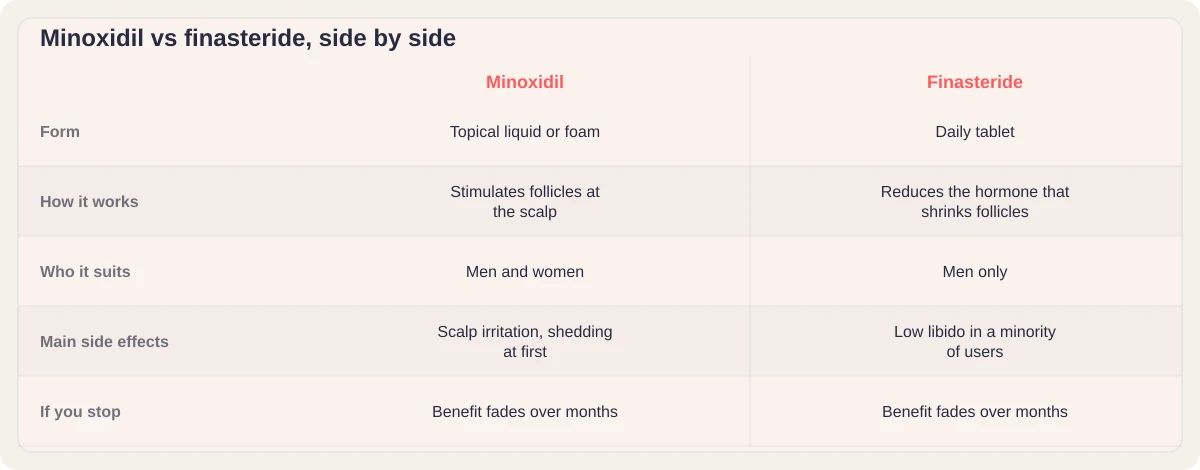
In practice, the choice often comes down to who you are (finasteride is restricted to men), how you feel about a daily tablet versus a topical routine, and how you weigh the different side-effect profiles against the evidence for each.
Can you use both together?
Because minoxidil and finasteride act on different parts of the hair loss process, using them together is a recognised approach for men who want the strongest effect, and studies comparing the combination to either treatment alone have generally found it more effective at both slowing loss and encouraging regrowth. A combined product such as Finasteride + Minoxidil can make a two-part routine more convenient, since it reduces the daily steps to remember, though some men prefer to use Minoxidil and a separate finasteride tablet so each element can be adjusted or stopped independently if needed.
There is no requirement to use both. Some men start with one treatment, see how they get on over several months, and add the second later if results are modest, while others prefer to begin with the combination under clinical guidance, particularly if their hair loss is already fairly advanced. Either way, consistency matters more than which option you start with, since both treatments only work while they are being used regularly.
What to expect, and how long it takes
Neither treatment works quickly, and it helps to know this before you start so the early months do not feel discouraging. Most men need three to six months of consistent use before any change is visible, with the fuller picture becoming clear after around a year of continued treatment. A temporary increase in shedding in the first few weeks is common with minoxidil in particular, as resting hairs are pushed out to make way for new growth, and this usually settles on its own within a month or two.
Both treatments maintain their benefit only for as long as you continue using them. If you stop, the underlying pattern of hair loss resumes and any gains made are gradually lost over the following months, typically mirroring the pace at which they were gained. This is worth factoring into your decision alongside the practical side of taking a daily tablet or applying a topical treatment twice a day, since the right choice is also the one you can realistically keep up long term.
Which treatment is likely to suit you, and getting started safely
If you are a woman with pattern thinning, minoxidil is generally the starting point, since finasteride is not an option; a clinician may also check whether another cause, such as a thyroid problem or a nutritional deficiency, is contributing before treatment begins. If you are a man who wants the strongest available effect and is comfortable with a daily tablet, finasteride, often alongside minoxidil, tends to be the first choice discussed; men who would rather avoid a tablet, perhaps because of the small risk of sexual side effects or simply a preference for a topical routine, often start with minoxidil alone and review how things go after a few months.
Both treatments are more effective when started before extensive hair loss has occurred, so it is worth seeking advice sooner rather than waiting to see how things progress. A consultation allows a clinician to confirm that what you are experiencing fits the pattern of androgenetic hair loss, check your general health and any medicines you take, and make sure there is no reason a particular treatment would be unsuitable for you, matching the plan to your priorities, whether that is minimising side effects, keeping the routine simple, or getting the strongest possible result. A follow-up review gives you the chance to discuss how treatment is going and adjust the approach if your initial choice is not delivering what you had hoped for.
When to seek advice
If your hair loss is patchy, sudden, or comes with other symptoms such as scalp soreness, unexplained tiredness or weight change, it is worth having this assessed rather than assuming it is the common pattern type, since the treatment approach would be different. For straightforward pattern hair loss, our clinical team can talk through whether minoxidil, finasteride or a combination of the two may be suitable for you, subject to a clinical assessment, and explain what to expect at each stage.
Frequently asked questions
Is minoxidil or finasteride more effective?
Studies comparing the two have generally found finasteride somewhat more effective for men, and the combination of both more effective than either alone. Minoxidil remains the only licensed option for women.
Can women use finasteride?
No. Finasteride is licensed for men only and should not be handled by anyone who is pregnant or may become pregnant. Women with pattern hair loss are usually offered minoxidil instead, following an assessment.
How long until I see results from minoxidil or finasteride?
Most people need three to six months of consistent use before noticing a change, with the full effect becoming clearer after around a year. A temporary increase in shedding early on is common and usually settles.
What happens if I stop using minoxidil or finasteride?
The benefit fades once treatment stops, and the underlying pattern of hair loss gradually resumes over the following months. Ongoing use is needed to maintain any gains.
Can I use minoxidil and finasteride together?
Yes, many men use both, either as separate products or as a combined formulation, and this combination tends to work better than either treatment alone, used under clinical guidance.
What are the main side effects to be aware of?
Minoxidil can cause scalp irritation or temporary extra shedding. A minority of men on finasteride report reduced libido. A clinician will discuss these with you before you start.