
Testicular lumps and self-checks: what's normal and what to do
Quick answer
Each testicle normally feels smooth and firm, a little like a hard-boiled egg, with a soft cord-like structure (the epididymis) at the back. See a GP promptly for any new lump, swelling, change in size, heaviness, or ache, even without pain. Most lumps are not cancer, but any change needs checking rather than watching and waiting.
What a normal testicle feels like
It helps to know your own normal before you can spot a change. A healthy testicle feels smooth, firm and slightly springy, often compared to a hard-boiled egg without the shell. It should move fairly freely within the scrotum and feel roughly even in texture across its surface, without any distinct hard area or lump on the front, back or sides.
It is completely normal for one testicle, usually the left, to sit a little lower than the other, and for the two to differ slightly in size and weight. Temperature also changes how things feel day to day: the scrotum relaxes and hangs lower in warmth, which is partly why a warm bath or shower is the easiest time to get a reliable feel.
Behind and above each testicle sits the epididymis, a soft, coiled tube that carries and stores sperm as it matures. It can feel like a distinct, slightly tender ridge or lump at the back of the testicle, and this is a normal structure, not a sign of a problem. It is worth deliberately finding and feeling your own epididymis so you can tell it apart from a genuine new lump on the main body of the testicle itself.
Everyone's normal is a little different, which is why a one-off feel on its own is less useful than noticing a change from how things usually feel for you. Checking occasionally, rather than obsessively, gives you a reliable baseline without tipping into health anxiety.
Signs and changes worth checking
A few specific changes are worth getting checked rather than simply monitored at home:
- A lump or swelling in part of one testicle, even if it is completely painless
- A testicle that has become noticeably larger, smaller, or firmer than usual
- A change in the normal texture, such as a hard area where the surface used to feel even
- A feeling of heaviness in the scrotum, or a dull ache in the lower abdomen or groin
- A sudden build-up of fluid in the scrotum, which can make it look swollen rather than feel lumpy
- Any persistent pain, swelling, or tenderness that does not settle within a few days
Painless lumps are the easiest to dismiss, but a change in a testicle's size or texture is one of the clearest early signs worth acting on, whether or not it hurts. A heavy, dragging sensation, sometimes described as a dull ache rather than sharp pain, is also reported often enough that it is worth taking seriously on its own, even with nothing obvious to feel.

How to do a self-check
A self-check takes less than a minute and is easiest straight after a warm bath or shower, when the scrotal skin is relaxed and the testicles sit lower and looser. Standing in front of a mirror can help the first few times, so you can also look for any visible swelling or change in the skin.
Support the scrotum in one hand, then examine one testicle at a time, rolling it gently between your thumb and fingers so you cover the whole surface. You are feeling for any new lump, hard area, or change in size compared with how that testicle usually feels, and comparing it with the other side rather than against some fixed idea of normal. Remember that the epididymis at the back is a normal cord-like structure, not a lump to worry about, and that a spermatic cord running up from the top of each testicle is also a normal, slightly firm structure.
There is no official UK screening programme for testicular self-examination, and the evidence that checking on a strict monthly schedule changes outcomes is limited; Cancer Research UK notes a lack of trial evidence that a particular self-check routine improves survival. What matters more in practice is simply being familiar enough with your own normal that a genuine change stands out, and then acting on it promptly rather than waiting to see if it goes away.
What a lump might be, besides cancer
Most testicular lumps are not cancer. Common, usually harmless causes include an epididymal cyst, a small fluid-filled sac that forms on the epididymis and feels like a separate, movable lump above or behind the testicle itself. A varicocele is another frequent cause, caused by enlarged veins in the scrotum, often described as feeling like a soft bag of worms above the testicle, and it is usually more noticeable when standing than lying down.
A hydrocele is a painless, fluid-filled swelling around the testicle that can make the whole scrotum look larger without an obvious discrete lump, and it often shrinks a little overnight. An inguinal hernia can also cause a lump or swelling that extends up towards the groin, sometimes more noticeable when coughing or straining, and this needs a different kind of assessment again.
Infection or inflammation of the testicle or epididymis, sometimes linked to a urine infection or a sexually transmitted infection, can cause pain, swelling and tenderness that comes on over a day or two, often alongside feeling generally unwell or feverish. This is usually more painful and comes on faster than a typical cancer-related lump, but the overlap in how things feel is exactly the problem: none of these possibilities can be reliably told apart from a cancerous lump by touch alone.
Getting it checked, what to expect
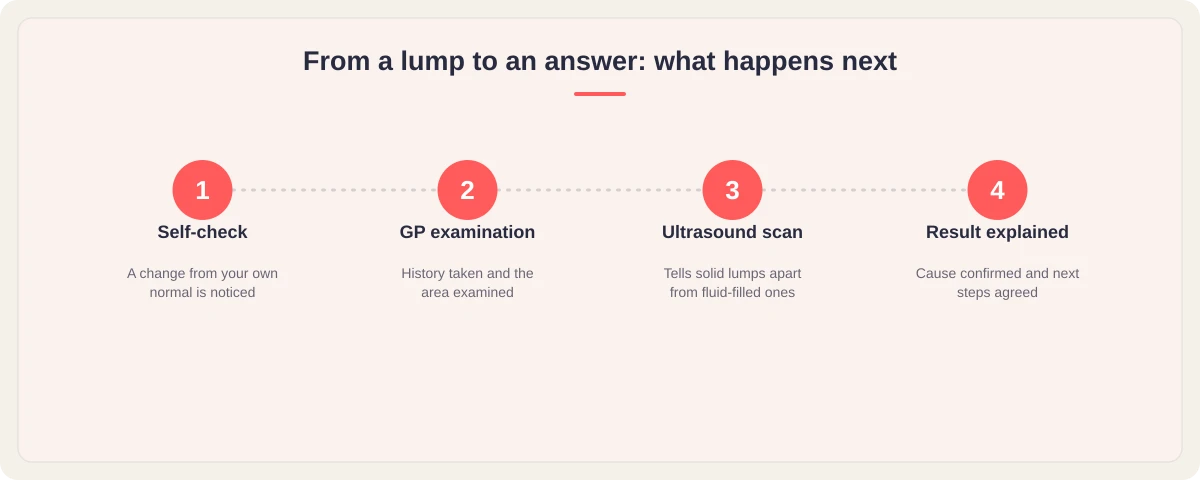
A GP will usually examine the scrotum and ask how long the change has been there, whether it is painful, and whether anything makes it better or worse. In many cases the history and examination alone point clearly towards a harmless cause such as a cyst or varicocele.
If anything feels uncertain, the next step is an ultrasound scan: a painless, quick scan that can tell solid lumps apart from fluid-filled ones with a high degree of accuracy, and is usually the test that settles the question either way. A blood test looking for tumour markers is sometimes done alongside this, particularly if a solid lump is found, though a normal result does not fully rule out cancer on its own and is interpreted together with the scan.
If a GP refers you for suspected cancer, the NHS Faster Diagnosis Standard aims to confirm or rule out a diagnosis within 28 days of the hospital receiving the referral. Testicular cancer is also one of the more treatable cancers when caught early, with high cure rates even when it has spread a little, which is part of why a prompt check, rather than a wait-and-see approach, is the consistent guidance across UK sources.
When a private men's health check can help
A new lump or change should always go to a GP promptly rather than wait for a routine appointment elsewhere, since it may need an urgent referral for a scan that a GP is best placed to arrange quickly. A private men's health consultation is not a substitute for that first step, and should never be used to delay seeing a GP about a new testicular lump.
Where a clinic check can help is alongside this, or once a lump has already been assessed. General men's health testing can cover related symptoms, such as hormone levels if you also have tiredness, low mood or reduced libido, or a wider health review if you want a second opinion once initial results are back. A pharmacist-led consultation can also help you understand a referral letter or a scan result in plain terms, and talk through what reasonable next steps look like, always alongside your GP's own follow-up rather than instead of it.
Frequently asked questions
Does a testicular lump always mean cancer?
No. Most testicular lumps are caused by harmless conditions such as an epididymal cyst, a varicocele, or a hydrocele. Even so, a lump cannot be safely told apart from cancer without a clinical examination and often an ultrasound scan, so any new lump should still be checked.
How often should I check my testicles?
There is no official UK screening schedule, and the evidence for a strict monthly routine is limited. What matters most is being familiar with your own normal shape and feel, so that you notice a genuine change and act on it promptly.
Is a painless lump less serious than a painful one?
Not necessarily. Testicular cancer often presents as a painless lump, while pain is more commonly linked to infection or inflammation. Painless does not mean harmless, so any new lump or swelling is worth getting checked regardless of whether it hurts.
What happens at a GP appointment for a testicular lump?
A GP will usually ask about your symptoms and examine the area. If the cause is not clear, you will likely be referred for an ultrasound scan, which can distinguish solid lumps from fluid-filled ones, sometimes alongside a blood test for tumour markers.
How quickly will I get seen if cancer is suspected?
If a GP refers you for suspected testicular cancer, the NHS Faster Diagnosis Standard aims to confirm or rule out a diagnosis within 28 days of the hospital receiving the referral.
Can a men's health clinic diagnose a testicular lump?
A pharmacist-led men's health consultation can discuss symptoms and point you towards the right next step, but a new or changing testicular lump should be assessed by a GP promptly, as it may need an urgent scan referral rather than a routine clinic visit.