TRT side effects: what is common, what is serious and how clinicians manage them
 Clinically reviewed by the My London Pharmacy clinical team
·16 November 2026
·6 min read
·Reviews on Trustpilot
Quick answer
Most TRT side effects are mild: acne, oily skin, fluid retention and mood changes, often settling as the dose beds in. The one that most reliably needs action is raised haematocrit (thickened blood), checked at every blood test. Serious problems are uncommon, which is exactly why regular monitoring exists, to catch issues early.
How common are TRT side effects, really?
Most men on properly prescribed, monitored TRT tolerate it well. Side effects, when they happen, tend to cluster in the first few months while the body and dose are still settling, and many ease once a stable dose and formulation are found. No two men respond identically: a dose or formulation that suits one person can produce more noticeable side effects in another, which is part of why TRT is started cautiously and reviewed rather than prescribed as a fixed, one-size-fits-all plan.
The formulation itself shapes the pattern of side effects you're more likely to notice. Daily gel tends to bring skin-related issues, such as irritation where it's applied, along with a small risk of transferring testosterone to someone else through skin contact before it's fully dry. Injections avoid that transfer risk but can cause more noticeable swings in how you feel between doses, particularly with shorter-acting esters given every one to two weeks, alongside a small chance of redness or a firm lump at the injection site.
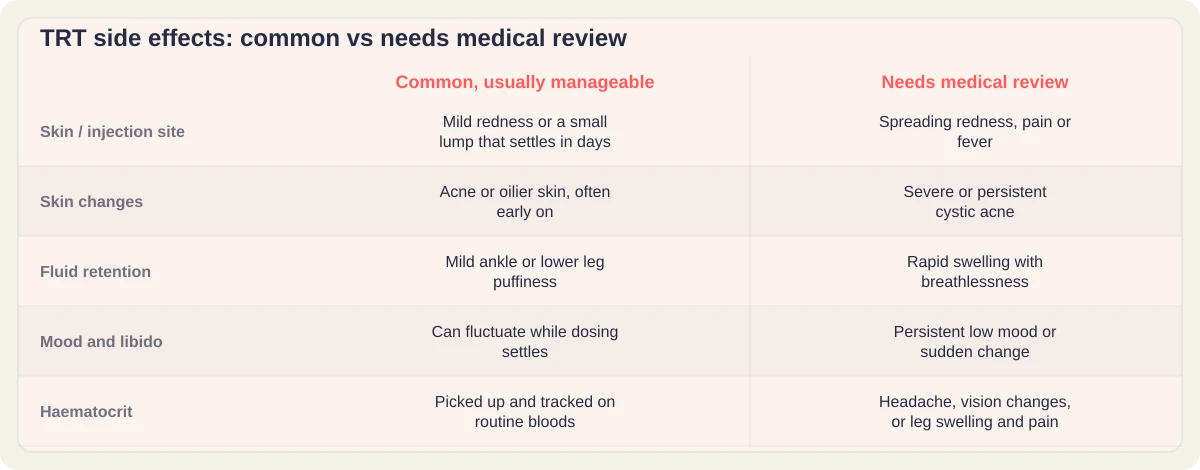
The common, usually mild side effects
These are the effects a clinician would expect to see mentioned most often, and the ones that are usually manageable without stopping treatment:
- Acne and oilier skin. Common, especially in the first few months, and often settles or responds to ordinary skincare.
- Fluid retention. Mild ankle or lower leg puffiness, usually minor and often improves as the dose is fine-tuned.
- Mood and libido changes. Can go either way while the body adjusts; libido often rises, though it can also dip for some men early on.
- Injection site reactions. Redness, mild soreness or a small lump that generally settles within a few days, for men on injectable formulations.
- Hair changes. Testosterone converts to DHT, which can speed up male pattern hair loss in men already prone to it. It doesn't cause hair loss in men who weren't going to experience it anyway.
- Breast tenderness. Mild tenderness or sensitivity around the nipples can occur as hormone levels shift.
None of these need urgent attention on their own, but worth raising at your next review so your clinician can see whether a dose or formulation change would help.
What affects your personal risk of side effects
A few factors shape how likely you are to notice side effects, and how significant they're likely to be. Age matters: older men tend to run a higher baseline haematocrit and prostate risk, so monitoring is often closer. Starting dose and how quickly it's increased matters too, which is why most clinics begin conservatively and adjust gradually against blood results rather than symptoms alone. Pre-existing conditions, particularly sleep apnoea, high blood pressure, or an already raised haematocrit, change the risk-benefit picture and the monitoring plan from day one.
Formulation choice plays a part as well. Short-acting injections given every one to two weeks produce a sharper peak and trough in blood levels between doses, which some men feel as mood or energy swings, while longer-acting injections or daily gel tend to give a steadier profile. None of this is a reason to avoid TRT where it's genuinely indicated; it's the reason a proper clinical assessment, rather than a one-off prescription, sits at the centre of safe treatment.
Raised haematocrit: the side effect clinicians watch closest
Testosterone stimulates the bone marrow to produce more red blood cells, which raises haematocrit, the proportion of blood made up of red cells. A modest rise is expected and not a problem in itself. The concern is when it climbs too high: thicker blood is harder for the heart to pump and carries a greater risk of clotting, which is why haematocrit is one of the blood tests checked at every TRT review, not just at the start.
If haematocrit rises too far, a clinician has several options: reducing the dose, spacing out injections to smooth out the peaks that drive red cell production, switching to a different formulation, or, less often, advising a venesection (essentially giving blood) to bring the level back down quickly. This is a routine, well-understood part of TRT management, not a reason to assume something has gone wrong.
Less common but serious risks to know about
Serious problems on properly monitored TRT are uncommon, but they're exactly what the monitoring schedule exists to catch early:
Prostate changes. Current evidence doesn't show that TRT causes prostate cancer in men who don't already have it, but testosterone can speed up the growth of an existing, undiagnosed cancer. That's why PSA (a prostate blood marker) is checked before starting and at regular intervals afterwards, particularly in older men.
Cardiovascular factors. Blood pressure and cholesterol are reviewed as part of ongoing monitoring, since they sit alongside haematocrit as part of the overall cardiovascular picture on treatment.
Sleep apnoea. TRT can worsen untreated obstructive sleep apnoea, so it's usually flagged and managed, or treatment is reconsidered, if you already have this condition.
Gynaecomastia. Rarely, some testosterone converts to oestrogen and causes breast tissue changes. A clinician can assess and manage this if it happens.
Effects on fertility and testicle size
TRT raises testosterone in the bloodstream, which signals the brain to reduce the hormones (LH and FSH) that drive the testes' own hormone and sperm production. In practice, that usually means smaller testicles and reduced sperm production while on treatment, which is typically, though not always, reversible after stopping, over a timeframe that can run to several months rather than weeks. Our guide to TRT and fertility covers the mechanism and the options in more detail.
If you're planning to start a family in the near future, this is worth discussing with your clinician before you start, not after. Depending on your situation, that conversation might cover timing treatment around family planning, or additional medicines used alongside TRT to help preserve fertility.
When to get help sooner rather than later
Most side effects can wait for your next scheduled review. A smaller number of symptoms shouldn't wait, and need prompt medical attention:
- Chest pain, breathlessness, or a racing or irregular heartbeat
- Swelling, pain or redness in one leg, which can signal a blood clot
- A sudden, severe headache, vision changes, or weakness or numbness on one side of the body
- A significant or sudden change in mood, or any thoughts of self-harm
- Spreading redness, warmth or fever around an injection site
If you notice any of these, don't wait for your next appointment. Seek urgent medical attention (contact 111, your GP, or 999/A&E for anything severe), and let your prescribing clinician know as soon as you can afterwards.
Frequently asked questions
Do TRT side effects go away if I stop treatment?
Most do. Haematocrit and fluid retention typically settle within weeks of stopping, while fertility and testicle size usually recover too, though this can take several months. Always discuss stopping with your prescribing clinician rather than stopping suddenly on your own.
How often will I have blood tests on TRT?
Expect a review a few weeks after starting or after any dose change, then periodically once your levels and symptoms are stable. Your clinician will set the exact schedule based on your results and how you're responding.
Can TRT cause prostate cancer?
Current evidence doesn't show that TRT causes prostate cancer in men who don't already have it. It can, however, speed up the growth of an existing, undiagnosed cancer, which is why PSA monitoring is a standard part of TRT care.
Is raised haematocrit on TRT dangerous?
It can be, if it's left unmanaged, because thicker blood raises the risk of clotting. This is precisely why it's checked at every review and why your clinician will adjust your dose, frequency or formulation, or occasionally recommend venesection, if it climbs too high.
Will TRT affect my fertility permanently?
Usually not, but the suppression of sperm production can take months to reverse after stopping, and a small number of men don't fully recover. If you're planning to conceive, raise this with your clinician before starting rather than after.
What should I do if I notice a side effect between appointments?
Contact your prescribing clinician or pharmacy team rather than waiting for your next scheduled review, especially if a symptom is new, worsening or worrying you. For anything on the urgent list above, seek same-day medical help first.