
Vaping vs nicotine replacement therapy: which helps you quit smoking?
Quick answer
Evidence from UK trials and a Cochrane review suggests nicotine vaping helps more smokers quit than nicotine replacement therapy (NRT) alone, though NRT remains effective and is more widely available through pharmacies and stop smoking services. The right choice depends on your smoking pattern, preferences and what support you can access.
How nicotine replacement therapy works
Nicotine replacement therapy (NRT) gives your body a measured dose of nicotine without the thousands of other chemicals found in cigarette smoke, including the tar and carbon monoxide that drive most of the long-term harm. The idea is to ease withdrawal symptoms, such as irritability, poor concentration and strong cravings, while you break the behavioural habit of smoking itself.
It comes in several forms: patches, gum, lozenges, nasal spray and inhalators, each releasing nicotine at a different speed and suited to a different pattern of cravings. Patches deliver a steady background dose over 16 or 24 hours, which helps with constant, low-level cravings throughout the day. Gum, lozenges, sprays and inhalators act faster, usually within a few minutes, and are better suited to sudden urges, such as after a meal, with a morning coffee, or during a stressful moment.
Many stop smoking services recommend combining a patch with one of these faster-acting products from the start, known as combination or dual NRT, since this tends to cover both steady and sudden cravings more completely than a single product used alone. A typical course runs for around 8 to 12 weeks, with the dose gradually reduced as the body adjusts to lower nicotine levels and the habit itself weakens.
Almost everyone who smokes, including most people with underlying health conditions and pregnant women under guidance from a midwife or GP, can use some form of NRT, which is part of why it remains the most widely offered first-line option through pharmacies and stop smoking services.
How vaping compares as a quitting aid
Vaping (e-cigarettes) works differently from both smoking and traditional NRT: a battery-powered device heats an e-liquid containing nicotine, flavourings and a base of propylene glycol or vegetable glycerine into a vapour that is inhaled. This more closely mimics the hand-to-mouth habit, the inhale and exhale, and the rapid nicotine hit of smoking a cigarette, which is part of why many smokers find it easier to switch to than a patch or gum.
A UK randomised controlled trial led by researchers at Queen Mary University of London, and published in the New England Journal of Medicine, found that smokers given an e-cigarette starter kit were almost twice as likely to have stopped smoking after a year as those given standard NRT products, even though both groups also received behavioural support. A Cochrane review, which systematically pools the results of multiple clinical trials into a single evidence rating, has since rated the evidence that nicotine vaping helps more people quit smoking than NRT as high-certainty, meaning further research is considered unlikely to substantially change that conclusion.
Public Health England's smoking toolkit data has also found that nicotine vaping products are the most commonly used aid among people trying to quit smoking in England, ahead of NRT and prescription tablets, and that people using a vape as part of a supported quit attempt through local stop smoking services report some of the higher success rates among the aids on offer.
What the evidence doesn't yet settle
None of this means vaping is risk-free or automatically the right choice for everyone. Nicotine vaping products have been in widespread use for a far shorter period than NRT, which itself has decades of safety data behind it, so long-term evidence is still developing, particularly around any effects of years of continuous use.
Most of the trial participants who benefited from vaping had stopped smoking cigarettes entirely, rather than using both products side by side. Continuing to smoke while also vaping, known as dual use, is linked to a smaller quitting benefit and keeps most of the health risks of cigarettes in place, since the harm from smoking comes overwhelmingly from the burning of tobacco rather than nicotine itself.
Vaping is also not currently available on NHS prescription in the way that some NRT products and the tablet varenicline are, so the upfront cost of a device and the ongoing cost of e-liquid are usually paid out of pocket. NRT, by contrast, is often available free or at reduced cost through local stop smoking services, which narrows the practical gap between the two for many people even where the clinical evidence favours vaping.
Combination NRT: a middle option
If vaping doesn't appeal, or you'd rather stay within long-established, pharmacy-based products, combination NRT narrows much of the gap with single-product NRT in practice. Pairing a patch for background nicotine with a faster-acting gum, lozenge, spray or inhalator for cravings is well established in UK stop smoking services, and it's usually the first thing a pharmacist or stop smoking advisor will suggest adjusting if a single product on its own isn't controlling cravings well enough.
Choosing the right strength also matters: lozenge and gum strength is generally matched to how many cigarettes a day you currently smoke, since someone who smokes twenty or more a day typically needs a higher starting dose than someone who smokes occasionally. Getting this wrong in either direction, too little nicotine or too much, is a common reason people feel NRT isn't working for them when a strength or combination adjustment would have helped.
Prescription tablets such as varenicline are a further licensed option for people who haven't found NRT or vaping suitable. Varenicline works on nicotine receptors in the brain to reduce both cravings and the satisfaction gained from smoking, and it's taken as a course of tablets rather than used alongside a device or patch. A clinician can talk through whether NRT, combination NRT, vaping, or a tablet-based option fits your health history, how heavily you smoke, and what's worked or not worked for you in previous quit attempts.
How to choose: what actually matters
The table below sets out the practical differences that tend to drive the decision in practice, beyond the headline trial results.
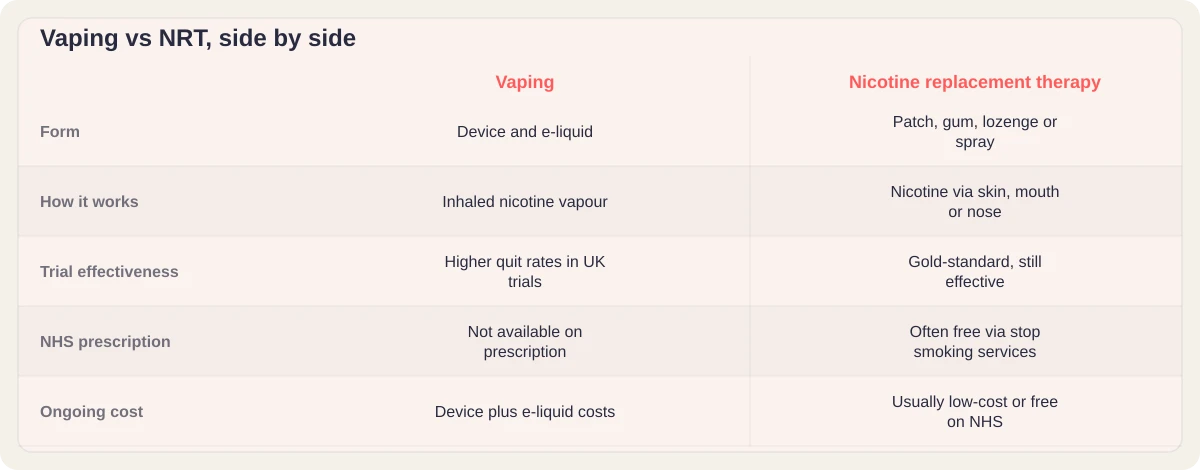
In practice, people who find the hand-to-mouth habit and the inhale of smoking hard to let go of often get on better with vaping, since it replicates more of that physical routine. Those who'd rather avoid taking up a new device and nicotine habit altogether, or who want free, structured support through a local service, tend to do well with combination NRT instead.
Pregnancy, certain heart conditions, recent heart attack or stroke, and existing respiratory disease such as asthma or COPD are among the factors a clinician will want to know about before recommending either option, since they can affect which product, dose and combination is most suitable for you specifically rather than in general.
Getting support to quit
Whichever product you lean towards, the evidence is consistent on one point that's easy to overlook: combining any stop smoking aid, whether that's NRT, vaping or a prescription tablet, with behavioural support roughly doubles your chances of quitting successfully compared with a product or willpower alone. That support can be as simple as a short pharmacist consultation, a local stop smoking service appointment, or a structured telephone or app-based programme.
A short consultation can help match the right combination of NRT, vaping advice or a prescription option to your smoking history, how many previous quit attempts you've made and what happened with them, and any underlying health conditions, rather than guessing which approach suits you and finding out the hard way that it doesn't.
Frequently asked questions
Is vaping definitely more effective than NRT?
UK trial evidence and a Cochrane review point to nicotine vaping helping more smokers quit than standard single-product NRT, but outcomes vary between individuals and depend on using the product correctly and consistently. Both are far more effective than trying to quit unaided.
Can I use vaping and NRT together?
Some people use a vape alongside NRT, particularly in the first weeks after stopping cigarettes, though there's less formal trial evidence for this specific combination than for combining different NRT products with each other. A pharmacist or stop smoking advisor can talk through whether this makes sense for your situation.
Is vaping safer than smoking?
Current evidence indicates vaping carries substantially less risk than smoking cigarettes, since it avoids the combustion of tobacco and many of the harmful chemicals this produces. It isn't risk-free, long-term data is still developing, and vaping isn't recommended for people who have never smoked.
How long should I use NRT for?
Most courses run for around 8 to 12 weeks, with the dose gradually tapered down as cravings ease. Stopping too early is a common reason cravings return, so it's worth completing the full course agreed with your pharmacist or clinician rather than stopping as soon as you feel better.
Can pregnant women use NRT or vaping to quit smoking?
Stopping smoking is strongly recommended in pregnancy because of the risks to both mother and baby, and NRT can be used under guidance from a midwife, GP or pharmacist, who will advise on the most suitable product and dose. Vaping should only be considered after discussing the options with a healthcare professional.