
Warts on feet: verruca treatment options that work
 Reviewed by the My London Pharmacy clinical team · Clinically checked by Zeenah Araim, GPhC 2077620
·26 October 2026
·7 min read
·Reviews on Trustpilot
Quick answer
A verruca is a wart caused by a virus, usually picked up in warm, wet places like pools or changing rooms. Many clear on their own over time. Over-the-counter salicylic acid treatments, used daily for several weeks, are the usual first step. See a pharmacist if it is painful, spreading or you have diabetes.
What is a verruca?
A verruca, also called a plantar wart, is a small, rough growth that appears on the sole of the foot or around the toes. It is caused by the human papillomavirus (HPV), the same family of viruses behind warts elsewhere on the body, though a different strain is usually responsible for verrucas specifically. The virus infects the top layer of skin and causes it to grow more quickly than usual, producing the thickened, slightly raised patch that is typical of a verruca.
Verrucas often have a rough, cauliflower-like surface, though constant pressure from walking can flatten them and push them inward, which sometimes gives them a harder, more callus-like appearance. A ring of small black dots is common in the centre; these are tiny blood vessels supplying the growth, not dirt, and seeing them is a useful way to tell a verruca apart from a corn or callus.
They can appear singly or in small clusters, and some people develop a 'mosaic' verruca, where several small growths merge into one larger patch. They are not usually painful, but a verruca on a weight-bearing part of the foot can feel like standing on a small stone, especially if it grows inward under pressure.
Are verrucas contagious?
Yes. The virus that causes verrucas spreads through direct skin contact or, more often, by contact with a contaminated surface. Warm, wet environments such as swimming pool surrounds, communal showers, gym changing rooms and shared sports mats are common places to pick one up, because the virus survives well on damp surfaces and bare feet are more likely to pick up small breaks in the skin that let it in.
Verrucas can also spread from one part of the same person's foot to another, particularly if the area is picked at, scratched or shaved over, which can carry infected skin cells to a new spot. Sharing towels, socks or shoes with someone who has a verruca is another route, though this is a less common way for it to pass between people than contact with contaminated floors.
Not everyone who is exposed to the virus develops a verruca; skin that is already slightly damaged, for example from being constantly wet or from minor cuts and cracks, seems to pick up an infection more easily. Children and teenagers tend to get verrucas more often than adults, possibly because their immune systems have not yet built up resistance to this particular strain of HPV.

How long do verrucas last?
Many verrucas clear up on their own without any treatment, as the immune system gradually recognises and clears the virus. However, this can be slow: an untreated verruca may resolve within months, but it can also persist for a year or more, and some last considerably longer, particularly in adults. There is no reliable way to predict how long any individual verruca will take to clear naturally.
Because of this unpredictable timeline, most people who find a verruca uncomfortable, embarrassed by it, or who simply want it gone sooner choose to treat it rather than wait. Treatment does not guarantee a faster result for everyone, but it gives the immune system some help and is a reasonable first step for most otherwise healthy adults and children.
Verrucas that have been present for a long time, that keep coming back in the same spot, or that are unusually large are more likely to need a longer course of treatment, or input from a pharmacist or GP, than a verruca that has only just appeared.
Verruca treatment options that work
Salicylic acid is the main over-the-counter treatment for verrucas and is widely recommended as a sensible first step. It works by gradually softening and breaking down the thickened, infected skin, layer by layer, so the body can shed it. It is sold as a paint, gel or medicated plaster from most pharmacies, usually under brand names rather than listed by the plain chemical name on the shelf, so it is worth asking a pharmacist to point you to a suitable product.
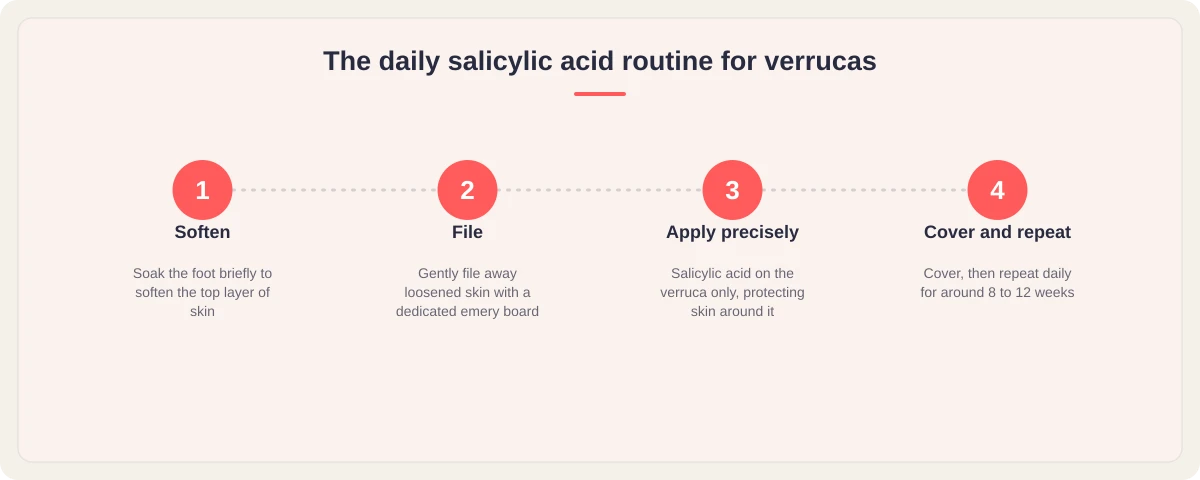
Consistency matters more than any single application. The usual approach is a daily routine, kept up for around 8 to 12 weeks, sometimes longer. A typical routine looks like this: soak the foot briefly to soften the skin, gently file away the loosened top layer with an emery board kept only for this purpose, apply the salicylic acid precisely to the verruca while protecting the surrounding healthy skin, for example with a small piece of tape or plaster, then cover and repeat the next day.
Skipping days, stopping too early, or applying the treatment inconsistently is the most common reason it appears not to work. If there is no improvement after around three months of regular use, it is worth having it looked at rather than continuing indefinitely with the same approach.
When home treatment is not enough
If salicylic acid has not helped after a full course, or a verruca is large, painful or keeps spreading, a pharmacist or GP can discuss other options. Cryotherapy, freezing the verruca with liquid nitrogen, is a common next step and is available at some pharmacies and GP surgeries, though it usually needs several sessions a few weeks apart rather than a single visit.
Other approaches a clinician might discuss include stronger prescription-strength treatments for stubborn cases, or, occasionally, referral to a podiatrist for verrucas that are particularly painful or affecting someone's ability to walk comfortably. Results vary from person to person, and some verrucas simply take longer to respond than others, regardless of which method is used.
People with diabetes, poor circulation, or a weakened immune system should check with a pharmacist or GP before starting any home treatment, since reduced sensation or slower healing can make self-treatment of the skin on the feet riskier for this group.
Preventing a verruca from spreading
A few simple habits lower the chance of a verruca spreading to someone else, or to another part of your own foot. Wearing waterproof flip-flops or verruca socks around swimming pools, communal showers and changing rooms is one of the most effective steps, since it blocks the direct contact with contaminated surfaces that lets the virus pass on.
Covering the verruca with a waterproof plaster when swimming, and keeping it covered generally if you are around other people barefoot, reduces the risk to others. Avoid sharing towels, socks, shoes or nail files with other people while you have an active verruca, and try not to pick, scratch or shave over it, since broken skin both spreads the virus more easily and gives it an easier route back in.
Keeping feet clean and dry, and changing socks daily, also helps, since the virus favours warm, damp conditions. None of these steps guarantee a verruca will not spread, but together they meaningfully reduce the risk.
When to see a pharmacist or GP
Most verrucas are harmless and can be managed with patience and a consistent over-the-counter routine. It is worth getting a verruca checked rather than treating it at home if it is very painful, bleeding, rapidly growing, changing in colour or appearance, or if you are unsure whether it is actually a verruca rather than a corn, callus or something else that needs a different approach.
People with diabetes, poor circulation, or a weakened immune system should speak to a pharmacist or GP before trying salicylic acid or any other home treatment on the feet, as these conditions can affect how skin on the feet heals and how safely it can be treated at home. The same applies if a verruca appears during pregnancy, since some treatments are not suitable at this time.
A pharmacist can confirm what you are dealing with, recommend a suitable product, and advise on timescales, or refer you on if a verruca needs further assessment.
Frequently asked questions
How long do verrucas take to clear with treatment?
With daily use of salicylic acid, most people see improvement within 8 to 12 weeks, though some verrucas take longer. Left untreated, a verruca can take months, and sometimes a year or more, to clear on its own.
Are verrucas contagious?
Yes. The virus spreads through direct contact or, more commonly, by contact with contaminated surfaces such as pool surrounds, communal showers and changing room floors. Covering the verruca and wearing waterproof footwear in these areas reduces the risk of passing it on.
Does salicylic acid actually work for verrucas?
It can, but it needs to be used consistently, usually daily for 8 to 12 weeks, to have the best chance of working. Skipping days or stopping early is the most common reason it appears not to help.
Can I go swimming if I have a verruca?
Yes, but it is best to cover it with a waterproof plaster or wear a verruca sock to reduce the chance of passing the virus on to others through the pool surrounds or changing areas.
Should I try to cut or pick a verruca off myself?
No. Cutting, picking or shaving over a verruca can spread the virus to other areas of the foot, introduce infection, and increase the risk of scarring. Stick to a proper over-the-counter treatment or see a pharmacist instead.