Weight management treatment eligibility: what BMI and health criteria mean
Quick answer
Eligibility for weight management treatment is usually based on a BMI of 30 or above, or 27 or above alongside a weight-related health condition such as high blood pressure or type 2 diabetes. Lower thresholds can apply for some ethnic groups. A clinician reviews your BMI alongside your wider health history before deciding whether treatment is suitable for you.
What eligibility for weight management treatment means
Weight management treatment is only prescribed to people who meet set clinical criteria, not to anyone who asks for it. This is a safety requirement rather than a formality: the medicines involved carry risks and side effects, and they are licensed for use within specific BMI and health thresholds set by the National Institute for Health and Care Excellence (NICE) and the medicines regulator.
A reputable UK pharmacy or online clinic will always check eligibility through a health questionnaire, and often a consultation, before any prescription is considered. If you don't meet the criteria, a responsible service will say so rather than proceeding anyway, and may point you towards other options, including NHS weight management support.
Understanding the criteria in advance can also save time and reduce disappointment. Knowing roughly where you stand before you start an assessment means you can go in with realistic expectations, and ask more focused questions during your consultation about the specific factors that apply to you.
The BMI thresholds most services use
Body mass index (BMI) is calculated from your height and weight. The standard NHS bands for adults are: under 18.5 is underweight, 18.5 to 24.9 is a healthy weight, 25 to 29.9 is overweight, and 30 or above is within the obese range.
For prescription weight management treatment, most UK services follow NICE-aligned criteria: a BMI of 30 or above on its own, or a BMI of 27 or above alongside a weight-related health condition such as type 2 diabetes, high blood pressure, high cholesterol, or obstructive sleep apnoea. These thresholds exist because the balance of benefit and risk shifts once weight is affecting, or starting to affect, your health, not simply because of how a person looks.
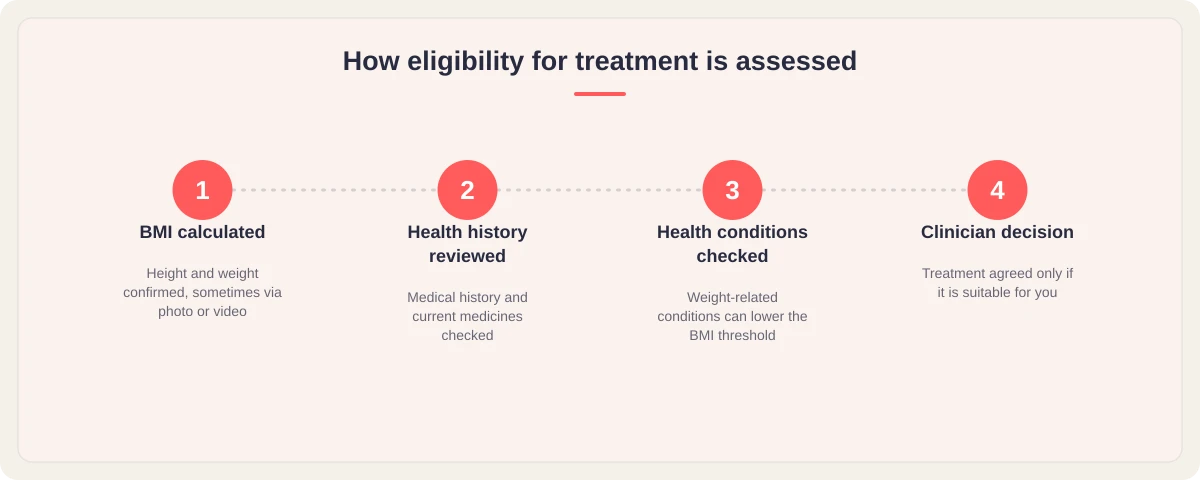
Meeting the BMI threshold is a starting point, not an automatic approval. A clinician still needs to confirm the figure is accurate and consider it alongside the rest of your health picture before agreeing that treatment is appropriate. If your height and weight were measured some time ago, you may be asked to provide a more recent figure, since even a small change can move you across a threshold.
Health conditions and other factors that matter
Alongside BMI, a clinician will ask about conditions that are commonly linked to excess weight, including type 2 diabetes, high blood pressure, high cholesterol, obstructive sleep apnoea, and joint problems made worse by weight. Having one of these can bring your eligibility threshold down from a BMI of 30 to 27, because the health benefit of losing weight is considered greater when a related condition is already present.
Certain factors can also rule treatment out, at least for now. These typically include pregnancy, breastfeeding, actively trying to conceive, a history of certain eating disorders, some thyroid or digestive conditions, and being under 18. Current medicines are reviewed too, since some can interact with weight management treatment or affect which option is suitable.
Not every licensed option uses the same cut-off. Orlistat (Xenical Capsules), for example, is usually available from a BMI of 28 with a weight-related risk factor, or 30 on its own, which is a slightly lower bar than some other treatments. This is one reason the right starting point can differ from person to person rather than there being one single rule for everyone. A clinician can talk through which licensed options you may be eligible for, and why, rather than you having to work it out from general guidance alone.
Why BMI thresholds can differ by ethnicity
NICE guidance recognises that the health risks linked to excess weight can appear at a lower BMI for people of South Asian, Chinese, Black African, and African-Caribbean backgrounds. For this reason, many services apply an adjusted threshold, often treating a BMI of around 27.5 as the equivalent of the standard overweight cut-off for assessing weight-related risk in these groups.
In practice, this means two people with the same BMI number can be assessed against slightly different thresholds depending on this guidance, because the aim is to judge risk consistently rather than to apply a single figure regardless of context. A clinician will take your ethnicity into account as part of this wider assessment, alongside your health history and any existing conditions.
This approach reflects wider evidence that health risks linked to weight can build at different BMI levels across different population groups, rather than following one universal pattern. Mentioning your ethnic background during a consultation, if you are asked, helps ensure the threshold applied to you reflects current guidance rather than a generic figure.
What happens during an eligibility assessment
Most UK services start with an online health questionnaire covering your height, weight, medical history, current medicines, and any relevant family history. Some ask you to confirm your measurements with a photograph, a video consultation, or figures from a recent GP or practice nurse appointment, rather than relying on self-report alone.
A clinician then reviews this information before any decision is made. For some treatments, baseline blood tests may be requested first, to check things like blood sugar, cholesterol, or liver and kidney function, particularly if you have an existing health condition. If everything checks out, a plan can be agreed; if not, the clinician will explain why, and what might need to change before reapplying, or suggest other routes such as NHS weight management services.
How long this takes varies. A straightforward case with no complicating health conditions may be assessed quickly, while a more complex medical history, or a need for blood test results first, can mean the process takes a little longer. This is a normal part of making sure the decision is the right one for you, not an unnecessary delay.
What BMI does and doesn't tell you
BMI is a useful starting point because it is quick to calculate and strongly linked to health risk across large populations, but it has real limits for an individual. It does not distinguish between fat and muscle, so it can overestimate risk in someone who is very muscular, and it can be less reliable in older adults or people with certain body shapes. Where muscle mass is a factor, or there's uncertainty, a clinician may also look at waist circumference, which gives extra information about where fat is carried.
Because of this, BMI is treated as one part of the picture rather than the whole story. Two people with an identical BMI can have quite different health risks, which is why a clinician's overall assessment, not the number alone, decides whether treatment is suitable and which option fits your situation. If you have concerns that your BMI doesn't reflect your actual health, for example because of a very muscular build, it is worth raising this directly during your consultation so it can be factored in.
Getting started safely
If you're considering weight management treatment, a sensible first step is an honest look at your current height, weight, and any health conditions you have, so you have a realistic sense of where you stand before you begin an assessment. Being asked further questions, or being asked to provide blood test results, is a normal part of a safe process rather than a sign that something has gone wrong.
If you don't meet the criteria for prescription treatment right now, that doesn't mean nothing can help. Lifestyle support, your GP, and NHS weight management services remain available, and eligibility can also change over time as your health picture does. My London Pharmacy's clinicians can talk through where you currently stand, what the assessment involves, and whether a consultation is the right next step for you.
Frequently asked questions
What BMI do I need to qualify for weight management treatment?
Most UK services require a BMI of 30 or above, or 27 or above with a weight-related health condition such as type 2 diabetes or high blood pressure. Some licensed options, including orlistat, use slightly different thresholds.
Can I still get treatment if my BMI is below 30?
Possibly. A BMI of 27 or above can be enough if you also have a weight-related health condition. A clinician will review your individual health history to confirm whether you meet the criteria.
Does my ethnic background affect my BMI threshold?
It can. NICE guidance recognises that weight-related health risks can appear at a lower BMI for some ethnic groups, so an adjusted threshold, often around 27.5, may be used when assessing eligibility.
What other health information is checked besides BMI?
Clinicians review your medical history, current medicines, and conditions linked to weight such as high blood pressure, high cholesterol, and sleep apnoea. Factors like pregnancy or certain eating disorders can affect eligibility too.
Will I need blood tests before starting treatment?
Sometimes. Baseline blood tests, such as blood sugar or cholesterol, may be requested for certain treatments or if you have an existing health condition, so your clinician can confirm the option chosen is appropriate.
What happens if I'm not eligible right now?
A clinician will explain why, and what might need to change before you could reapply. NHS weight management services and GP support remain available, and eligibility can change over time.