
What happens when you stop weight-management treatment?
Quick answer
For most people, appetite starts returning within about a week of stopping weight-management treatment, with weight coming back gradually over the following months. Research suggests many people regain a substantial share of what they lost within a year without ongoing support, and cardiometabolic improvements can ease too. A UK-registered clinician can help plan your next step.
Why appetite tends to return
Weight-management treatment usually works by changing the hormone signals that control hunger and fullness, helping you feel satisfied on smaller amounts of food and reducing the urge to snack between meals. Those effects come from the medicine being active in your system, not from a lasting change to how your body regulates appetite.
When you stop, the medicine gradually clears from your body and those hormone signals return to their usual pattern. Many people notice hunger picking up within around a week, and for some it's one of the first signs that the treatment has stopped working. This isn't a sign that anything has gone wrong; it's simply the expected effect of the medicine no longer being present.
How noticeable this feels varies. Some people find their appetite settles close to where it was before starting treatment, while others notice it more sharply, particularly if they stopped suddenly rather than as part of a planned, clinician-guided reduction.
It can also feel different psychologically to how it felt physically before treatment. Many people describe a renewed awareness of hunger cues after months of them being quieter, and getting used to noticing and managing that again can take a little time, even where the physical hunger itself isn't especially strong.
How much weight do people typically regain?
A 2025 analysis in The BMJ, pooling data from 37 studies and more than 9,300 people, found that stopping weight-management medicines was consistently followed by weight regain. On average, people regained around 0.4kg a month after stopping, with weight projected to return close to their starting point after roughly 1.7 years.
The pattern was faster for the newer class of appetite-reducing medicines specifically, at an average of around 0.8kg a month, with an estimated return to baseline weight within about 1.5 years. Other research, including work from the University of Cambridge, has found that some people keep off a meaningful proportion of the weight they lost, even a year or more after stopping, so the picture isn't the same for everyone.
The same analysis found that regain after stopping medicine was, on average, faster than regain seen after people finished structured behavioural weight-loss programmes that didn't involve medicine, even after accounting for how much weight had been lost in the first place. That doesn't mean medicine-assisted weight loss is less durable overall; rather, it suggests the habits and support that run alongside treatment matter as much as the treatment itself once it stops.
What's consistent across the evidence is the direction of travel: regain is common, it tends to be gradual rather than sudden, and it happens faster the sooner ongoing lifestyle support falls away.
A realistic timeline after stopping
Every person's experience is different, but research on stopping weight-management treatment points to a broadly consistent pattern over time.
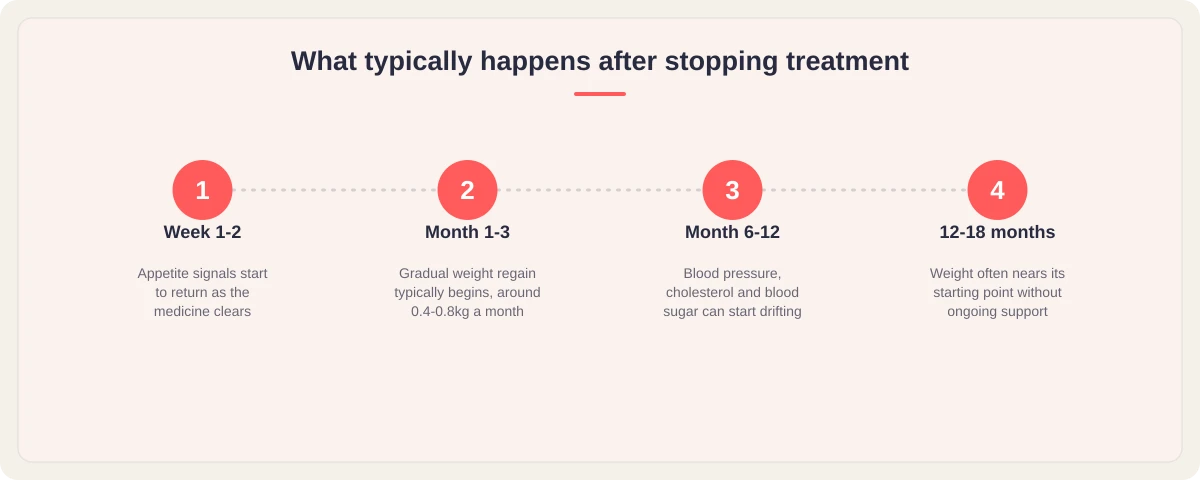
This timeline is an average drawn from population-level research, not a prediction for any individual. Your own pattern will depend on how long you were on treatment, your starting weight, and whether you keep up the diet and activity habits built during treatment.
What happens to blood pressure, cholesterol and blood sugar
Weight-management treatment often brings improvements beyond the number on the scale, including better blood pressure, cholesterol, triglycerides and blood sugar control (measured by HbA1c). The same BMJ analysis found that these cardiometabolic markers tend to drift back toward pre-treatment levels within around 1.4 years of stopping, broadly tracking the pace of weight regain.
This matters because it's often these underlying markers, rather than weight itself, that drive long-term health risks such as heart disease and type 2 diabetes. It's one of the reasons a UK-registered clinician will usually want to keep monitoring your blood pressure and relevant blood tests for a period after you stop treatment, rather than considering the process finished the moment the last dose is taken.
Ways to reduce how much weight comes back
NICE guidance is clear that long-term lifestyle changes, alongside weight-management medicines rather than instead of them, are what help people manage their weight after stopping. Medicines create a window in which change is easier; what happens in that window tends to shape what happens afterwards.
- Keeping a diet that's higher in protein and fibre, which supports fullness even without the medicine's effect
- Maintaining regular physical activity, including some strength training to help protect muscle mass alongside any weight change
- Staying engaged with structured support, such as a dietitian or a weight-management programme, rather than stopping all contact at the same time as the medicine
- Planning the stop with your clinician, including whether a gradual dose reduction rather than an abrupt stop is appropriate for you
- Continuing regular weigh-ins or check-ins in the first few months, so any regain is noticed early rather than only once it's already substantial
None of this guarantees that weight will stay exactly where it was. But the evidence consistently shows that regain tends to be slower and smaller when these habits carry on after treatment stops.
Is it different for other weight-management treatments, such as orlistat?
Not every weight-management medicine works on appetite hormones. Orlistat, for example, works in the gut by reducing how much fat from food is absorbed, rather than by changing hunger signals. Because of this, stopping orlistat doesn't tend to bring the same rapid rebound in appetite that some people describe with appetite-reducing medicines.
That said, the underlying principle is the same: once any weight-management treatment stops, your weight is shaped again by the balance between what you eat and how active you are, without the extra support the medicine was providing. Whatever treatment you've been using, the habits you've built during it are usually the biggest factor in what happens next.
When restarting or continuing treatment might be considered
For some people, particularly those whose weight-related health risks are significant, a clinician may discuss continuing treatment for longer, or restarting it if regain affects health markers like blood pressure or blood sugar. This is an individual decision, weighed against your overall health picture, not something to decide alone.
If you're thinking about stopping, or you've already stopped and are noticing changes, the most useful step is an honest conversation with your clinical team. They can review your bloods, talk through what a realistic plan looks like for you, and help you decide whether continuing, adjusting, or stopping treatment altogether fits your circumstances.
Frequently asked questions
How quickly does weight come back after stopping weight-management treatment?
Appetite often starts returning within about a week, but meaningful weight regain tends to build gradually over the following months rather than happening all at once.
How much weight will I regain after stopping?
Research suggests average regain of around 0.4 to 0.8kg a month, with weight often returning close to its starting point within one to two years, though this varies a lot between individuals.
Can I avoid regaining weight after stopping treatment?
You can't guarantee it, but keeping up diet, activity and check-in habits built during treatment is consistently linked to slower, smaller regain than stopping everything at once.
Is it safe to stop weight-management treatment suddenly?
It's not usually dangerous, but a planned, clinician-guided stop, sometimes with a gradual dose reduction, tends to suit people better than stopping without any discussion.
Will my blood pressure and cholesterol get worse again after stopping?
Cardiometabolic improvements gained during treatment can ease back toward pre-treatment levels over a similar timeframe to weight regain, which is why ongoing monitoring after stopping is worthwhile.