
Altitude sickness tablets: what acetazolamide does and who may need it
 Reviewed by the My London Pharmacy clinical team
·28 October 2026
·7 min read
·Reviews on Trustpilot
Quick answer
Altitude sickness tablets usually mean acetazolamide (Diamox), a prescription medicine that can lower the risk of acute mountain sickness when you ascend quickly. It works alongside a gradual ascent, not instead of one. A clinician can advise whether it suits you, the dose to use, and how to plan a safer trip.
What altitude sickness is, and why it happens
Altitude sickness, also called acute mountain sickness (AMS), happens when you climb or fly to a height where the air contains less oxygen than your body is used to. It typically starts above around 2,500 metres, though some people notice symptoms lower than that. The problem is not the altitude itself, it is the speed of the ascent: your body needs time to adjust its breathing rate, heart rate and red blood cell production, and if you climb faster than it can adapt, symptoms follow.
AMS is common on treks and climbs in places such as the Andes, the Himalayas, Kilimanjaro and parts of East Africa, and it can affect fit, healthy people just as easily as anyone else. Fitness does not protect you from it; acclimatisation does. A strong hill walker who flies straight into a high-altitude city, or ascends too many metres in a single day, can still develop AMS, while a slower, more cautious traveller who builds in rest days may avoid it altogether.
Other factors that influence your personal risk include how quickly you ascend, the final altitude you reach, how much time you spend sleeping at height rather than just visiting during the day, and whether you have had AMS before, which makes you more likely to get it again on a future trip.
Recognising the symptoms
Mild AMS usually feels like a hangover: a headache that does not ease with simple painkillers, nausea, tiredness, dizziness and poor sleep. Symptoms generally appear within a few hours of reaching a new altitude and often ease once your body has had a day or two to adjust. Some people also notice a loss of appetite, mild breathlessness on exertion, or swelling of the hands, feet or face, which is usually harmless on its own but worth mentioning to a travel companion.
Severe altitude illness is rarer but serious. High altitude cerebral oedema (HACE) causes confusion, severe headache and an unsteady, stumbling walk, sometimes described as looking drunk. High altitude pulmonary oedema (HAPE) causes breathlessness at rest, a persistent cough, sometimes with frothy or blood-tinged sputum, and extreme fatigue. Both are medical emergencies that need immediate descent and urgent medical help, not tablets. A simple rule used by many trekking guides is that if someone with AMS cannot walk a straight line, or is confused about where they are, they need to descend without delay.
How acetazolamide works
Acetazolamide, sold under the brand name Diamox, is a prescription-only medicine licensed in the UK to help prevent acute mountain sickness. It belongs to a group of medicines called carbonic anhydrase inhibitors, and it works by changing the balance of acid and bicarbonate in your blood in a way that encourages you to breathe slightly faster and deeper. This speeds up the natural acclimatisation process your body would otherwise go through more slowly on its own.
It is important to understand what acetazolamide does not do: it does not treat altitude sickness once severe symptoms have set in, and it is not a substitute for sensible ascent planning. It reduces the risk of mild AMS and can make the first day or two at altitude more comfortable, but descent is still the main treatment if symptoms become severe.
Who might benefit from it
Acetazolamide is usually considered for travellers who are ascending quickly, such as flying directly into a high-altitude city, joining a short trek with limited acclimatisation days, or who have had AMS on a previous trip. It may also suit people climbing routes where a gradual ascent is not practical, for example a fixed itinerary on a guided trek where the daily altitude gain is set in advance.
It is not automatically needed for everyone travelling to altitude. Many people acclimatise well with a sensible itinerary, built-in rest days and a slow ascent rate, and never need it. Others prefer to carry it as a precaution even on a well-planned trip, particularly if their schedule leaves little flexibility to slow down or wait out symptoms. A clinician will ask about your planned route, ascent speed, past experience of altitude and your general health before deciding whether it is appropriate for you, and whether a lower, more cautious dose might suit you better than the standard one.
Typical use and possible side effects
When it is prescribed for prevention, acetazolamide is usually started a day or two before ascending and continued for a few days at the new altitude, with the exact dose and timing set by your prescriber based on your trip and health history. It should never be adjusted or shared without medical advice.
Side effects are usually mild and settle on their own. The most common are tingling or pins and needles in the fingers, toes or lips, needing to wee more often, and a change in taste, where fizzy drinks can taste flat. Less commonly it can cause drowsiness or an upset stomach. Acetazolamide is related to sulfonamide medicines, so it is not suitable for anyone with a sulfonamide allergy, and it needs careful review if you have kidney or liver disease, are pregnant, or take certain other medicines.
Mild symptoms vs a medical emergency
Knowing the difference between symptoms you can manage yourself and symptoms that need immediate descent can be life-saving at altitude. The comparison below sets out the main differences.
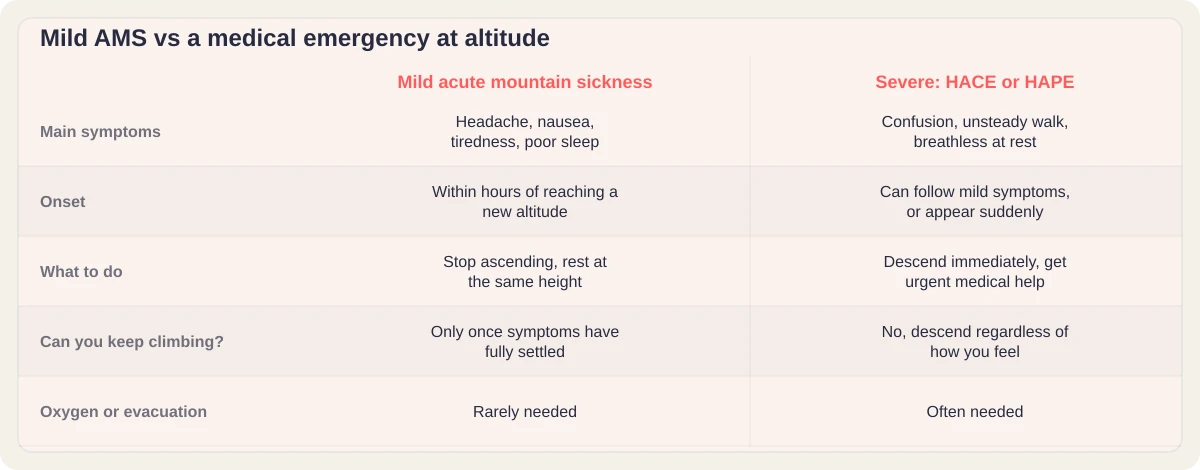
If you are ever unsure which category your symptoms fall into, treat it as the more serious one. Stop ascending, tell the people you are travelling with, and get help. It is always safer to lose a day of your trip than to keep climbing with symptoms that are getting worse.
Other ways to reduce your risk
Tablets are only one part of staying well at altitude. The most effective prevention is still a gradual ascent, following the old mountaineering rule of climbing high but sleeping low where possible, and building in rest days to acclimatise, particularly above 3,000 metres.
Alongside this, drink plenty of water, avoid alcohol for the first day or two at a new altitude, eat enough even if your appetite drops, and avoid sleeping pills early on, as they can mask symptoms or affect your breathing overnight. If you have a long-term health condition, or are travelling with children or during pregnancy, it is worth discussing your trip with a clinician well before you go.
Getting advice before you travel
Because acetazolamide is prescription-only in the UK and is best started before you ascend, it is worth seeking advice several weeks ahead of your trip rather than the day before you fly. This gives time to review your medical history, discuss your itinerary and agree whether it is the right choice for you, and to arrange any other travel health needs, such as vaccinations or antimalarial tablets, at the same time.
A short consultation can cover your route, your planned ascent rate, your past experience of altitude, any medicines you already take, and practical acclimatisation advice for your specific trip, so you travel with a clear plan rather than guesswork. Bring details of your itinerary, including the altitudes you expect to sleep at each night, as this is often more useful to a clinician than the highest point you will reach during the day.
Frequently asked questions
Do I need a prescription for altitude sickness tablets in the UK?
Yes. Acetazolamide (Diamox) is a prescription-only medicine in the UK. It can be arranged through a GP or a private clinician consultation before you travel, who will check it is suitable for you first.
Can I start acetazolamide once I already feel unwell?
It is mainly used to help prevent symptoms, so it works best when started before or as you ascend. If you already have symptoms that are worsening, the priority is to stop ascending or descend, and to get medical advice rather than relying on tablets alone.
What are the main side effects of acetazolamide?
The most common side effects are tingling in the fingers, toes or lips, needing to wee more often, and fizzy drinks tasting flat. These are usually mild and settle as your body adjusts. Less common effects include drowsiness or an upset stomach.
Who should not take acetazolamide?
It is not suitable for people with a sulfonamide allergy, and it needs careful review if you have kidney or liver disease, are pregnant, or take certain other medicines. A clinician will check your health history before prescribing it.
Does acetazolamide stop altitude sickness completely?
No. It reduces the risk and severity of mild acute mountain sickness, but it does not guarantee you will avoid it, and it is not a treatment for severe altitude illness. A gradual ascent remains the most important prevention measure.
How soon before travelling should I get advice?
Ideally several weeks ahead. This allows time to review your health history, discuss your route and ascent speed, and agree the right dose and timing for your trip, rather than arranging it at the last minute.