
Discoid eczema: symptoms, triggers and treatment
 Reviewed by the My London Pharmacy clinical team · Clinically checked by Zeenah Araim, GPhC 2077620
·29 October 2026
·6 min read
·Reviews on Trustpilot
Quick answer
Discoid eczema (also called nummular eczema) causes distinct coin-shaped, itchy, dry or weepy patches, most often on the arms and legs. It is not contagious and is not the same as ringworm. Treatment usually combines regular emollients with a topical steroid during flares, plus avoiding known triggers such as very dry skin or skin injury.
What is discoid eczema?
Discoid eczema, also known as nummular eczema or nummular dermatitis, is a type of eczema that shows up as distinct, coin-shaped patches rather than the more widespread, ill-defined redness seen in atopic eczema. "Discoid" simply refers to the round or oval shape of the patches, which can range from the size of a small coin to several centimetres across.
It can appear at any age but is seen more often in adults, and tends to affect the arms, legs and trunk rather than the face. Patches usually start as small, intensely itchy, red or pink spots that merge into a larger rounded area. The skin within a patch is often dry and scaly, though some patches become wet, weepy and crusted, particularly if scratched or if the skin becomes infected.
Discoid eczema is not contagious. You cannot catch it from someone else or pass it on, and it is unrelated to hygiene. It can, however, be a long-term, relapsing condition, with patches clearing and then reappearing, sometimes in the same places, sometimes elsewhere on the body.
Symptoms to look out for
The patches are usually the first thing people notice: well-defined, round or oval areas that stand out clearly from the surrounding skin. Within a patch, the skin is commonly:
- Red, pink or darker than the surrounding skin, depending on skin tone
- Intensely itchy, sometimes described as the most troublesome symptom
- Dry, scaly and rough to the touch in the early or settled stage
- Weepy, wet or crusted in the acute stage, especially if infected
- Thickened over time if a patch is scratched repeatedly
Patches most often appear on the lower legs, forearms and hands, though the trunk can also be affected. A single patch or several patches can appear at once, and new ones can develop while older ones are settling. Once a patch clears, it can leave the skin temporarily darker or lighter than usual; this discolouration usually fades over weeks to months and is not scarring.

Discoid eczema vs ringworm: telling them apart
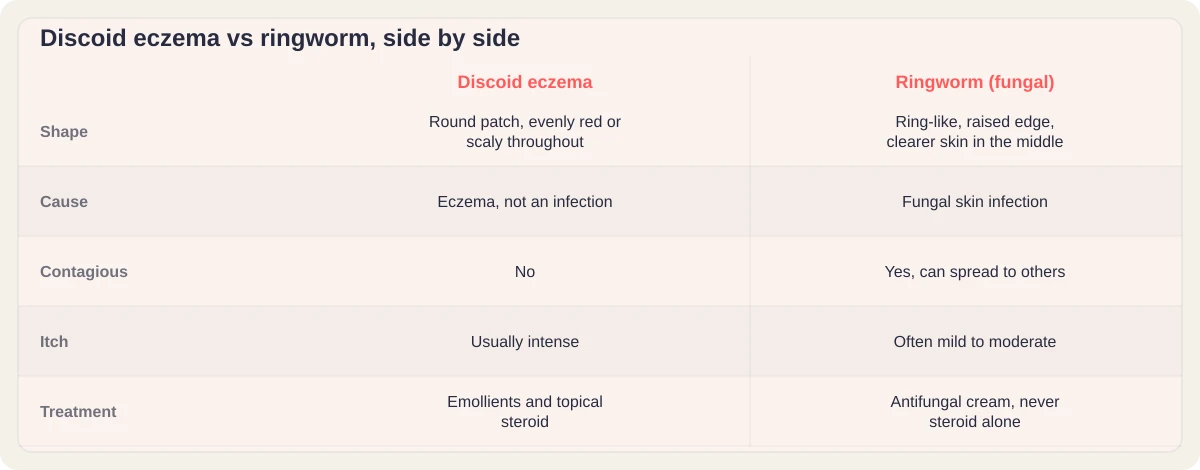
Because both conditions cause round patches on the skin, discoid eczema is often confused with ringworm (tinea), a fungal skin infection. They are not related and need different treatment, so getting the distinction right matters.
Ringworm typically has a more defined, slightly raised, scaly border with clearer skin in the middle, giving it a ring-like appearance, which is where the name comes from. It tends to spread outwards slowly and can be passed on through close contact or shared items such as towels. Discoid eczema patches are usually more uniformly red or scaly across the whole patch, without that distinct central clearing, and they are not infectious.
Using a steroid cream on ringworm by mistake can make a fungal infection worse and allow it to spread further, while an antifungal cream will not treat eczema. If a patch is not responding to treatment as expected, or you are unsure which one you are dealing with, a pharmacist or GP can usually tell the two apart on examination, and may take a skin scraping to confirm a fungal infection if there is doubt.
What triggers discoid eczema?
The exact cause of discoid eczema is not fully understood, but several factors are recognised as common triggers or aggravating factors:
- Very dry skin, particularly in cold or low-humidity weather
- Skin injury, including insect bites, minor cuts, grazes or burns
- Irritants such as soap, detergents and some fabrics
- Skin infections, which can sometimes trigger a patch to develop at the site
- Poor circulation in the lower legs, which is why patches are common there
- Stress, which can worsen eczema generally, though it is not a direct cause
Some people notice a clear pattern, for example, patches appearing after a specific injury or during a particularly dry spell, while others cannot identify an obvious trigger at all. Keeping a simple note of when patches appear and what preceded them can help you and a clinician spot patterns worth avoiding.
Treatment options
Discoid eczema is managed in much the same way as other forms of eczema, with an emphasis on protecting and repairing the skin barrier alongside calming inflammation during flares.
Emollients (moisturisers) are the foundation of treatment, used generously and often, including on skin that currently looks clear, to reduce dryness and the likelihood of new patches. Ointment-based emollients are often more effective for discoid eczema than lighter lotions, because the skin tends to be particularly dry.
Topical corticosteroids, such as hydrocortisone 1% for milder patches or a stronger steroid such as Eumovate Cream & Ointment for more stubborn areas, are used to settle inflammation and itching during a flare. They are typically applied for a limited course rather than continuously, and a clinician will advise on strength and duration based on how the skin responds.
Antihistamines can help with sleep disruption caused by itching, though they do not treat the eczema itself. If a patch becomes infected, which shows as increasing pain, spreading redness, pus or a fever, a combined steroid and antibiotic cream such as Betamethasone with Neomycin Cream may be prescribed, or oral antibiotics if the infection is more extensive.
For patches that are widespread or not responding to standard treatment, a GP or dermatologist may consider phototherapy or other specialist options.
Self-care and preventing flare-ups
Alongside prescribed treatment, everyday habits can reduce how often patches appear and how severe they become:
- Use a soap substitute instead of regular soap or shower gel, which can strip the skin's natural oils
- Keep baths and showers short and lukewarm rather than hot
- Pat skin dry gently rather than rubbing, and apply emollient while skin is still slightly damp
- Avoid scratching where possible, keep nails short, and consider light cotton gloves at night if scratching in sleep is a problem
- Choose loose-fitting clothing in natural fibres over synthetic or wool fabrics that can irritate the skin
- Treat minor skin injuries promptly and keep the area moisturised while it heals
When to seek help
Most discoid eczema can be managed with emollients and, when needed, a topical steroid. Speak to a pharmacist or GP if:
- Patches are not improving after a couple of weeks of consistent treatment
- A patch looks infected: increasing redness, warmth, pain, pus or you feel generally unwell
- You are unsure whether a patch is eczema or a fungal infection such as ringworm
- Patches are widespread, very distressing, or affecting your sleep or daily life
- You need a stronger or longer course of steroid than you have been able to get over the counter
A clinician can confirm the diagnosis, rule out other causes, and set out a treatment plan matched to how your skin is responding.
Frequently asked questions
Is discoid eczema contagious?
No. Discoid eczema is not an infection and cannot be passed from person to person. It is sometimes mistaken for ringworm, which is contagious, but the two conditions are unrelated.
How long does a discoid eczema patch take to clear?
With consistent emollient use and a course of topical steroid when needed, patches often start improving within a couple of weeks, though some take longer. Discoid eczema can be a relapsing condition, so new patches can appear even after old ones clear.
Can discoid eczema be cured permanently?
There is no single cure, but most people manage it well long-term with regular moisturising and prompt treatment of flares. Many people find patches become less frequent once consistent skin care and trigger avoidance are in place.
What is the difference between discoid eczema and nummular eczema?
They are the same condition with two names. "Discoid" and "nummular" both describe the round, coin-shaped appearance of the patches; UK clinicians use the terms interchangeably.
Can adults develop discoid eczema for the first time?
Yes. Unlike atopic eczema, which often starts in childhood, discoid eczema commonly first appears in adulthood, including in people who have never had eczema before.
Does discoid eczema leave scars?
Discoid eczema itself does not usually scar. It can leave temporary darker or lighter patches of skin after it clears, which generally fade over several weeks to months, but scarring is more likely if a patch becomes infected or is scratched heavily.