Do testosterone boosters work? Supplements vs TRT, what the UK evidence shows
 Clinically reviewed by the My London Pharmacy clinical team
·13 November 2026
·7 min read
·Reviews on Trustpilot
Quick answer
Most over-the-counter testosterone boosters show little to no meaningful effect on testosterone levels in men who are not actually deficient, and UK-relevant trial evidence is weak for most ingredients. If your symptoms suggest genuinely low testosterone, a morning blood test and a clinical review, not a supplement, is the reliable way to find out and treat it.
What are testosterone boosters, exactly?
"Testosterone booster" is a marketing term, not a medical one. It covers a wide range of over-the-counter supplements sold in pharmacies, health shops and online, usually combining herbal extracts such as ashwagandha, fenugreek or tribulus terrestris with amino acids like D-aspartic acid, plus vitamins and minerals including zinc, magnesium and vitamin D.
None of these products contain testosterone itself. They are sold as food supplements, not medicines, which matters because it changes how they are regulated and what evidence they need before they can be sold.
Most men reach for one after noticing tiredness, a flatter mood, less interest in sex, or a gym routine that no longer seems to pay off the way it used to. Supplement marketing, particularly around fitness, often implies these changes are a testosterone problem that a tub of powder or a bottle of capsules can fix. In reality, the same symptoms have a long list of common, unrelated causes, which is exactly why the next section matters.
What does the evidence actually show?
The research picture is mixed and, for most ingredients, fairly weak. Zinc and vitamin D can genuinely support healthy testosterone production, but trials consistently show this only matters if you are deficient in that specific nutrient to begin with. Topping up a nutrient you already have enough of does not push your testosterone higher.
Ashwagandha has some small, short studies suggesting a possible effect on stress hormones and semen parameters, but evidence specifically showing a meaningful testosterone rise in men with normal levels remains limited and inconsistent. Fenugreek and tribulus terrestris have an even thinner evidence base, with trial results that vary a great deal between studies and often do not hold up when a result is checked against a placebo group properly.
A lot of this comes down to how the studies were run. Many trials in this space are small, last only a few weeks, and are funded by the company selling the supplement, which is worth bearing in mind when reading a confident claim on a product page. A short, small, industry-funded trial is a weaker form of evidence than the kind of large, independent study that supports a licensed medicine, and the difference between the two is part of why TRT and a supplement are treated so differently by clinicians.
Why the marketing promises more than the research supports
Supplement manufacturers are not required to prove a product works before it reaches a shelf, in the way a licensed medicine is. Many labels use vague wording like "supports testosterone" rather than "raises testosterone levels", which sounds similar but means something quite different and is far easier to justify.
"Proprietary blend" labelling is another common pattern. It lists the ingredients but not the individual doses, so there is no way to know whether a product contains enough of an active ingredient to match the amount used in the studies its marketing refers to.
Customer reviews and influencer endorsements add to the impression that a product works, but they carry none of the controls a clinical trial does. A man who feels more energetic after starting a supplement may genuinely feel better, for reasons that have nothing to do with his testosterone level: better sleep that week, a change in diet, or simply the placebo effect of taking something with the expectation that it will help.
When low testosterone is genuinely the cause
Persistent fatigue, low libido, low mood, reduced muscle mass or erectile difficulty that lasts for weeks, rather than days, and is not explained by poor sleep, stress, thyroid problems or mental health, is worth investigating properly rather than treating with a supplement on a trial-and-error basis.
This distinction matters because a supplement aimed at general wellbeing is a very different starting point to a confirmed medical diagnosis, and the two call for different next steps. It also matters because several of these symptoms overlap heavily with other common conditions, including an underactive thyroid, depression, poor-quality sleep and even undiagnosed sleep apnoea, none of which improve with a testosterone supplement regardless of how the product is marketed.
Lifestyle steps that genuinely help testosterone
Several everyday habits have a more established link to healthy testosterone levels than most supplements on the shelf. Carrying excess weight, particularly around the middle, is associated with lower testosterone, so gradual, sustainable weight management can help where this applies.
Regular resistance exercise, consistent and adequate sleep, and keeping alcohol intake within recommended limits are all linked to healthier hormone levels in general health guidance. None of these are quick fixes, and none will dramatically change a normal reading overnight, but together they do more for most men than an unproven capsule.
Testosterone boosters versus TRT, side by side
TRT (testosterone replacement therapy) is a prescription-only treatment, used only once blood tests confirm testosterone is genuinely low. It works in a fundamentally different way to a supplement: it replaces testosterone directly, under clinical supervision, rather than trying to nudge the body's own production.
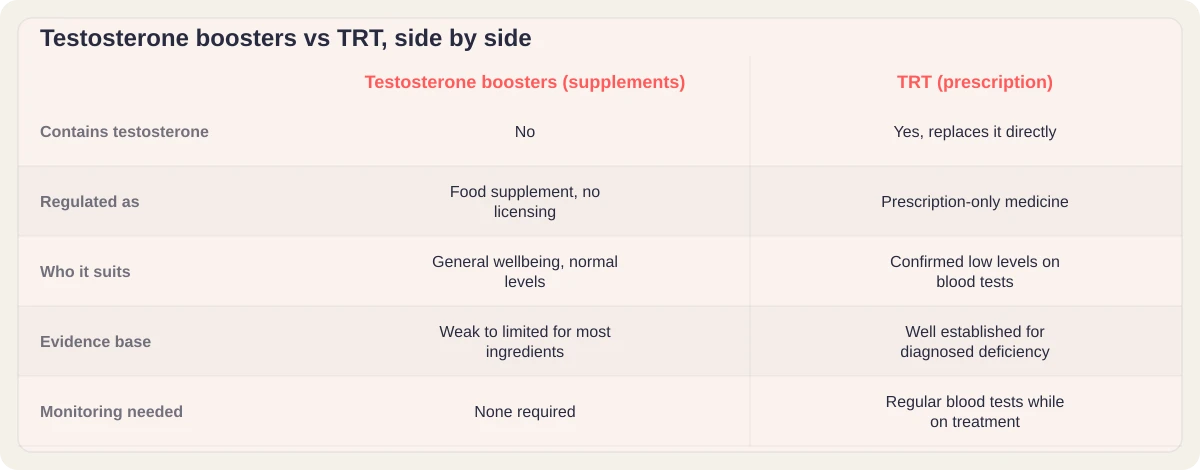
If your levels do turn out to be genuinely low, a supplement is not an alternative route to the same outcome. Only TRT replaces testosterone directly.
Safety and what to check before trying one
Because testosterone boosters are not licensed medicines, batch-to-batch consistency is not checked to the same standard, and some products sold online have been found on independent testing to contain ingredients not listed on the label.
Herbal ingredients can also interact with prescribed medicines, including those for blood pressure, blood thinning or diabetes. If you take regular medication, it is worth checking with a pharmacist before starting a new supplement, rather than assuming "natural" means risk-free.
Stacking several supplements at once, or combining a testosterone booster with a separate multivitamin, can also push mineral intake higher than intended. Taking too much zinc over a sustained period, for example, can interfere with how the body absorbs copper, which is a reminder that "more" is not automatically better, even with ingredients generally considered safe.
How to get a proper answer, not a guess
A morning blood test, taken before around 11am when testosterone is at its highest, is the only reliable way to find out whether your levels are actually low. A single low reading is usually repeated on a separate morning before anything is diagnosed, since levels can vary naturally from day to day.
From there, a clinician reviews the result alongside your symptoms and health history, and TRT is only considered if a genuine deficiency is confirmed. That route gives you a real answer, rather than weeks of guessing with a supplement that may not be doing very much either way.
You can usually arrange this testing through your GP or through a private pharmacy-led service, and either route starts the same way: a blood sample, taken at the right time of day, read in the context of how you are actually feeling. Whatever a supplement label promises, that combination of a proper test and a clinician's review is the only way to separate a genuine hormone problem from everyday tiredness.
Frequently asked questions
Do testosterone booster supplements actually increase testosterone?
For most men whose testosterone is already in the normal range, well-designed trials show little to no meaningful increase. Ingredients such as zinc or vitamin D may help only if you are deficient in that specific nutrient, not testosterone itself.
Can testosterone boosters replace TRT if my levels are genuinely low?
No. If blood tests confirm testosterone is genuinely low, a supplement is not an alternative to TRT. TRT replaces testosterone directly under clinical supervision, while a supplement does not.
Are testosterone boosters safe to take with other medicines?
Many contain herbal ingredients that can interact with prescribed medicines, including those for blood pressure, blood thinning or diabetes. Check with a pharmacist before starting one if you take regular medication.
How do I find out if my testosterone is actually low?
A morning blood test, taken before around 11am when levels are at their highest, is the reliable way to check. A single low result is usually repeated before any diagnosis is made.
Is there any evidence behind ashwagandha for testosterone?
Some small studies suggest a possible effect on stress hormones and semen parameters, but evidence specifically showing a testosterone rise in men with normal levels remains limited and inconsistent.
Are testosterone booster supplements regulated in the UK?
They are sold as food supplements rather than medicines, so they do not go through the same licensing and evidence requirements as a prescription treatment like TRT.