
Dry scalp treatment: causes, home care and what helps
 Reviewed by the My London Pharmacy clinical team · Clinically checked by Zeenah Araim, GPhC 2077620
·21 October 2026
·6 min read
·Reviews on Trustpilot
Quick answer
A dry scalp is usually caused by harsh shampoo, cold weather, ageing skin or an underlying skin condition such as eczema. Washing less often with a gentle, fragrance-free shampoo and using a scalp-friendly moisturiser usually helps within a few weeks. See a pharmacist if flaking, redness or itching does not settle.
What a dry scalp actually is
A dry scalp develops when the skin covering your head loses moisture faster than it can replace it. The result is skin that feels tight, itchy and sometimes flaky, often most noticeable after washing or during cold weather. Unlike oily, yellowish dandruff flakes, dry scalp flakes tend to be small, white and powdery, and the scalp underneath usually looks a little red rather than greasy.
It is extremely common and, on its own, is not a sign of anything serious. Most cases improve with simple changes to how you wash and care for your hair, though a small number of people have an underlying skin condition that needs a specific treatment rather than general home care.
The scalp has more oil glands than almost anywhere else on the body, so when it does dry out, the irritation can feel disproportionate to how small the affected area is. Itching, tightness after washing and visible flaking at the hairline or on the shoulders are the three symptoms people usually notice first, often together rather than on their own.
Common causes of a dry, itchy scalp
Several everyday factors can dry out the scalp, often acting together rather than alone.
- Harsh or frequent washing. Shampoos with strong detergents, or washing your hair every day, can strip away the natural oils that keep skin comfortable.
- Cold, dry weather and central heating. Low humidity outdoors and indoors both draw moisture out of the skin, which is why dry scalp is often worse in winter.
- Hot water and hot styling tools. Very hot showers and frequent use of hairdryers or straighteners add to moisture loss.
- Ageing skin. Skin naturally produces less oil as you get older, so a dry scalp becomes more likely with age.
- Underlying skin conditions. Seborrhoeic dermatitis, eczema or psoriasis can all affect the scalp and cause ongoing dryness, flaking or itching that does not respond to shampoo changes alone.
- Hair products and styling habits. Alcohol-based hairsprays, strong-hold gels and leaving dry shampoo on the scalp for long periods can all add to irritation over time.
It is worth thinking about which of these apply to you, since home care works best when it targets the actual cause rather than treating every dry scalp the same way.
Dry scalp vs dandruff: how to tell them apart
Dry scalp and dandruff are often confused because both cause flaking, but they have different causes and usually respond to different approaches.
Dandruff is linked to a yeast that lives naturally on everyone's skin, and an overactive oil response to it. This tends to produce larger, yellowish, oilier flakes and a scalp that looks greasy rather than tight. A dry scalp, by contrast, produces smaller, drier, whiter flakes on skin that feels tight and sensitive rather than oily.
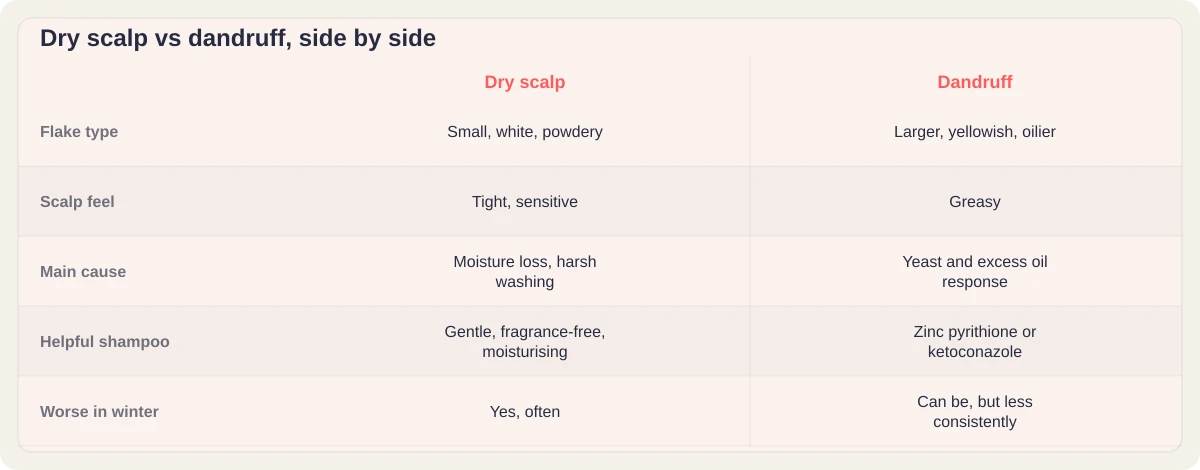
The practical difference matters because the shampoos that treat dandruff (containing ingredients such as zinc pyrithione or ketoconazole) can sometimes be too drying for a scalp that is already dry, while a rich moisturising shampoo aimed at dryness will not usually clear dandruff on its own.
Home care that helps
For most people, a dry scalp settles with small, consistent changes rather than one single fix.
- Wash less often. Two to three times a week is usually enough for most hair types; washing daily can make dryness worse.
- Use lukewarm, not hot, water. Hot water feels pleasant but accelerates moisture loss from the scalp.
- Choose a gentle, fragrance-free shampoo. Sulphate-free formulas are usually less stripping than standard supermarket shampoos.
- Moisturise the scalp directly. A small amount of scalp oil or a leave-in scalp treatment, massaged in gently, can help restore comfort between washes.
- Avoid scratching. It is tempting but can break the skin and make irritation worse.
- Keep the air in your home less dry. A humidifier in winter, or simply drying washing away from radiators in the bedroom, can reduce how much moisture the air pulls from your skin overnight.
Most people notice an improvement within two to four weeks of making these changes consistently, provided they are kept up rather than tried for a few days and abandoned.
Choosing the right shampoo
Not every "dandruff shampoo" is right for a dry scalp, so it helps to know what to look for on the label.
For straightforward dryness, look for shampoos described as gentle, moisturising or for sensitive scalps, ideally fragrance-free and sulphate-free. Ingredients such as glycerin, oat extract or mild plant oils can help the scalp hold on to moisture.
If flakes are yellowish and the scalp feels oily rather than tight, a shampoo containing zinc pyrithione, selenium sulfide or ketoconazole is more likely to help, as these target the yeast associated with dandruff and seborrhoeic dermatitis rather than simple dryness. Using the wrong type for your scalp is one of the most common reasons home care does not seem to work.
It can help to alternate: a gentle moisturising shampoo for most washes, with an anti-dandruff shampoo used once or twice a week if you have features of both. Leave any medicated shampoo on the scalp for the time stated on the bottle, usually a few minutes, rather than rinsing it straight off, since this is when the active ingredient does most of its work.
When home care is not enough
If your scalp stays red, flaky or itchy for more than a few weeks despite gentle washing and regular moisturising, an underlying skin condition is more likely, and a different approach may be needed.
Seborrhoeic dermatitis causing persistent scalp inflammation sometimes needs a short course of a medicated scalp treatment, such as Betnovate Scalp Application, used under medical guidance for a limited period rather than long term. A pharmacist or GP can assess your scalp and advise whether a medicated option, rather than an over-the-counter shampoo, is the right next step for you.
Psoriasis affecting the scalp can look similar to severe dandruff but tends to produce thicker, more defined patches and may need a specific treatment plan, so it is worth having it properly assessed rather than guessing.
When to see a pharmacist or GP
Most dry scalp cases are mild and manageable at home, but it is worth getting advice if:
- Symptoms have not improved after four to six weeks of consistent home care.
- The scalp is cracked, bleeding, or shows signs of infection such as crusting, pus or spreading redness.
- You notice patchy hair thinning alongside the scalp changes.
- Flaking is thick, silvery and well-defined, which can suggest psoriasis.
A pharmacist can often examine the scalp, rule out a condition needing specific treatment, and recommend or prescribe something more targeted when a standard shampoo change has not been enough. Most people never need to go further than this, and a brief pharmacy consultation is usually enough to get a persistent dry scalp back under control.
Frequently asked questions
What is the main difference between a dry scalp and dandruff?
A dry scalp produces small, white, powdery flakes on skin that feels tight and sensitive, while dandruff produces larger, yellowish, oilier flakes on a scalp that looks greasy. They sometimes need different types of shampoo, so telling them apart helps you choose the right product.
Can diet affect dry scalp?
Diet is not usually the main cause, but staying well hydrated and getting enough essential fatty acids, found in foods such as oily fish, nuts and seeds, can support overall skin health, including the scalp.
How often should I wash my hair if I have a dry scalp?
Most people with a dry scalp do better washing two to three times a week rather than daily, since frequent washing with hot water strips away the natural oils that keep the scalp comfortable.
Is a dry scalp a sign of eczema or psoriasis?
Not usually. Most dry scalp is simply down to weather, washing habits or ageing skin. However, if flaking is thick and well-defined, or comes with redness that does not settle, eczema or psoriasis is worth ruling out with a pharmacist or GP.
Can a dry scalp cause hair loss?
A dry, irritated scalp does not usually cause hair loss on its own, but constant scratching can damage hair follicles over time. If you notice thinning alongside scalp symptoms, it is worth getting checked rather than assuming it is unrelated.
How long does it take for a dry scalp to improve?
With consistent gentle washing and scalp moisturising, most people notice an improvement within two to four weeks. If there is no change after four to six weeks, it is worth seeking advice in case an underlying condition is involved.