
Hepatitis B and C testing: what to know and how to get tested
Quick answer
Hepatitis B spreads through blood and sexual contact; hepatitis C mainly through blood-to-blood contact. Both can cause no symptoms for years while quietly affecting the liver. Free NHS testing includes at-home finger-prick kits and clinic blood tests. Hepatitis C is curable with a short tablet course; hepatitis B is managed long-term and can be prevented with a vaccine.
Why hepatitis testing matters
Hepatitis B and hepatitis C are viral infections that affect the liver, and both can be present in the body for years without causing any symptoms you would notice. During that silent period, the virus can still gradually affect liver function and can still be passed on to other people, which is why testing rather than waiting for symptoms is the reliable way to know your status.
The two infections are different from each other. Hepatitis C can usually be cured with a short course of tablets, and modern treatment is successful for the great majority of people who complete it. Hepatitis B cannot currently be cured in the same way, but it can be closely monitored and managed, and a safe, effective vaccine can prevent it in the first place.
An early diagnosis matters for both. It means treatment or monitoring can start before any liver damage has had time to develop, and it means you can make informed choices to protect partners, family members or anyone else you share close contact with. Left undiagnosed over many years, either infection can gradually lead to scarring of the liver, so picking it up early, while it is still straightforward to manage, makes a genuine difference to your long-term health.
How hepatitis B and C spread
Hepatitis B is mainly spread through contact with infected blood and bodily fluids, including through unprotected sex, sharing needles or other injecting equipment, from a mother to her baby around birth, and occasionally through sharing items like razors or toothbrushes that carry traces of blood.
Hepatitis C is spread almost entirely through blood-to-blood contact. In the UK, the most common route is sharing needles, syringes or other injecting equipment. It can also be passed on through tattoos or piercings done with unsterile equipment, from a mother to her baby, and less commonly through sex, particularly where blood may be present.
Neither virus is spread through everyday contact such as hugging, sharing cutlery, or being in the same household, which is worth knowing if you are supporting a partner or family member through testing or treatment.
Symptoms: why many people don't know they have it
Both infections are often described as silent, and that is not an exaggeration. Many people with hepatitis B or hepatitis C feel completely well for years, sometimes decades, while the virus remains active in the body.
When symptoms do appear, they tend to be vague and easy to put down to something else: persistent tiredness, a loss of appetite, mild nausea, or discomfort in the upper right side of the abdomen where the liver sits. Some people notice yellowing of the skin or eyes, known as jaundice, or darker urine, though this is more common with a new, acute infection than with a long-standing one.
A short-lived, acute illness shortly after exposure is also possible with either virus, particularly hepatitis B, and can feel like a mild flu with tiredness and nausea that settles on its own. Because that early illness is so easy to mistake for something else entirely, and because most people do not get it at all, it is not a reliable way to know whether you have been exposed.
Because symptoms are so unreliable as a warning sign, testing is recommended based on risk and exposure rather than waiting to feel unwell. This includes anyone who has ever injected drugs or shared equipment to do so, anyone born in or with family from a country where hepatitis B is more common, anyone who has had a tattoo or piercing abroad with equipment they were not confident was sterile, sexual partners of someone with hepatitis B or C, and babies born to mothers with hepatitis B.
How to get tested in the UK
Testing for hepatitis B and C is free on the NHS. In England, adults can request a free at-home finger-prick test for hepatitis C by post, with the sample sent to a laboratory and a result usually back within around two weeks. In Wales, a combined at-home test covering hepatitis B, hepatitis C and HIV is available through the national testing service.
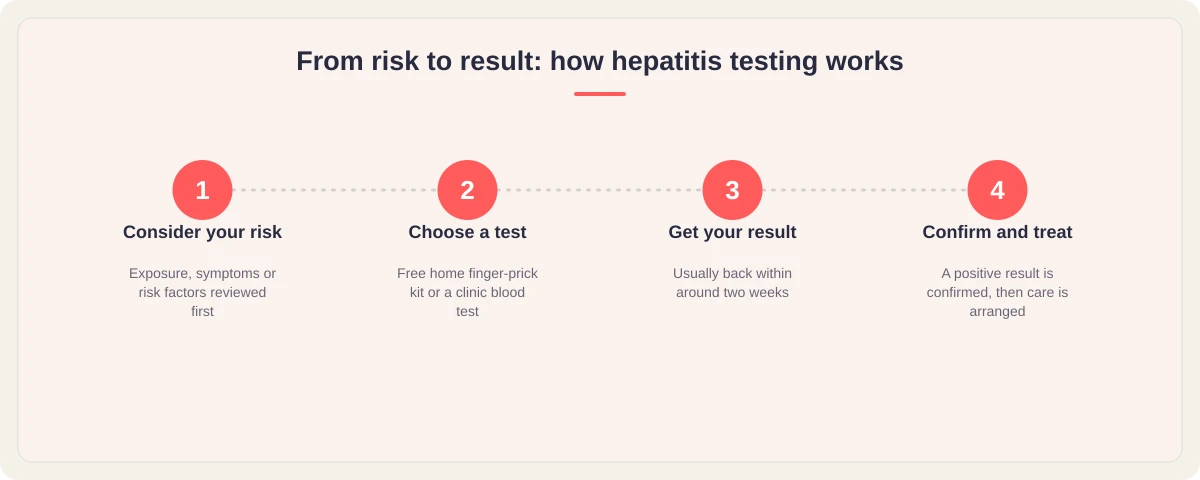
Sexual health clinics and many GP surgeries also offer hepatitis testing as part of a routine blood test or STI screen, and testing is increasingly offered opportunistically to anyone already having a blood test in an NHS emergency department. If you would rather have a private, same-week test and talk through your personal risk factors first, a pharmacy consultation with a clinician is a straightforward way to get clear, judgement-free guidance on which test suits your situation.
What your result means
A negative result is reassuring, though if you have had a recent possible exposure, your clinician may advise a repeat test after enough time has passed for the virus to become detectable, since testing too soon after exposure can miss an early infection.
A positive hepatitis C result means the virus is currently detectable, and your clinician will usually confirm this with a follow-up test before arranging treatment. A positive hepatitis B result is followed up with further blood tests to work out whether the infection is a recent, short-term one that your immune system is likely to clear on its own, which is common in adults, or a long-term, chronic infection that needs ongoing monitoring.
A hepatitis B result can look more complicated than a single positive or negative, because the panel of blood tests also shows whether you are already immune, for example from past vaccination, or whether you have been exposed before and cleared the virus naturally. Your clinician will talk you through exactly what your particular combination of results means rather than leaving you to interpret it alone.
Whichever result you receive, you will be supported by a clinician who can explain exactly what it means for you, what happens next, and how to protect anyone you live with or are sexually active with in the meantime.
Treatment: hepatitis B compared with hepatitis C
Hepatitis C is treated with direct-acting antiviral tablets, usually taken for eight to twelve weeks. Modern treatment is successful for the great majority of people who complete a course, generally with mild or no side effects, and a cure means the virus is no longer detectable in the blood and can no longer be passed on.
Hepatitis B does not currently have a cure in the same sense. Many adults who catch it clear the infection naturally within a few months without needing treatment. For those who go on to develop a chronic, long-term infection, care usually means regular monitoring of liver health, and antiviral medicine where a clinician judges it will help protect the liver, rather than a fixed course that ends in a cure.
In both cases, avoiding alcohol or keeping intake low while the liver is affected, and letting any other clinician treating you know about your hepatitis status, are simple ways to support your liver alongside whatever treatment plan you agree.
Reducing your risk and vaccination
A vaccine against hepatitis B is available on the NHS for people at higher risk, including household and sexual contacts of someone with hepatitis B, people who inject drugs, and people travelling to or living in areas where the infection is more common. It is also part of the routine childhood immunisation schedule. There is currently no vaccine against hepatitis C, so avoiding blood-to-blood contact, such as never sharing needles or injecting equipment, and choosing reputable, licensed studios for tattoos and piercings, remains the main way to reduce your risk.
If you are unsure whether you are due a hepatitis B vaccine, or want to talk through your personal risk factors before deciding whether to test, a clinician can help you weigh this up alongside your wider sexual health and travel plans.
Frequently asked questions
Can hepatitis B or C be passed on without any symptoms?
Yes. Both infections can be present in the body and passed on to others for years before any symptoms appear, which is why testing based on risk and exposure, rather than waiting to feel unwell, is recommended.
Is hepatitis C curable?
Yes, in most cases. A course of direct-acting antiviral tablets, usually taken for eight to twelve weeks, is successful for the great majority of people who complete treatment, meaning the virus becomes undetectable and can no longer be passed on.
Is there a vaccine for hepatitis B or C?
There is a vaccine for hepatitis B, available on the NHS for people at higher risk and given as part of routine childhood immunisation. There is currently no vaccine against hepatitis C.
How do I get tested for hepatitis in the UK?
Testing is free on the NHS. Adults in England can request an at-home finger-prick test for hepatitis C by post, people in Wales can access a combined home test for hepatitis B, C and HIV, and testing is also available through sexual health clinics, many GP surgeries, and pharmacy consultations.
How long does a hepatitis test result take?
A postal home test usually returns a result within around two weeks. Clinic blood tests are processed by a laboratory, and your clinician will let you know the expected turnaround when the sample is taken.
Can I catch hepatitis B or C from everyday contact with someone who has it?
No. Neither virus is spread through everyday contact such as hugging, sharing cutlery, or living in the same household. Hepatitis B and C are spread through specific routes involving blood or, for hepatitis B, sexual contact.