
How to lose weight after menopause: a realistic guide
 Reviewed by the My London Pharmacy clinical team
·5 November 2026
·6 min read
·Reviews on Trustpilot
Quick answer
Menopause makes weight easier to gain and harder to shift, mainly through hormonal changes, muscle loss and disrupted sleep. Strength training, protein and fibre, consistent sleep and realistic, gradual goals help most. If lifestyle changes alone are not enough, a clinical weight-management consultation can review your options, subject to suitability.
Why weight gain after menopause is so common
Many women notice weight creeping on around the menopause, often without changing how they eat or move. This is a real, well-documented pattern rather than a lack of effort or willpower, and it tends to catch people off guard precisely because nothing in their routine has obviously changed.
As oestrogen levels fall, fat tends to redistribute from the hips and thighs towards the abdomen, so even a stable weight can look and feel different, with clothes fitting differently around the middle even when the number on the scale barely moves. Ageing itself also plays a part, separately from menopause: muscle mass naturally declines with age, typically from the mid-30s onwards, and muscle burns more calories at rest than fat does, so your resting metabolic rate gradually slows year on year.
Sleep is often disrupted by hot flushes and night sweats, and poor sleep is linked to increased appetite, particularly cravings for higher-calorie, less balanced food the next day, as tiredness affects the hormones that regulate hunger and fullness. Many women are also at a stage of life with higher stress, caring responsibilities for children or elderly parents, and less time for exercise than before, all of which can add up quietly over several years rather than arriving all at once.
Why very fast approaches tend to disappoint
Restrictive diets and very low-calorie plans can produce fast initial results, but they are hard to sustain beyond a few weeks and often lead to muscle loss alongside fat loss, which can make the underlying metabolic slowdown worse over time rather than better. When the diet inevitably ends, weight regain is common, and some of what returns tends to be fat rather than the muscle that was lost.
Cutting out entire food groups, skipping meals, or relying on a single 'miracle' food or supplement is not supported by good evidence for this stage of life, and can leave you short of nutrients that matter more after menopause, such as calcium and protein for bone and muscle health. The most consistent predictor of long-term success in weight research is not how fast weight comes off, but whether the approach is one you can realistically keep doing for months and years, not just days or weeks.
What actually helps, based on the evidence
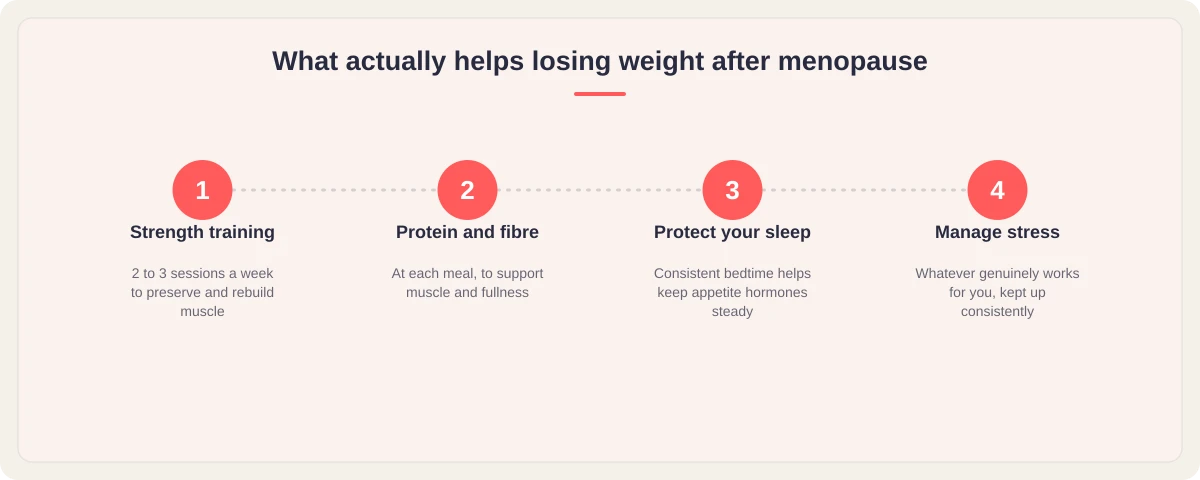
A combination of small, sustained changes tends to outperform any single dramatic one, and the four below are consistently supported by NHS and NICE guidance for this life stage.
Strength or resistance training two to three times a week helps preserve and rebuild muscle, which supports your resting metabolic rate as you age rather than letting it decline further. UK guidance for adults recommends at least 150 minutes of moderate activity a week, such as brisk walking or cycling, alongside muscle-strengthening activity on two or more days, which can be bodyweight exercises, resistance bands or weights.
Prioritising protein and fibre at meals supports muscle maintenance and helps you feel fuller for longer, which tends to make other changes easier to stick with rather than feeling like a constant fight against hunger. Protecting your sleep, including a consistent bedtime and addressing night sweats where possible, helps keep the hormones that regulate appetite working as they should. Managing stress in whatever way genuinely works for you, whether that is walking, breathing exercises or simply protecting some downtime each week, can also help, since ongoing stress raises cortisol, a hormone linked to increased abdominal fat storage.
What a realistic pace looks like
Losing around 0.5 to 1kg a week, or roughly 5 to 10% of your starting weight over about six months, is considered a realistic and clinically meaningful target by NHS and NICE guidance. This pace is meaningful in practice because even modest loss at this level is linked to measurable improvements in blood pressure, blood sugar and cholesterol, well before you reach any longer-term goal weight.
Progress is rarely a straight line. Weight can plateau for several weeks even when you are doing everything consistently, and that is expected physiology, often linked to water retention or muscle gain from strength training, rather than a sign that something has gone wrong or that the approach has stopped working. Tracking how your clothes fit, your energy levels and your strength in the gym or on the stairs, not just the number on the scale, tends to give a more honest and encouraging picture of progress over time.
Other factors worth ruling out
If weight continues to rise despite genuine, sustained effort, it is reasonable to check whether something else is contributing. An underactive thyroid becomes more common around midlife and can slow metabolism and cause tiredness alongside weight gain, and it is usually identified with a simple blood test. Certain medicines, including some used for blood pressure, mood or sleep, can also affect weight as a side effect, so it is worth reviewing your current medicines with a pharmacist or GP rather than assuming nothing can be done.
Disrupted sleep from untreated menopausal symptoms is another common and often overlooked contributor, and treating the underlying symptoms, rather than only the weight, can sometimes make other changes noticeably easier to sustain.
Where medication fits in
For some women, lifestyle changes alone are not enough, particularly where weight is affecting health. Orlistat (Xenical Capsules) is a licensed tablet that works in the gut to reduce the amount of fat absorbed from food, and it is typically considered alongside, not instead of, diet and activity changes. It is not suitable for everyone and needs a clinical assessment to check whether it is appropriate and safe for you, subject to suitability.
Any medication is one part of a wider plan rather than a substitute for the basics above, and a clinician can help you weigh up whether it is a sensible option in your individual circumstances, taking into account your full medical history.
When to consider a clinical consultation
If you have made genuine, sustained changes to your diet, activity, sleep and stress and are still struggling, or if your weight is linked to other health concerns such as raised blood pressure or blood sugar, it is reasonable to ask for help rather than keep trying alone with no clear plan.
A clinical weight-management consultation looks at your full picture, including your medical history, current medicines and any menopausal symptoms, and can help you understand which options, if any, are suitable for you. This is a conversation, not a commitment, and any treatment offered is always subject to clinical suitability following a proper assessment.
Frequently asked questions
Does menopause itself cause weight gain, or is it just ageing?
Both play a part. Ageing brings natural muscle loss and a slower metabolism regardless of menopause, but falling oestrogen specifically encourages fat to shift towards the abdomen and can affect appetite and sleep, which makes the menopausal years a particularly common time for weight to creep up.
Does HRT cause weight gain?
Good evidence does not show that HRT itself causes weight gain; weight change around this time is more closely linked to ageing, hormonal shifts and lifestyle factors. Some women feel more able to be active once menopausal symptoms are better managed, which can support weight management indirectly.
How long does it realistically take to lose weight after menopause?
A sustainable pace is usually around 0.5 to 1kg a week, or roughly 5 to 10% of starting weight over about six months. It is normal for this to include plateaus, and going slower is not a failure; it tends to produce more lasting results than a rapid approach.
Is strength training really necessary, or is cardio enough?
Cardio has real benefits, but strength training specifically helps preserve the muscle that supports your metabolic rate, something that becomes more important as muscle naturally declines with age. Most guidance recommends combining both rather than relying on one alone.
When should I speak to a clinician about my weight after menopause?
It is worth considering a consultation if sustained lifestyle changes are not making a difference, or if your weight is linked to other health concerns such as raised blood pressure, blood sugar or cholesterol. A clinician can review your full picture and discuss whether further options are suitable for you.