
Ingrown hair treatment: how to treat and prevent them
 Reviewed by the My London Pharmacy clinical team · Clinically checked by Zeenah Araim, GPhC 2077620
·22 October 2026
·7 min read
·Reviews on Trustpilot
Quick answer
An ingrown hair happens when a hair curls back or grows sideways into the skin, causing a small, often itchy bump. Most clear within a week or two with warm compresses, gentle exfoliation and letting the area rest. See a pharmacist if it becomes red, swollen, warm or filled with pus, as this can mean infection.
What is an ingrown hair?
An ingrown hair develops when a hair curls back on itself or grows sideways into the skin instead of rising straight up and out of the follicle. The body treats the trapped hair as something foreign, so the skin around it becomes inflamed, forming a small, raised bump that can be red, itchy or mildly tender to the touch. Sometimes a short length of trapped hair is visible just under the surface, and the bump can look similar to a small spot or pimple.
Ingrown hairs can appear anywhere hair is removed, but they are most common on the beard area and neck in men who shave, and on the legs, bikini line, underarms and chest in people who shave, wax or pluck. They are more likely where hair is naturally coarse or curly, because curved hairs are more prone to curling back into the follicle as they regrow, and they tend to appear a day or two after hair removal rather than straight away.
Most are harmless and settle without treatment, but a small number become more troublesome, either through infection or by developing into a longer-lasting lump under the skin. Knowing which is which helps decide whether home care is enough or whether a clinician should take a look.
Why ingrown hairs happen
A few things make an ingrown hair more likely. Shaving very close to the skin can cut the hair at a sharp angle just below the surface, so the sharp tip catches the follicle wall as it grows back out. Waxing, threading and plucking pull the hair out at the root, and the new hair that grows in afterwards can sometimes break through the skin at an angle rather than straight out, which has the same effect.
A build-up of dead skin cells over the follicle opening can also block the usual exit route, forcing the regrowing hair to find another path through the surrounding skin instead of upwards. Tight clothing and friction over recently shaved or waxed skin, such as snug waistbands or sports kit, add to the irritation and make it easier for a hair to become trapped.
Curly and coily hair is particularly prone to this because the hair naturally grows in a curved path under the skin, making it far more likely to re-enter the surface close to where it emerged. This is why ingrown hairs and the razor bumps they cause are more common, and often more persistent, in people with curlier hair textures, particularly in the beard area.
How to treat an ingrown hair at home
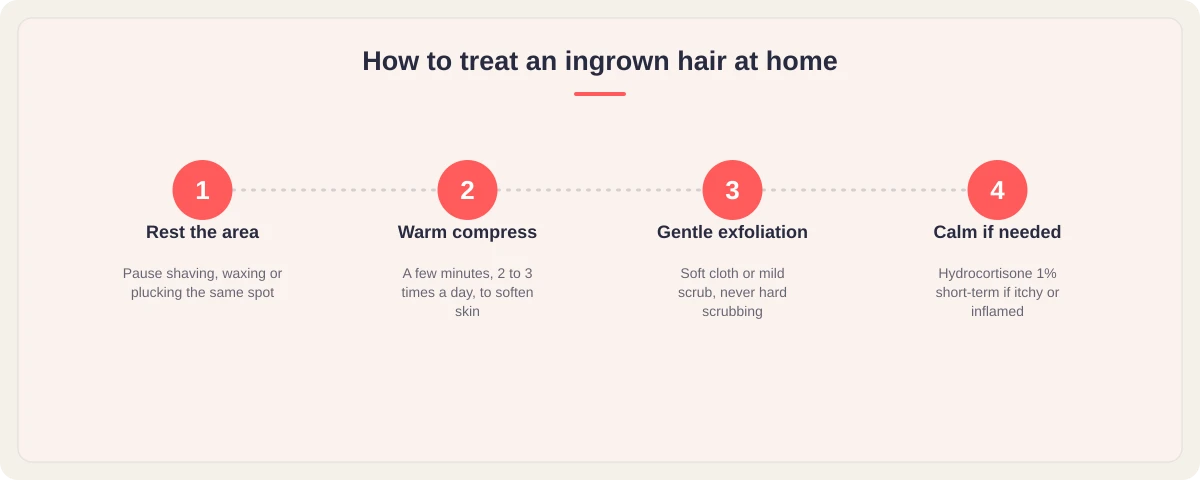
Most ingrown hairs settle on their own within one to two weeks with simple home care. A warm compress held against the area for a few minutes, two or three times a day, softens the skin and reduces swelling, which can help the trapped hair work its way back out on its own without any further intervention. Gentle exfoliation with a soft cloth, a flannel, or a mild, non-abrasive scrub can help clear the dead skin sitting over the follicle, but it should always be light; scrubbing too hard only adds to the irritation and can break the skin.
The area is best left alone while it heals: avoid shaving, waxing or plucking the same spot, and resist the urge to pick, squeeze or dig the hair out with a needle or tweezers. Doing this at home, without clean equipment, raises the risk of pushing the hair deeper, introducing bacteria, and leaving a scar or dark mark once it heals. If a hair loop is clearly visible just under the surface and lifts out easily with sterile tweezers after a warm compress, it can sometimes be freed gently, but it should never be forced.
If the bump is itchy or uncomfortable, a short course of Hydrocortisone 1% can help calm the inflammation and reduce itching while the area settles. It is intended for short, occasional use rather than everyday use on the same patch of skin, and a pharmacist can advise on how long it is reasonable to use it for.
When an ingrown hair becomes infected
Occasionally, an ingrown hair becomes infected, a condition sometimes called folliculitis when it affects the follicle itself. Signs to watch for include increasing redness or swelling, warmth around the bump, growing pain rather than a steady improvement, a visible head of pus, or several inflamed spots appearing close together in the same area. A low-grade fever, feeling generally unwell, or red streaking spreading out from the area are signs that need prompt attention rather than continued home care.
A pharmacist can assess whether a topical antiseptic or antibiotic cream is appropriate for a mild, localised infection, or whether it has spread enough to need an oral antibiotic from a prescriber. Infections are more likely where the skin has been repeatedly irritated by shaving, where a hair has been dug out with unclean tweezers or a needle, or where the same area is shaved again before the previous irritation has fully settled.
Ingrown hair cysts
Repeated irritation at the same spot can sometimes lead to a firmer, longer-lasting lump under the skin, often described as an ingrown hair cyst. Unlike a straightforward ingrown hair, this type of lump tends to take longer to settle, feels deeper and more solid rather than sitting just under the surface, and does not usually respond to warm compresses alone within the first week or two.
These cysts should not be squeezed, pricked or lanced at home; doing so can push the inflammation deeper into the skin and increase the chance of scarring or a more serious infection taking hold. If a lump persists for more than a few weeks, keeps coming back in the same spot, or becomes painful or tender, it is worth having it looked at so the right treatment can be arranged. Depending on how it presents, this may include a course of antibiotics, a steroid injection to settle the inflammation, or a minor procedure to drain it safely.
Preventing ingrown hairs after shaving, waxing or plucking
- Exfoliate gently a day or two before shaving or waxing to clear dead skin from the follicle opening.
- Shave in the direction the hair grows, not against it, using a sharp, clean single or twin-blade razor rather than a multi-blade one that cuts very close to the skin.
- Use a shaving gel, foam or lubricant, and avoid pulling the skin tight while shaving curly or coarse hair, as this encourages the cut hair to retract below the surface.
- Consider leaving a small amount of stubble with clippers or a trimmer instead of shaving right to the skin, particularly in areas that react badly or scar easily.
- Moisturise straight after hair removal and avoid tight, rough or synthetic clothing over freshly treated skin for a day or two while it settles.
- Replace razors regularly; a blunt blade drags rather than cuts cleanly, which increases irritation and the chance of an ingrown hair forming.
For people who get ingrown hairs repeatedly in the same area despite these steps, it is worth discussing other hair removal methods, including longer-term options, with a clinician who can advise on what suits that skin and hair type.
When to see a pharmacist or GP
Most ingrown hairs can be managed at home and clear up without any lasting mark. It is worth getting checked if the area becomes increasingly red, swollen, warm or painful, if pus develops, if a lump persists for more than a few weeks, or if ingrown hairs and cysts keep recurring in the same spot despite careful prevention. People with diabetes or a weakened immune system should get any skin infection checked promptly, as these can take longer to settle and are more likely to spread if left untreated.
A pharmacist can examine the area, advise on whether a cream or antibiotic is needed, and help work out whether a change in shaving or hair removal routine would help going forward.
Frequently asked questions
How long does an ingrown hair take to heal?
Most ingrown hairs settle within one to two weeks with warm compresses, gentle exfoliation and by leaving the area alone. A cyst or a more deeply embedded hair can take longer and may need a clinician's help to clear.
Can you pop or squeeze an ingrown hair?
This is best avoided. Squeezing, picking or digging a hair out with a needle or tweezers can push the irritation deeper, introduce bacteria and increase the chance of scarring or infection.
Is it safe to shave over an ingrown hair?
It is better to avoid shaving directly over an inflamed ingrown hair until it has settled, as this adds more irritation to skin that is already reacting. Shave around the area if needed, or pause hair removal there for a week or two.
Can ingrown hairs leave scars or dark marks?
Repeated irritation or picking at the same spot can leave darker marks or, less often, small scars, particularly on darker skin tones. Leaving the hair to resolve on its own with gentle care lowers this risk.
Are some people more prone to ingrown hairs?
Yes. Curly or coily hair is more likely to curl back into the follicle as it regrows, so people with this hair type tend to get ingrown hairs more often, especially in areas that are regularly shaved or waxed.