Male menopause: is it real, and what are the symptoms?
 Clinically reviewed by the My London Pharmacy clinical team
·20 November 2026
·8 min read
·Reviews on Trustpilot
Quick answer
There is no male equivalent of the menopause. Testosterone falls gradually, by around 1 percent a year from the late 30s or 40s, not suddenly. Many symptoms blamed on it (fatigue, low mood, poor sleep) have other, more common causes that are worth ruling out before testing.

Why 'male menopause' is a misleading name
The term 'male menopause' gets used a lot, in magazine articles, in casual conversation and sometimes by men themselves describing how they feel in their 40s or 50s. The NHS describes it as an unhelpful term, though, and the comparison it draws with the female menopause does not really hold up medically.
The female menopause is a fairly sudden, defined event. The ovaries stop releasing eggs, periods end, and oestrogen production drops sharply over a relatively short window, usually a matter of months to a couple of years. There is a clear turning point, and a recognisable set of changes that follow a broadly predictable pattern. Men do not go through anything comparable to that.
There is no single event, no equivalent hormonal cliff edge, and no fixed age at which it happens for men. What men experience instead is a slow, steady decline in testosterone that starts decades before most people notice any symptoms, if they notice any changes from it at all. Many men reach their 70s and 80s with testosterone levels that, while lower than in their 20s, have never caused a symptom worth mentioning.
The more accurate term, used in medicine, is late-onset hypogonadism, or sometimes andropause. Neither phrase captures public attention the way 'male menopause' does, which is probably why the misleading version has stuck around in everyday conversation and in some headlines, even though it describes something quite different from what is actually happening in the body.
What actually changes in men's hormones with age
Testosterone is produced mainly in the testes, under signals sent from the brain, and levels peak in early adulthood before beginning a slow downward drift. From the late 30s or 40s onward, testosterone typically falls by roughly 1 percent a year. That is a gradual slope, not a sudden drop, and it is a completely normal part of ageing for most men, in the same way eyesight or joint flexibility change gradually over decades.
Because the change happens so slowly, most men never notice it as a distinct event. Levels at 70 are lower than they were at 30, but the difference from one year to the next is small enough to pass unnoticed against the background of ordinary daily life. Other hormones shift gradually with age too, and general health, weight and fitness tend to have at least as much influence on how someone feels day to day as the testosterone figure on a lab report.
A minority of men see their testosterone fall further or faster than this typical pattern, sometimes because of an underlying health condition, certain medicines, or a testicular problem rather than ageing alone. It is this smaller group, with a genuinely abnormal result rather than an ordinary age-related dip, where symptoms and testing become clinically relevant.
Symptoms that get blamed on it, and their other causes
Tiredness, low mood, reduced interest in sex, erectile difficulties, poor concentration, disrupted sleep, reduced muscle strength and a general sense of not feeling like yourself are the symptoms most often put down to 'male menopause'. They are real experiences, worth taking seriously, but testosterone is rarely the only, or even the main, explanation for them.
Depression and anxiety can produce exactly the same tiredness, low mood and loss of interest in things, including sex, that get attributed to hormones. Chronic work or financial stress has a similar effect. Poor sleep, whether from insomnia, shift work, a new baby in the house, or undiagnosed sleep apnoea, affects energy, concentration and libido entirely on its own, regardless of what testosterone is doing.
Being overweight, drinking more than the recommended amount of alcohol, a sedentary lifestyle, and simply being busier and more run down in midlife than earlier in adulthood, all push these same symptoms in the same direction, independent of testosterone. Certain medicines and underlying conditions, such as an underactive thyroid or diabetes, can also produce a very similar picture.
Because so many common conditions overlap with the symptoms of low testosterone, a pharmacist or GP will typically want to look at sleep, mood, weight, alcohol intake and other medicines alongside any blood test, rather than assuming testosterone is the cause as soon as these symptoms appear. Treating the actual cause, when it turns out to be sleep or mood rather than hormones, usually brings far quicker and more reliable improvement.
Testing: when a testosterone blood test is worth it
A testosterone blood test is worth considering when symptoms are persistent (lasting weeks rather than days), when the more common causes above have genuinely been considered, and when the symptoms are affecting daily life rather than fluctuating with a bad week at work or a poor night's sleep. Testing out of curiosity alone, with no symptoms, is rarely useful and is not something clinicians generally recommend.
Timing matters more than most people expect. Testosterone follows a daily rhythm and is at its highest first thing in the morning, so a sample taken before around 11am gives a far more reliable reading than one taken later in the day, when levels have naturally fallen. A test done in the afternoon can look artificially low even in a man with perfectly normal morning levels.
A single low result is not enough on its own to confirm anything. A second morning sample, usually taken a few weeks later, is used to check the first reading before any diagnosis is made, since testosterone can dip temporarily during an illness, a period of poor sleep, or significant stress. Alongside the testosterone result itself, a clinician will often check related markers, such as LH and FSH, which help show whether the issue sits with the testes themselves or with the signal from the brain that controls them.
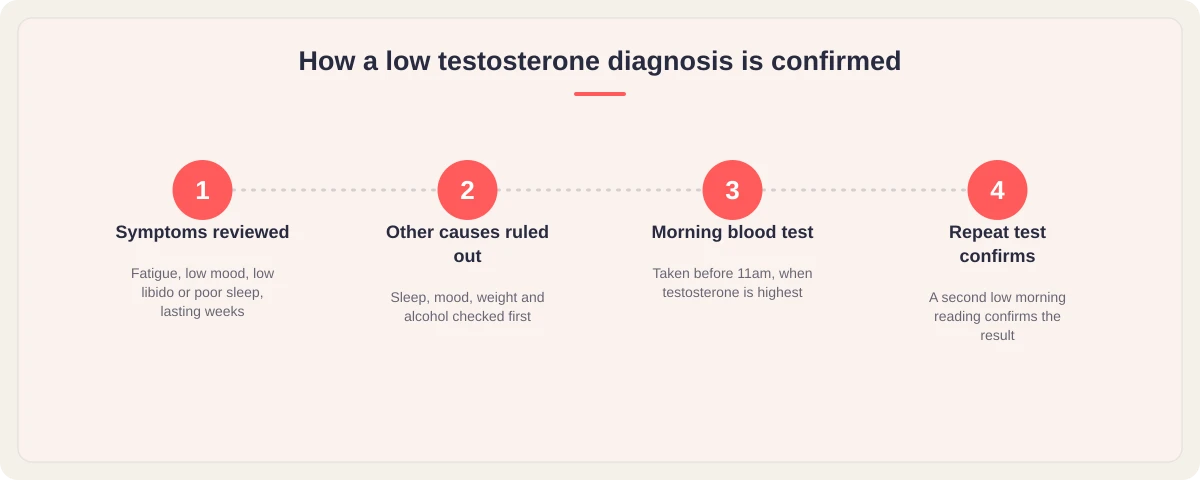
Two consistently low morning readings, alongside symptoms that fit the pattern, are what actually point towards a diagnosis, rather than a single number from a single sample on a single day.
Late-onset hypogonadism, and when TRT is considered
Late-onset hypogonadism describes a smaller group of men whose testosterone is consistently low, confirmed on two separate morning blood tests, alongside symptoms that fit the pattern. It affects a minority of men, not the general ageing male population, and it is a specific clinical diagnosis rather than a label for feeling generally run down or simply getting older.
Where late-onset hypogonadism is confirmed, testosterone replacement therapy (TRT) is one option a clinician may discuss. This usually starts with an assessment of your overall health, including prostate health and cardiovascular risk factors, since TRT is not considered appropriate for everyone and carries its own monitoring requirements once started. Topical TRT is one of the forms this can take, applied daily to the skin, though the right option, if any, depends entirely on your individual results and health history, and is a decision made with a clinician rather than chosen off the shelf.
TRT is not something to start on the strength of symptoms alone, however convincing they feel. It is only considered once low testosterone has actually been confirmed on blood tests, other causes have been reasonably ruled out, and a clinician has judged it appropriate for you specifically, with a plan for ongoing monitoring once treatment begins.
Lifestyle factors that move testosterone
Several everyday factors influence testosterone levels and are worth addressing regardless of what a blood test eventually shows. Carrying excess weight, particularly around the abdomen, is linked to lower testosterone, and losing weight can help levels recover to some degree. Regular strength training, in particular, and general physical activity support healthier levels too, alongside their many other wellbeing benefits.
Poor or insufficient sleep lowers testosterone production, since a significant amount of it is produced overnight during deeper sleep stages. Protecting sleep, through a consistent bedtime and winding down properly beforehand, is one of the more effective, and most overlooked, changes available to most men. Drinking less alcohol, and reducing chronic stress where that is realistically possible, also supports a healthier hormonal picture over time, since both alcohol and prolonged stress hormones work against testosterone production.
None of this replaces a proper diagnosis where symptoms are significant and persistent, and lifestyle changes will not meaningfully help a case of genuine late-onset hypogonadism. But for many men whose testosterone sits at the lower end of a normal range rather than clearly outside it, these changes bring a real improvement in energy, mood and sleep well before testing or treatment becomes necessary at all.
Frequently asked questions
Is male menopause a real medical condition?
Not in the way the female menopause is. The NHS describes 'male menopause' as a misleading term: men do not have a sudden hormonal drop. What is real is a gradual, lifelong decline in testosterone, and in a minority of men, a diagnosable condition called late-onset hypogonadism.
At what age does testosterone start to decline?
Testosterone typically begins its gradual decline from the late 30s or 40s, falling by roughly 1 percent a year after that. It is a slow slope rather than a sudden change at any particular age.
What are the main symptoms linked to low testosterone?
Tiredness, low mood, reduced interest in sex, poor concentration and disrupted sleep are commonly linked to low testosterone, though all of these can also be caused by depression, stress, poor sleep, weight and alcohol, which are usually considered first.
How is low testosterone diagnosed?
Diagnosis needs two separate morning blood tests, since testosterone is highest early in the day and a single reading is not reliable enough on its own. Results are read alongside your symptoms, not in isolation.
Can lifestyle changes raise testosterone without medication?
Yes, for many men. Losing excess weight, regular strength training, better sleep and drinking less alcohol can all support healthier testosterone levels, and are usually tried before any medical treatment is considered.
Is TRT the right treatment for everyone with low-ish testosterone?
No. TRT is only considered once low testosterone is confirmed on two morning blood tests and a clinician has assessed your overall health, prostate and cardiovascular risk. It is not appropriate for men with normal levels or unconfirmed symptoms alone.