
Testosterone test in the UK: how to get one, when to take it and what the result means
 Reviewed by the My London Pharmacy clinical team
·23 October 2026
·6 min read
·Reviews on Trustpilot
Quick answer
A testosterone test is a morning blood sample checking whether low levels explain symptoms such as fatigue, low libido or reduced muscle mass. It can be arranged through your GP or a private provider, as a venous draw or a home finger-prick kit, and a low result is usually confirmed on a second morning sample before any diagnosis is made.
Why you might need a testosterone test
Persistent tiredness, low libido, low mood, reduced muscle mass and difficulty concentrating are commonly linked to low testosterone, but every one of them overlaps with poor sleep, stress, thyroid problems or simply getting older. That overlap is exactly why a testosterone test matters: it turns a list of possible symptoms into a measurable result, rather than leaving you to guess at the cause.
Testing is usually worth arranging if symptoms have lasted several weeks, are not explained by another obvious cause, or you have a risk factor such as obesity, type 2 diabetes, or a history of testicular or pituitary problems. A single symptom on its own, especially something as common as tiredness, is rarely a reason on its own to test; it is the combination and the duration that tends to prompt a clinician to suggest bloods.
If you want a fuller breakdown of which symptoms point towards testing, our guide on low testosterone symptoms and when to act covers this in more depth.
Total testosterone, free testosterone and SHBG explained
A standard testosterone test usually reports total testosterone, the combined amount circulating in your blood, whether bound to proteins or free. Most of it travels bound to sex hormone binding globulin (SHBG) or albumin, and only the small unbound portion, free testosterone, is readily available for your tissues to use.
SHBG levels vary between people and can shift with body weight, thyroid function, liver health and certain medicines. A raised or lowered SHBG can make a total testosterone result look misleadingly normal or low, which is why a clinician may request free testosterone, or calculate it from total testosterone and SHBG together, particularly if your symptoms do not match what the total result alone suggests.
How to get a testosterone test in the UK
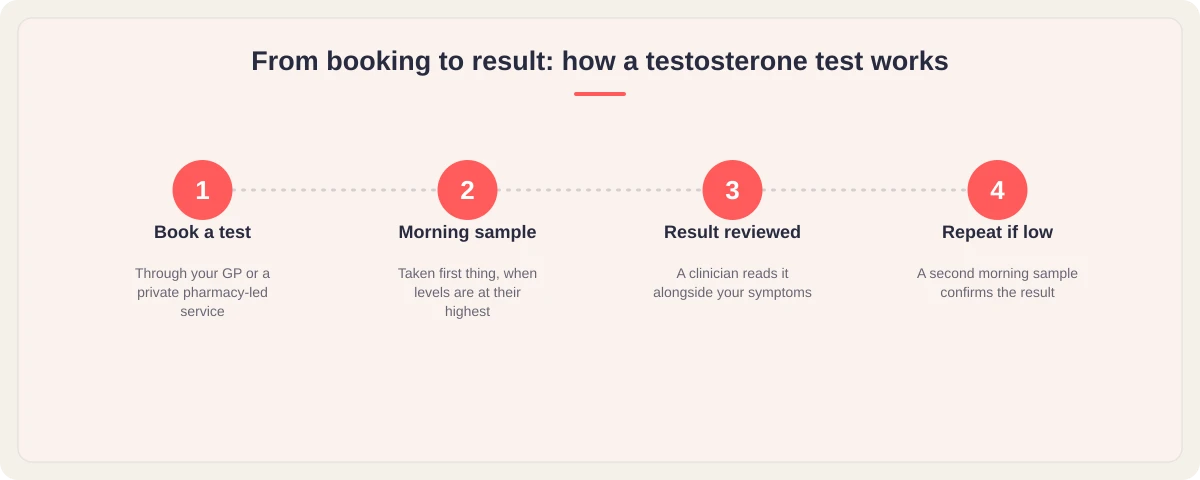
There are two main routes. Through your GP, a testosterone test can be arranged on the NHS where there is a clinical reason for it, usually alongside a review of your symptoms and medical history. Waiting times and exactly which other tests are added to the panel depend on local pathways.
Privately, pharmacy-led and online clinical services offer testing either as a venous blood draw at a local clinic or phlebotomy service, or as a home finger-prick kit you complete yourself and post to a lab. Both routes test the same thing; the difference is mainly speed, convenience, and whether a clinician reviews the result with you by phone or video call afterwards.
When to take the test: timing matters
Testosterone follows a daily rhythm. Levels are highest in the early morning and fall through the day, so UK guidance is to take the sample between roughly 7am and 11am for a reading that reflects your true baseline rather than a normal afternoon dip. A test taken later in the day can come back lower than your actual morning level, which is one of the most common reasons a result looks borderline when it is not.
Fasting is not usually required for testosterone itself. If your panel also includes tests such as cholesterol or blood glucose, you may be asked to fast beforehand, so it is worth checking the specific instructions your provider sends with the kit or appointment.
A single low reading is not treated as a diagnosis on its own. UK practice is to confirm a low result with a second early-morning sample, usually taken a few weeks apart, before low testosterone is formally diagnosed and any treatment is discussed.
Testosterone levels and age
Testosterone tends to decline gradually from around the 30s onwards, but the pace and extent of that decline varies considerably between individuals. Plenty of men in their 50s and 60s have levels comfortably within the normal range, while a younger man can occasionally have a genuinely low result that needs investigating rather than being written off as ageing.
Reference ranges also differ slightly between laboratories, depending on the specific assay used to measure the sample. This is why your result is reported alongside the range used by that particular lab, rather than against one fixed UK-wide number, and why comparing a result from one provider directly against a friend's result from another is not always a fair comparison.
This is also why age on its own is never used to diagnose low testosterone. A result is always read against your symptoms and the lab's own reference range, not against a general assumption about what counts as normal for your age.
What the result actually means
In the UK, testosterone is usually reported in nmol/L. A result sitting comfortably within the lab's reference range, with no significant symptoms, generally needs no further action. A result below range, especially alongside matching symptoms, points towards further investigation rather than an immediate label of low testosterone on its own.
Borderline results are the trickiest to interpret, and this is where LH and FSH become useful: these pituitary hormones help work out whether a low reading is coming from the testicles themselves (primary) or from signalling further up, at the pituitary or hypothalamus (secondary). Prolactin is often checked at the same time, since a raised level can point towards a separate pituitary cause that needs its own assessment before anything else is decided.
What happens if your result comes back low
If a low result is confirmed on a second morning sample, the next step is usually a wider panel rather than an immediate prescription. This typically includes LH, FSH and prolactin to help explain why levels are low, alongside general safety bloods such as a full blood count and liver function tests. A raised PSA can also be checked where age-appropriate, since this is part of the usual safety picture before testosterone treatment is considered.
Once the picture is clear, a clinician will talk through whether treatment is appropriate for you, subject to a full assessment. Options can include testosterone replacement therapy in different forms, such as Topical TRT gel or an injectable formulation, each with its own monitoring schedule once started. Our guide on the blood tests needed for TRT covers that monitoring in detail.
Questions worth asking before you book
Before booking a testosterone test, it is worth confirming a few things with your provider:
- Whether the sample needs to be taken in the morning, and by what time
- Whether it is a home finger-prick kit, a venous blood draw, or a choice of either
- Which other hormones, such as LH, FSH or SHBG, are included in the panel
- How and when you will get your result, and whether a clinician talks you through it
- What happens next, in practice, if your result comes back low or borderline
A provider who can answer these clearly before you book is a reasonable sign that the testing process, and what happens afterwards, has been properly thought through.
Frequently asked questions
Can I get a testosterone test through my GP?
Yes, if your symptoms or risk factors support it clinically. Your GP can arrange the required bloods, though which other tests are added alongside testosterone, and how quickly you are seen, depends on local pathways.
What is considered a low testosterone result in the UK?
Reference ranges vary slightly between laboratories, so your result is read against the specific range quoted on your report rather than a single nationwide cut-off. A clearly low total testosterone, together with matching symptoms and a confirmatory second sample, is what points towards a diagnosis, not one number taken in isolation.
Does the time of day affect a testosterone test?
Yes. Testosterone is highest in the early morning and falls through the day, so UK guidance is to take the sample between roughly 7am and 11am for an accurate baseline reading.
Do I need to fast before a testosterone test?
Not usually for testosterone itself. If your panel also includes tests such as cholesterol or glucose, you may be asked to fast beforehand, so it is worth checking the specific instructions from your provider.
How much does a private testosterone test cost in the UK?
Pricing varies between providers and depends on whether you choose a single test or a wider hormone panel with a clinician review built in. Our guide on TRT costs breaks down typical price ranges across the private and NHS routes in detail.
What happens if my test comes back low?
A single low result is usually followed by a second early-morning sample to confirm it, along with further bloods such as LH, FSH and prolactin. If low testosterone is confirmed, your clinician will discuss suitable next steps with you, which may include testosterone replacement therapy, subject to a full clinical assessment.