Omeprazole vs lansoprazole: is one better for acid reflux?
 Clinically reviewed by the My London Pharmacy clinical team
·25 November 2026
·7 min read
·Reviews on Trustpilot
Quick answer
Omeprazole and lansoprazole are both proton pump inhibitors with similar healing rates for reflux. Lansoprazole is often preferred if you take clopidogrel, since omeprazole can reduce its effect. Otherwise the choice usually comes down to cost, availability and how each suits you.
Both are proton pump inhibitors
Omeprazole and lansoprazole both belong to the same family of medicines, proton pump inhibitors (PPIs), alongside esomeprazole and pantoprazole. They work in the same way: they switch off the pumps in the cells lining the stomach that produce acid, which reduces how much acid is made and gives irritated tissue in the gullet a chance to heal.
Because they work through the same mechanism, neither is a stronger or a weaker acid reducer in a general sense. Both can treat heartburn, acid reflux and the inflammation of the gullet (oesophagitis) that long-term reflux can cause, and both are also used alongside some antibiotic courses to treat stomach ulcers linked to the bacterium H. pylori.
The differences between the two medicines are smaller and more specific than people often expect: how they interact with a small number of other medicines, how the usual doses compare, and some practical points around when and how you take them. None of these differences make one medicine generally more effective than the other for ordinary reflux.
Dose equivalence and how they compare in studies
At their usual pharmacy and prescription doses, omeprazole 20mg and lansoprazole 30mg are considered roughly equivalent to one another. Clinical trials comparing the two medicines for healing reflux oesophagitis, inflammation of the gullet caused by stomach acid, have generally found similar healing rates and similar relief of heartburn symptoms between the two at these standard doses, over similar treatment periods.
Higher prescription-only doses exist for both medicines (such as omeprazole 40mg or lansoprazole 30mg twice daily) for more severe or stubborn cases, but these are only used when a GP or specialist has assessed that a higher dose is needed, for example with confirmed severe oesophagitis or certain ulcer conditions.
In practical terms, this means that for most people with straightforward, typical reflux, neither medicine has a clear edge over the other in how well it controls symptoms or heals the gullet lining. If one PPI has not worked well for you in the past, that is not on its own a strong reason to assume the other will fail too, though it is worth mentioning to a pharmacist or GP if you are considering a switch for that reason, since the underlying cause may need a closer look instead.
Which to choose: interactions, timing and cost
The clearest practical difference between the two is an interaction with clopidogrel, a blood-thinning medicine commonly used after a heart attack, stroke or the fitting of a coronary stent. Omeprazole can reduce how well clopidogrel works, because the two compete for the same liver enzyme (CYP2C19) that activates clopidogrel into its working form. Lansoprazole has a smaller effect on this particular enzyme, so it is often the preferred PPI for someone taking clopidogrel long-term, though the final decision should always be made with whoever prescribes the clopidogrel, since individual circumstances vary.
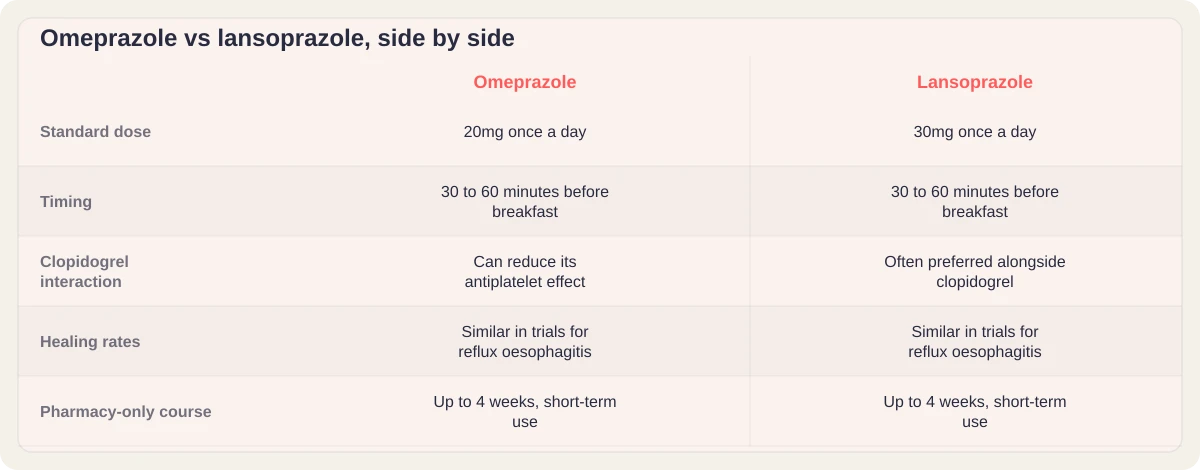
Outside of that specific interaction, the choice often comes down to simpler, more personal factors: which one is cheaper or more readily available where you usually shop, which pack size and strength suits how often you need treatment, and whether you have tried either medicine before without troublesome side effects. Both are taken once a day, generally 30 to 60 minutes before the first meal of the day, so timing on its own is not a deciding factor between the two.
A pharmacist can also take into account any other regular medicines you take when helping you choose, since both PPIs can affect how well some other drugs are absorbed from the stomach, including certain antifungal and HIV medicines, by changing the stomach's acidity.
Side effects and long-term use
Short courses of either medicine, the kind sold over the counter in a pharmacy, are generally well tolerated by most people. The most commonly reported side effects for both omeprazole and lansoprazole are headache, stomach upset or abdominal pain, wind, and changes in bowel habit such as constipation or diarrhoea. These usually settle on their own within a few days and rarely need treatment to be stopped.
Taking a PPI for months or years at a time, rather than the short courses that pharmacy packs are licensed for, is linked to a small increase in some specific risks. These include lower magnesium levels, reduced absorption of vitamin B12 over time, and a slightly higher chance of bone fractures with long-term, continuous use. There is also some evidence linking very long-term PPI use with a higher risk of certain gut infections, since stomach acid normally helps keep some bacteria in check.
None of this means long-term treatment is unsafe when it is genuinely needed for a diagnosed condition. It does mean that ongoing PPI use, with either medicine, should be reviewed with a GP or pharmacist from time to time, so that the lowest dose that controls your symptoms is used and the need for continued treatment is reassessed rather than the prescription simply being repeated indefinitely without anyone checking in.
Switching between omeprazole and lansoprazole
If you want to switch from one to the other, for example because of cost, local availability, or the clopidogrel interaction described above, this is usually straightforward given the dose equivalence between the two medicines (roughly omeprazole 20mg to lansoprazole 30mg). Most people can stop one medicine and start the other the very next day without needing a washout period or gap in treatment.
That said, it is sensible to check with a pharmacist before switching, particularly if you take other regular medicines, since a pharmacist can quickly check for any interactions specific to your situation and confirm the right strength for you. They can also advise on whether a gastro-resistant capsule, a dispersible tablet, or an orodispersible form might suit you better if swallowing standard capsules is difficult.
If switching from one PPI to the other does not meaningfully improve your symptoms, that is a useful signal in itself. It points towards the underlying reflux needing a different kind of attention, whether that is a change in dose, a closer look at triggers, or further investigation, rather than simply cycling through a third PPI brand in the hope of a different result.
When reflux needs review rather than another PPI
Reflux that has needed a PPI, of either kind, for more than four weeks without clear improvement is worth discussing with a pharmacist or GP rather than continuing to self-manage with repeat pharmacy purchases. The same applies to reflux that comes back quickly every time a short course finishes, since this pattern can benefit from a more thorough look at triggers, dose, timing and how long treatment is actually needed for.
Certain symptoms always need prompt medical assessment rather than simply starting another PPI course: difficulty or pain swallowing food, unexplained weight loss, vomiting blood or passing black, tarry stools, or reflux symptoms that started suddenly for the first time after the age of 55. These are not typical, straightforward reflux symptoms, and they need checking by a clinician rather than treating at home, since they can occasionally point to something that needs a closer look.
Simple lifestyle factors are also worth revisiting alongside any medicine: how close to bedtime you eat, portion sizes, alcohol and caffeine intake, smoking, and weight, since all of these can meaningfully affect how much reflux you get regardless of which PPI you take.
Our clinical team can help you work out whether omeprazole or lansoprazole is the better starting point for your situation, review how a course is progressing, and advise on sensible next steps if symptoms are not settling, subject to clinical suitability.
Frequently asked questions
Can I take omeprazole and lansoprazole together?
No. Taking two PPIs together does not give extra acid control and is not recommended; choose one at the appropriate dose rather than combining them.
Is lansoprazole stronger than omeprazole?
Not in a general sense. At their usual doses (omeprazole 20mg and lansoprazole 30mg) the two have shown similar healing rates and symptom relief in studies, so neither is reliably stronger than the other.
Why would a pharmacist recommend lansoprazole over omeprazole?
The main reason is the clopidogrel interaction: omeprazole can reduce how well clopidogrel works, so lansoprazole is often preferred for people taking that blood thinner. Cost, availability and personal tolerance can also play a part.
How long can I take omeprazole or lansoprazole for?
Pharmacy-bought packs of either are licensed for short courses, usually up to four weeks. Longer-term use is sometimes appropriate but should be reviewed by a GP or clinician rather than continued indefinitely on your own.
Can I switch from omeprazole to lansoprazole straight away?
Most people can switch the next day without a gap, since the two are considered roughly dose-equivalent. Check with a pharmacist first if you take other regular medicines.
Do omeprazole and lansoprazole have the same side effects?
Largely yes. Both commonly cause mild headache, stomach upset, wind or changes in bowel habit, and both carry the same small long-term risks around magnesium, B12 and bone health with extended use.