What does gastro-resistant mean? Tablets and capsules explained
 Clinically reviewed by the My London Pharmacy clinical team
·23 November 2026
·7 min read
·Reviews on Trustpilot
Quick answer
Gastro-resistant (enteric-coated) tablets and capsules have a special coating that stops them dissolving in stomach acid, so the medicine releases further down in the small intestine. This protects acid-sensitive drugs such as omeprazole, or protects your stomach lining from medicines like aspirin. Swallow them whole; never crush, chew or split them.
What a gastro-resistant coating actually does
"Gastro-resistant" is the official term used on UK medicine packets and patient information leaflets for what most people know as an "enteric-coated" tablet or capsule. It means the outer coating is designed to resist your stomach acid: it stays intact while the tablet passes through the stomach, then dissolves once it reaches the small intestine, where conditions are far less acidic.
Your stomach normally sits at a strongly acidic pH, while the small intestine just beyond it is much closer to neutral. A gastro-resistant coating is built to respond to that change: it holds firm in the acid, then breaks down once the tablet moves past the stomach. That timing matters for two quite different reasons, depending on the medicine, which the next section covers.
You will usually see the words "gastro-resistant" printed directly on the box or the strip of foil, sometimes shortened to "e/c" or "EC" on older packaging and some pharmacy labels. It is worth checking for this wording whenever you are prescribed a new tablet or capsule, since it tells you something about how the medicine needs to be taken, not just what it is for.
Why some medicines need this coating
Not every tablet needs a gastro-resistant coating, and the reason for using one depends on the drug. Broadly, there are two situations.
Protecting the drug from the acid. Medicines such as Omeprazole and Lansoprazole are acid-labile: stomach acid itself starts to break them down before they can be absorbed. A gastro-resistant coating shields the drug until it reaches the small intestine, where it can be absorbed intact and go on to do its job of reducing acid production.
Protecting your stomach from the drug. For some anti-inflammatory painkillers, the coating works the other way round. Naproxen Gastro-Resistant Tablets are coated so the drug does not sit directly against the stomach lining in concentrated form, which can otherwise contribute to irritation or, with long-term use, a higher risk of stomach problems. The coating does not remove that risk entirely, but it is one part of taking the medicine more safely.
Low-dose aspirin taken regularly for heart or circulation reasons is often prescribed in a gastro-resistant form for the same reason as naproxen: it is the direct contact between the drug and the stomach lining, repeated day after day, that the coating is there to reduce. If you are ever switched between a standard and a gastro-resistant version of the same medicine, it is worth asking your pharmacist why, since it usually reflects how your stomach has been coping rather than a change in your underlying dose.
How to take gastro-resistant tablets and capsules correctly
The coating only works if the tablet or capsule reaches your stomach and small intestine in one piece, so how you take it matters as much as which medicine you have been prescribed.
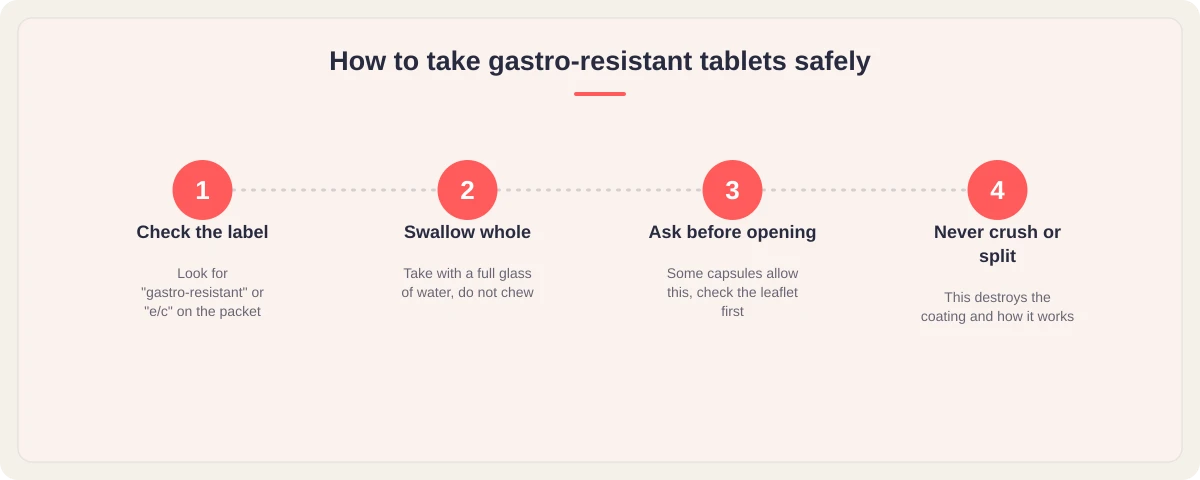
A few practical points worth keeping in mind: take the dose with a full glass of water so it moves through to the stomach promptly, and try to take it around the same time each day if your prescription asks for that. If you also take an antacid or an indigestion remedy, leave a gap of a couple of hours either side where you can, since some antacids can affect how well a gastro-resistant coating or the drug inside it works. If you are ever unsure about timing with your other medicines, your pharmacist can check this against everything else you take.
Why you must never crush, chew or split them
Crushing, chewing or splitting a gastro-resistant tablet breaks the coating, which defeats the entire purpose of the design. For an acid-labile drug such as omeprazole, a broken coating means the medicine is exposed to stomach acid early and a meaningful part of the dose can be degraded before it is ever absorbed, so the medicine may work less well. For a gastro-resistant painkiller, a broken coating means the drug sits against the stomach lining in a way it was specifically designed to avoid.
Capsules are a slightly different case from tablets. Some gastro-resistant capsules are filled with tiny coated pellets or granules rather than a single solid core, and for certain products the patient information leaflet explicitly allows the capsule to be opened and the pellets swallowed with water or soft food, without chewing, for people who find swallowing capsules difficult. This is not true for every product, and it is never true for a gastro-resistant tablet. Always check the patient information leaflet that comes with your specific medicine, or ask your pharmacist, before opening anything.
If you take a tablet or capsule through a feeding tube, or you give medicines to someone else this way, never assume a gastro-resistant product can simply be dispersed in water and put down the tube. The coating usually blocks fine tubes or clumps unpredictably, and even where it does not, the drug may be released in the wrong place. A pharmacist can check whether a liquid, dispersible or otherwise suitable alternative exists for that specific medicine.
Gastro-resistant vs modified-release vs prolonged-release
These terms get mixed up often, but they describe different things. "Gastro-resistant" is about where a medicine is released: it is held back until it clears the stomach, purely to manage acid exposure.
"Modified-release" and "prolonged-release" (sometimes written as MR, SR or XL on a label) are about timing rather than location. These coatings or formulations release the drug gradually over several hours, so levels in your body stay steadier and you may need fewer doses a day. A tablet can be modified-release without being gastro-resistant, and vice versa; a small number of products combine both properties. The practical point is the same either way: these formulations are engineered to release in a specific way, so crushing, chewing or splitting any of them, not just gastro-resistant ones, can change how much drug reaches your system and when.
What to do if you have already crushed, chewed or split a dose
If it has already happened, try not to worry about that single dose; it is rarely a reason for an emergency. The usual advice is to take your next dose as normal at the right time rather than trying to make up for it, and to take extra care with the formulation from then on. If you are not sure whether to take an extra dose, skip one, or do something else, your pharmacy, NHS 111, or your GP surgery can advise based on the specific medicine, your dose and how it was taken.
Contact NHS 111, your GP, or go to urgent care if you take a much larger amount than prescribed, if you feel unwell after taking a dose incorrectly, or if the medicine is one your prescriber has told you needs particularly careful handling. For most routine, one-off mix-ups with a single tablet, the practical answer is simply to carry on as prescribed and ask your pharmacist how to avoid it next time, for example by requesting a different formulation if swallowing whole tablets is consistently difficult.
Questions worth asking your pharmacist
If you are starting a new gastro-resistant medicine, or you are struggling to take one as prescribed, a pharmacist can talk you through it in a couple of minutes. Useful questions include:
- "Can this capsule be opened if I find it hard to swallow whole?"
- "What should I do if I have already chewed or crushed a dose by mistake?"
- "Can I take this alongside an antacid, or another stomach medicine I already use?"
- "Is there a different formulation of this medicine if I consistently struggle with this one?"
If swallowing tablets or capsules is a recurring problem rather than a one-off, it is worth raising this directly rather than working around it, since there may be a more suitable formulation or an alternative medicine for your situation.
Frequently asked questions
What does "gastro-resistant" mean on a medicine label?
It means the tablet or capsule has a coating designed to resist stomach acid, so it stays intact in the stomach and releases the medicine once it reaches the small intestine instead.
Is gastro-resistant the same as enteric-coated?
Yes. "Enteric-coated" is the older, informal name for the same thing. UK patient information leaflets and packaging now generally use the term "gastro-resistant".
Can I crush a gastro-resistant tablet if I struggle to swallow it?
No. Crushing destroys the coating, which can make the medicine less effective or increase stomach irritation depending on the drug. Speak to your pharmacist about an alternative formulation instead.
Can I open a gastro-resistant capsule and take the contents separately?
Sometimes, but only for specific products where the patient information leaflet says this is acceptable. It is never appropriate for a gastro-resistant tablet. Always check the leaflet or ask a pharmacist first.
Is modified-release the same as gastro-resistant?
No. Gastro-resistant is about location, releasing past the stomach rather than in it. Modified-release is about timing, releasing the dose gradually over several hours. A medicine can be one, both or neither.
Can I take gastro-resistant omeprazole with an antacid?
It is best to leave a gap of a couple of hours between the two where possible, since some antacids can interfere with how well the coating or the medicine works. Ask your pharmacist if you are not sure about your specific products.