
Threadworm treatment: how to get rid of them for the whole family
Quick answer
Threadworm treatment usually means one dose of mebendazole for everyone in the household on the same day, repeated after two weeks if advised. Alongside this, strict hygiene, daily washing, clean underwear, short nails and hot-washed bedding, helps stop eggs spreading and the same people becoming reinfected.
What are threadworms?
Threadworms are small, thread-like white worms, usually between 2mm and 13mm long, that live in the gut and are the most common worm infection in the UK. They are especially common in young children, who then often pass them on to the rest of the household.
The eggs are swallowed, usually from hands, food or household surfaces, and hatch in the small intestine. The young worms then travel to the large intestine to mature, which takes around two to three weeks from the first swallowed egg to a fully grown worm.
A female threadworm then travels out through the anus at night to lay her eggs on the surrounding skin, which causes the itching that is the main symptom. Scratching picks up eggs on the fingers and under the nails, and from there they can spread to bedding, clothing, toys and food, starting the cycle again in the same person or in someone else. The eggs can also survive on hard surfaces and in dust for a couple of weeks, which is part of why threadworms spread so readily in households, nurseries and schools.
Threadworms are not a sign of poor hygiene. Anyone can pick up the eggs, since they are extremely common and spread easily wherever people share close contact, regardless of how clean a home is.
Threadworm symptoms: what to look out for
The most common sign is itching around the anus, which is often worse at night when the female worms are most active. In girls and women, the itching can sometimes also affect the vagina, and occasionally cause irritation or a change in discharge.
- Intense itching around the bottom, usually worse at night
- Disturbed sleep or irritability, particularly in children, due to the night-time itching
- Visible worms in stools, in a nappy, or around the anus, looking like small pieces of white thread that may still be moving
- Occasional mild tummy discomfort or a reduced appetite, though many people have no other symptoms at all
- Rarely, scratching breaks the skin and leads to mild soreness or a secondary skin irritation around the area
Some people have threadworms with no symptoms at all and only find out when a worm is spotted in a nappy, underwear or the toilet. A simple way to check at home is the sticky tape test, pressing a strip of clear tape against the skin around the anus first thing in the morning, before washing, then looking at it for small white worms or eggs. If you are not sure what you are looking at, a pharmacist can usually advise based on a description or photo, without needing a GP appointment.
Threadworm treatment: what actually works
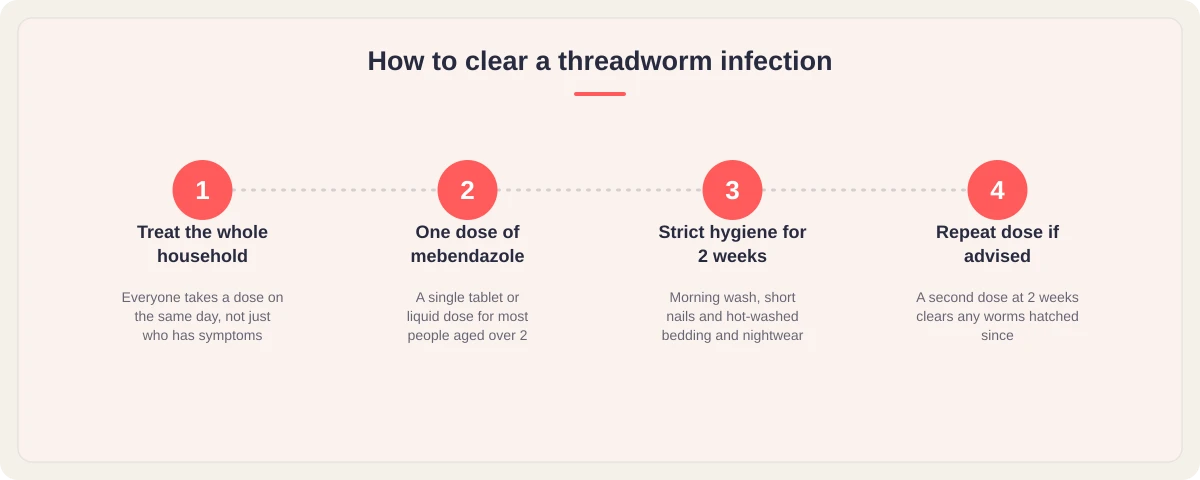
The standard over-the-counter treatment is mebendazole, taken as a single dose in tablet or liquid form, which is available from a pharmacy without a prescription for most adults and children over 2 years old. It works by stopping the worms absorbing sugar, which kills them over the following day or two, though it does not kill the eggs already laid, which is why hygiene measures matter just as much as the tablet itself.
A second dose two weeks after the first is sometimes recommended, since any eggs that survived the first dose and have since hatched into adult worms will be cleared by the repeat treatment before they can lay eggs of their own. A pharmacist can advise whether this applies to your situation, and on dosing for different ages, since liquid formulations are often used for younger children who cannot swallow a tablet.
Treatment will not work well on its own. Without strict hygiene alongside it, reinfection from eggs already in the home is common, which is why people sometimes feel the tablets have not worked when the real issue is new eggs being swallowed again after treatment. Most people notice itching easing within a few days, though it can take a little longer for symptoms to settle completely.
Why the whole household needs treating together
Because threadworm eggs spread so easily between people sharing a home, pharmacists generally advise treating everyone in the household on the same day, not just the person with symptoms. Someone without symptoms can still be carrying eggs and reinfect everyone else once the symptomatic person has been treated, since many threadworm infections cause no noticeable symptoms at all.
This includes adults as well as children, even if an adult has never noticed any itching, and anyone who regularly stays over, such as a partner living between two households or a child who splits time between separated parents. A pharmacist can confirm who in your household is suitable for mebendazole and advise on alternatives for anyone who is not, such as very young children or during early pregnancy.
Treating everyone together, on the same day, also makes the hygiene measures that follow far more effective, since a household working to the same routine and timeline is less likely to pass eggs back and forth between members who are on different schedules.
Hygiene measures that stop reinfection
Hygiene measures matter for about two weeks from the first dose, covering the time it takes for any surviving eggs to be cleared from the home and from under fingernails.
- Wash hands and scrub under nails before eating and after using the toilet
- Keep nails short, and discourage nail-biting and thumb-sucking where possible
- Have a bath or shower each morning to remove eggs laid overnight, rather than a bath in the evening
- Wear close-fitting underwear at night, changed each morning
- Wash sleepwear, bedding and towels on a hot cycle after the first one or two nights of treatment
- Vacuum floors and damp-dust surfaces, including window sills and skirting boards, since eggs can survive outside the body for a couple of weeks
- Avoid shaking bedding and nightwear before washing, which can scatter eggs into the air and onto nearby surfaces
Keep this routine going for the full two weeks, even once the itching has settled, since symptoms often ease before all the eggs in the environment have been dealt with. Children do not usually need to be kept off school or nursery once treatment has started, provided hands are washed regularly and nails are kept short.
Babies, pregnancy and other situations needing extra care
Mebendazole is not usually recommended for children under 2, or during the first trimester of pregnancy, and some people with certain liver conditions or who take particular other medicines may need a different approach. In these situations, a pharmacist can advise on hygiene-only management, which, kept up strictly for six weeks rather than two, can clear an infection without medication since it relies on breaking the cycle of reinfection until the current worms die off naturally, rather than killing them directly.
For babies and toddlers under 2, this usually means very frequent nappy changes and handwashing for everyone caring for them, along with the same bedding and surface hygiene described above, kept up for the full six weeks. Breastfeeding is not generally a reason to avoid mebendazole for the parent, but it is still worth checking with a pharmacist first.
If you are pregnant, breastfeeding, or treating a baby, it is worth speaking to a pharmacist before starting treatment, so you get guidance suited to your specific situation and stage of pregnancy rather than a general recommendation.
When to speak to a pharmacist or GP
Most threadworm infections are straightforward to manage from a pharmacy, without needing to see a GP. It is worth asking a pharmacist for advice, or booking a GP appointment, if symptoms do not improve after treating the whole household and following hygiene advice for a couple of weeks, if a child under 2 or someone pregnant is affected, or if you notice bleeding, ongoing tummy pain, weight loss, or are simply unsure what you are seeing.
A pharmacist can also talk through options if threadworms keep coming back despite repeated treatment, since recurring infections are usually down to a source of reinfection within the household, such as a family member who was missed, or hygiene measures that lapsed before the full two weeks, rather than the treatment itself failing to work.
Threadworms are unpleasant and disruptive to sleep, but they are not dangerous, and with the household treated together and hygiene kept up, most people clear them fully within a couple of weeks.
Frequently asked questions
Do I need a prescription for threadworm treatment?
No. Mebendazole, the standard threadworm treatment, is available from a pharmacy without a prescription for most adults and children over 2. A pharmacist can advise if it is not suitable for you or your child.
How quickly does threadworm treatment work?
Mebendazole starts killing the worms within a day or so, though it can take a week or more for itching to fully settle as the gut clears. It does not kill the eggs, so hygiene measures need to continue for about two weeks alongside it.
Does everyone in the house really need treating, even without symptoms?
Yes, this is the usual pharmacy advice. Threadworm eggs spread easily between people sharing a home, and someone without symptoms can still carry eggs and reinfect the household after the symptomatic person has been treated.
Can I treat threadworms without medication?
Yes, if medication is not suitable, such as for a baby under 2 or during early pregnancy, strict hygiene measures kept up for six weeks can clear an infection on their own by stopping eggs being swallowed again.
Why do threadworms keep coming back in my household?
Recurring infections are usually a sign that hygiene measures were not kept up for the full two weeks, or that someone in the household was not treated at the same time. A pharmacist can help you work through likely sources of reinfection.
Is it true threadworms mean poor hygiene?
No. Threadworm eggs are extremely common and spread easily in nurseries, schools and shared households regardless of how clean a home is. Picking them up is not a reflection of hygiene standards.