
Thrush or UTI? How to tell the difference and treat the right one
 Clinically reviewed by Zeenah Araim, GPhC 2077620
·26 November 2026
·6 min read
·Reviews on Trustpilot
Quick answer
Thrush causes itching, soreness and a thick white discharge. A UTI causes burning when you wee, needing to go often, and sometimes cloudy or smelly urine. They have different causes, so they need different treatment, and having antibiotics for a UTI can trigger thrush afterwards.

Two different problems in neighbouring places
Thrush and urinary tract infections (UTIs) both affect the area between your legs, which is why the symptoms can feel confusingly similar at first. But they are caused by completely different things. Thrush is an overgrowth of a fungus called Candida that normally lives harmlessly on the skin and in the vagina in small numbers. A UTI is a bacterial infection, usually of the bladder, caused by bacteria (often originating in the bowel) getting into the urinary tract through the urethra.
Because the vaginal opening and the urethra sit so close together anatomically, soreness from one area can easily be mistaken for the other, especially around urinating. Women are more prone to both problems than men for the same basic reason: a shorter urethra gives bacteria a shorter distance to travel to the bladder, and the warm, moist environment of the vulva and vagina suits Candida.
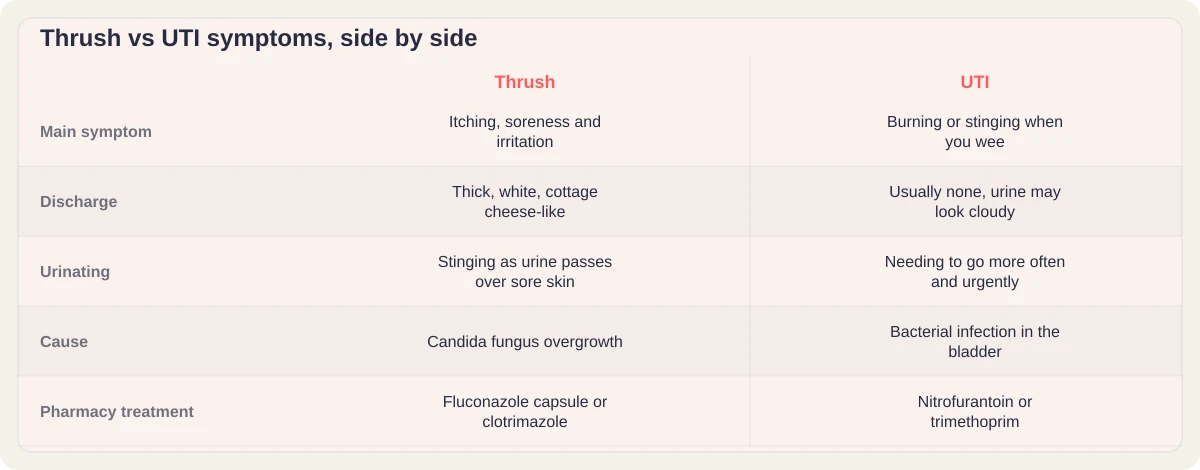
The table below is a quick way to compare the two conditions side by side before you decide what to do next.
Symptoms that point to thrush
Thrush tends to cause symptoms that sit on and around the vulva and vagina rather than inside the urinary tract itself. Typical signs include:
- Itching and irritation around the vulva and vagina
- Soreness or a stinging, burning feeling, especially during sex
- A thick, white vaginal discharge, often described as looking like cottage cheese, usually without a strong smell
- Redness and swelling of the vulva
- Stinging when urine passes over already-sore, inflamed skin, rather than a true burning sensation inside the urethra
That last point is the one that trips people up. The soreness of thrush can make weeing uncomfortable, but it is the skin stinging as urine passes over it, not a bladder problem.
Thrush is more likely to flare up after a course of antibiotics, during pregnancy, in people with poorly controlled diabetes, or after wearing tight, non-breathable underwear for long periods. None of these need to apply for thrush to develop, but they are common triggers worth being aware of.
Symptoms that point to a UTI
A UTI, most often a bladder infection (cystitis), tends to cause symptoms centred on urination itself:
- A burning or stinging pain when you wee, felt inside rather than on the skin surface
- Needing to wee more often than usual, including at night
- A sudden, strong urge to go, sometimes with little urine actually passed
- Urine that looks cloudy or smells stronger or different than usual
- A dull ache or pressure low in the tummy or pelvis
There is usually no significant vaginal discharge with a straightforward UTI. If discharge and itching are prominent, that points more towards thrush, a mixed picture, or another cause that is worth getting checked.
UTIs are also more common after sex, after menopause when natural changes in the vaginal and urethral tissue make infection more likely, and in anyone who does not fully empty their bladder, for example due to constipation pressing on the bladder.
Can you have both at once
Yes, and it happens more often than you might think. There are two common patterns. First, a course of antibiotics taken for a UTI can disturb the normal balance of bacteria in the vagina, allowing Candida to overgrow afterwards, so thrush can follow a UTI within a few days of finishing treatment. Second, the irritation and soreness from one condition can make the other feel worse, or make it harder to tell which symptoms belong to which problem, since inflamed, sore skin stings whenever urine touches it regardless of the underlying cause.
If your symptoms do not fit neatly into one list above, for example you have both itching and discharge as well as genuine burning felt inside when you wee, it is reasonable to treat whichever fits best first, but a pharmacist or GP can help sort out a mixed picture rather than you guessing and buying the wrong product twice.
Treatment for each and why the wrong one does nothing
Because thrush and UTIs have different causes, they need different treatments, and using the wrong one will not help, and can waste time while symptoms carry on.
Thrush is treated with an antifungal. A single Fluconazole 150mg Thrush Capsule taken by mouth is the most common pharmacy option, and clotrimazole is available as a cream or a pessary inserted into the vagina for those who cannot take fluconazole, including in pregnancy, when the oral capsule is not recommended. Antifungals target the Candida fungus directly and have no effect on bacteria. Alongside treatment, avoiding perfumed soap, shower gel and douches around the vulva, and switching to loose cotton underwear, can help symptoms settle and reduce the chance of a quick repeat episode.
An uncomplicated UTI in women is treated with a short course of antibiotics, usually Nitrofurantoin 100mg MR Capsules for Women or Trimethoprim 200mg for Women, in line with NICE guidance (NG109). These antibiotics kill or stop the growth of the bacteria causing the infection. They do nothing for a fungal overgrowth, which is why taking an antibiotic for thrush, or an antifungal for a UTI, will not clear the symptoms, it may even make things worse by further disrupting the vaginal flora. Drinking plenty of water and taking paracetamol for discomfort can help alongside antibiotics, but these measures alone will not clear an established bacterial infection.
If you are not sure which one you have, a pharmacist can usually help you work it out from your symptoms before recommending the right product, often without needing to see a GP first.
When to see a clinician and get a test
Most episodes of thrush or an uncomplicated UTI can be managed with an over-the-counter antifungal or a short course of antibiotics from a pharmacist. See a GP, call NHS 111, or book a consultation instead of self-treating if you have:
- Blood in your urine
- Fever, chills, or pain in your back or side (possible signs of a kidney infection, which needs urgent attention)
- Symptoms that have not improved, or have come back quickly, after treatment
- Recurrent episodes, such as two or more UTIs in six months, or thrush that keeps returning
- You are pregnant
- You are male, as urinary symptoms in men are assessed differently and are less often a simple bladder infection
- You have never had thrush or a UTI confirmed before and are not sure which this is
A simple urine test or vaginal swab can confirm what you are actually dealing with, which matters if symptoms keep coming back or do not settle with the usual treatment. Getting the right diagnosis once, rather than cycling through pharmacy products, is usually the quickest route back to feeling comfortable.
Frequently asked questions
Can you have thrush and a UTI at the same time?
Yes. It is common for thrush to develop after a course of antibiotics for a UTI, because the antibiotics disturb the normal bacterial balance in the vagina. The two can also simply occur close together by chance.
Does fluconazole treat a UTI?
No. Fluconazole is an antifungal that treats thrush by targeting the Candida fungus. It has no effect on the bacteria that cause a UTI, so it will not clear a bladder infection.
What is the main difference between thrush discharge and UTI symptoms?
Thrush typically causes a thick, white discharge along with itching and soreness. A straightforward UTI usually causes little or no discharge, with the main symptoms being burning when you wee and needing to go more often.
Can antibiotics for a UTI cause thrush afterwards?
Yes, this is a well-recognised pattern. Antibiotics can reduce the bacteria that normally keep Candida in check in the vagina, allowing it to overgrow and cause thrush in the days after a course finishes.
Is it safe to self-treat if I am not sure whether it is thrush or a UTI?
If your symptoms clearly match one list, a pharmacy antifungal or, where appropriate, a short course of antibiotics is usually fine. If symptoms are mixed, severe, or you are pregnant, male, or have red-flag symptoms such as fever or blood in your urine, speak to a pharmacist or GP first rather than guessing.
How quickly should treatment start working?
A single-dose antifungal for thrush often eases symptoms within a few days, though full relief can take a week. Antibiotics for an uncomplicated UTI usually improve symptoms within two to three days. If there is no improvement in that time, get it checked rather than continuing to self-treat.