
What to eat while taking antibiotics (and what to avoid)
 Clinically reviewed by the My London Pharmacy clinical team
·27 November 2026
·7 min read
·Reviews on Trustpilot
Quick answer
Some antibiotics work best on an empty stomach, others need food to avoid an upset stomach, and a few interact with dairy or alcohol. The right approach depends on which antibiotic you've been prescribed, so always check the patient information leaflet or ask your pharmacist if you're not sure.
With food or on an empty stomach? It depends on the antibiotic
There is no single rule for eating and drinking while taking antibiotics. Some work just as well with or without food, some need food to reduce stomach upset, and a few are less effective if taken alongside dairy products, calcium supplements or certain other medicines. The right approach depends entirely on which antibiotic you have been prescribed, not on antibiotics as a group, since different families of antibiotics behave quite differently once they reach your gut.
The patient information leaflet that comes with your medicine, or the pharmacy label on the box, will tell you exactly what applies to your course. If anything in this guide seems to conflict with that leaflet, follow the leaflet: it is written for your specific product, strength and dose, and your pharmacist can always talk you through it if anything is unclear or the wording seems ambiguous.
As a general rule, 'with food' means during or shortly after a meal or snack, rather than on a completely empty stomach; it does not need to be a large meal, and a slice of toast, a banana or a small bowl of cereal is usually enough to count. Staying well hydrated, with water rather than fizzy or sugary drinks where possible, also supports your recovery alongside whatever you eat.
Antibiotics that need food, and ones that work best on an empty stomach
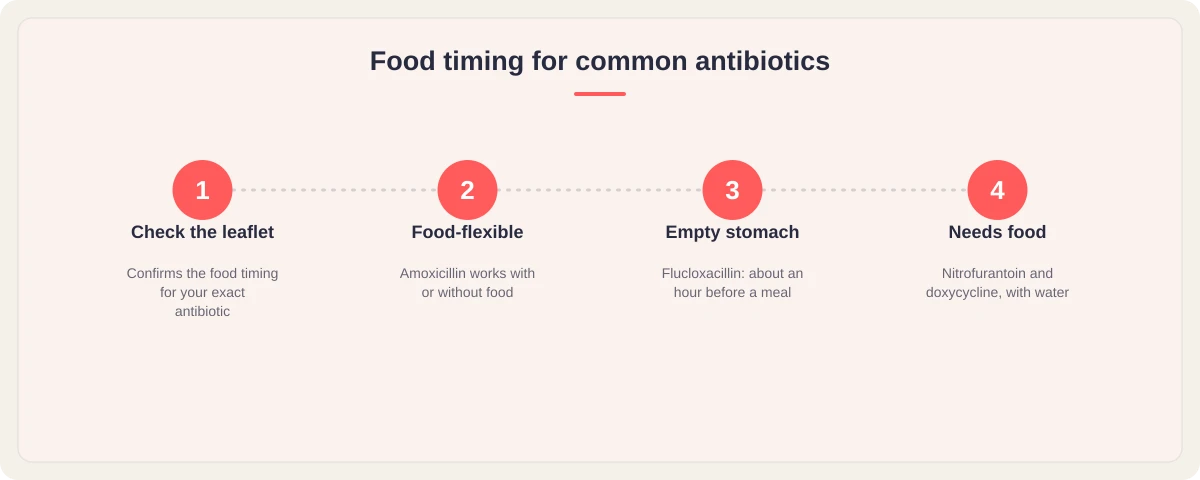
Amoxicillin, one of the most commonly prescribed antibiotics in the UK, can be taken with or without food; it makes no real difference to how well it works, so take it whenever suits your routine. Co-amoxiclav is usually best taken with food, since it can be harder on the stomach than amoxicillin alone.
Flucloxacillin and phenoxymethylpenicillin (penicillin V) are different: both are absorbed better on an empty stomach, so the usual advice is to take them around an hour before a meal, or roughly two hours after one. Nitrofurantoin, often prescribed for cystitis, is best taken with food, which also helps reduce nausea and improves how well it is absorbed. Doxycycline should be swallowed with a full glass of water while sitting or standing upright, ideally with or just after food, since taking it on an empty stomach can irritate the gullet.
- With food: nitrofurantoin, doxycycline, co-amoxiclav (plus plenty of water)
- Either, food or none: amoxicillin, cephalexin
- On an empty stomach: flucloxacillin, phenoxymethylpenicillin
If you are ever unsure which category your antibiotic falls into, the leaflet in the box will say, and a pharmacist can confirm it quickly over the phone or in person, including for antibiotics not listed here.
Dairy, calcium and the tetracyclines
Doxycycline belongs to a group of antibiotics called tetracyclines, and these interact with calcium, iron, zinc and magnesium in a way that matters for how well they work. Taking doxycycline together with milk, cheese, yoghurt, calcium or iron supplements, or indigestion remedies containing these minerals, can bind to the drug in your gut and reduce how much your body absorbs, making the dose less effective against your infection.
The simplest fix is timing rather than cutting these foods out altogether: leave a gap of around two hours between taking doxycycline and having dairy, calcium or iron supplements, or antacids. You do not need to avoid dairy completely for the whole course of treatment, just keep it clear of the dose itself on either side.
Amoxicillin, flucloxacillin, nitrofurantoin and most other common antibiotics do not have this dairy and mineral interaction, so this advice is specific to tetracyclines such as doxycycline and lymecycline, not to antibiotics in general. Grapefruit juice is also worth a mention: it can affect how some antibiotics, including certain macrolides, are broken down in the body, so it is sensible to check the leaflet if you drink it regularly.
Alcohol and antibiotics: metronidazole and the rest
Metronidazole is the one widely used antibiotic where alcohol genuinely needs to be avoided altogether, not just cut down. Drinking alcohol during a course of metronidazole, and for 48 hours after your last dose, can trigger a reaction with flushing, nausea, vomiting, a fast heartbeat and headache. This is a well documented interaction, not a theoretical caution, and it applies to metronidazole gel and vaginal preparations too if enough is absorbed.
For most other antibiotics, including amoxicillin, doxycycline, flucloxacillin and nitrofurantoin, an occasional drink is not dangerous in the way it is with metronidazole. That said, alcohol can still make some side effects, such as nausea, dizziness or drowsiness, feel worse, and it tends to disrupt sleep and hydration at a time when your body is trying to fight off an infection, both of which can slow your recovery.
A sensible approach for any course of antibiotics is to keep alcohol light or absent until you are feeling better and have finished the course, and to check the leaflet for your specific medicine if you are not sure which category it falls into.
Probiotics and gut recovery
Antibiotics do not just target the bacteria causing your infection, they also disturb the balance of bacteria that live naturally in your gut. This is why diarrhoea, bloating, wind or a generally upset stomach are common while taking them, and sometimes for a short while afterwards as your gut bacteria recover.
Evidence for probiotic supplements preventing antibiotic-associated diarrhoea is moderate rather than definitive: some trials show a worthwhile benefit, particularly with certain well-studied strains, while others show little difference. If you want to try one, it is usually best to take it a few hours apart from your antibiotic dose rather than at exactly the same time, since taking them together can reduce the probiotic's own survival and effect.
Live yoghurt and other fermented foods, such as kefir or sauerkraut, are a reasonable, low-risk option alongside or instead of a supplement, and most people tolerate them well during a course of antibiotics. Plenty of fluids and a normal, varied diet also help your gut settle once the course has finished.
Finishing the course, and what to do if you are sick after a dose
Unless your prescriber or pharmacist tells you otherwise, finish the full course even if you start feeling better after a day or two. Stopping early can allow the infection to come back, sometimes more stubbornly, and contributes to antibiotic resistance, which is one reason pharmacies and prescribers take dosing instructions seriously.
If you vomit within about 30 minutes of taking a dose, it is generally reasonable to take another one, since most of it probably was not absorbed. If it has been longer than that, or you are genuinely unsure, do not double up: wait until your next scheduled dose, and speak to a pharmacist if you keep being sick, cannot keep fluids down, or you are worried the infection is not improving.
If you miss a dose altogether, take it as soon as you remember unless it is nearly time for the next one, in which case skip the missed dose and carry on as normal from there. Never take two doses together to make up for a missed one, and contact a pharmacist if you are not sure how to get back on track.
It also helps to keep taking your antibiotics at roughly the same times each day, spaced as evenly as the dosing schedule allows, since steady levels in your blood are part of how the medicine keeps working between doses. A simple reminder on your phone, or taking the dose alongside an existing daily habit such as breakfast or brushing your teeth, makes this easier to keep up for the full length of the course.
Frequently asked questions
Can I drink coffee or tea while taking antibiotics?
Yes, for most antibiotics. Caffeine does not interact with common antibiotics such as amoxicillin, doxycycline or nitrofurantoin. If you have been prescribed ciprofloxacin, caffeine can build up in your system more than usual, so it is worth cutting back a little during that specific course.
Do I need to avoid all dairy products on antibiotics?
No, only if you are taking a tetracycline such as doxycycline, and even then it is about timing rather than avoidance. Leave roughly two hours between your dose and dairy, calcium or iron supplements, or antacids; dairy is fine the rest of the time, and with most other antibiotics there is no need to change your diet at all.
Is it safe to drink alcohol on antibiotics?
It depends on the antibiotic. Alcohol must be avoided completely with metronidazole, during the course and for 48 hours afterwards, because of a well documented reaction. With most other common antibiotics an occasional drink is not dangerous, though it can make side effects such as nausea feel worse and slow your recovery.
Should I take probiotics with antibiotics?
You can if you would like to. The evidence for probiotics reducing antibiotic-associated diarrhoea is moderate rather than definitive. If you try one, space it a few hours apart from your antibiotic dose, and live yoghurt or other fermented foods are a reasonable low-risk alternative.
What should I do if I am sick shortly after taking a dose?
If you vomit within about 30 minutes, it is generally fine to take another dose, since most of it likely was not absorbed. Beyond that window, wait for your next scheduled dose rather than doubling up, and speak to a pharmacist if sickness continues or you cannot keep fluids down.