
HbA1c test: what your blood sugar result means
Quick answer
An HbA1c test measures your average blood glucose over roughly two to three months, given as a single number in mmol/mol. Below 42 is normal, 42 to 47 suggests prediabetes and 48 or above indicates diabetes. Retesting frequency depends on your result and any treatment plan.
What an HbA1c test actually measures
HbA1c stands for glycated haemoglobin. Glucose in your blood attaches itself to haemoglobin, the protein in red blood cells that carries oxygen, and the more glucose has been circulating, the more of it sticks. Since a red blood cell survives for around two to three months, an HbA1c reading gives a picture of your average blood sugar over that whole period rather than a single moment in time.
This is what makes it different from a finger-prick or home glucose reading, which only shows your blood sugar at the point it was taken. A blood sugar level can shift within hours depending on food, activity or stress, so a single reading can be misleading on its own. HbA1c smooths those swings out, which is why it is the test most commonly used to check for, and monitor, type 2 diabetes.
The test itself is straightforward: a single blood sample, taken from a vein or sometimes a finger-prick device depending on where you are tested, sent for laboratory analysis. There is no need to prepare in any special way beforehand, and results are usually available within a few working days.
Where your result sits: normal, prediabetes or diabetes
HbA1c results in the UK are usually reported in mmol/mol, sometimes alongside the older percentage figure. The ranges used by the NHS and NICE to interpret a result are set out below.
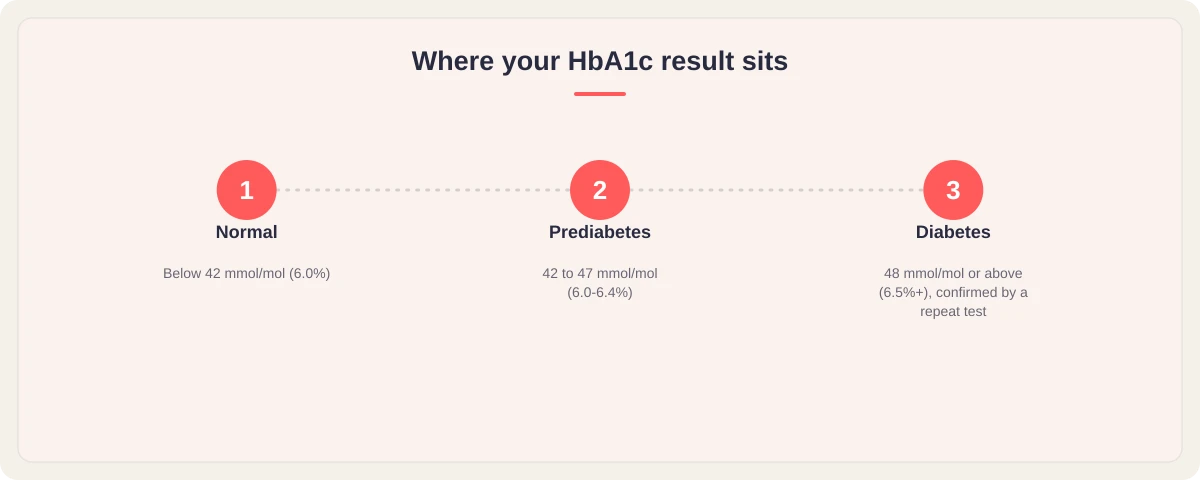
A result below 42 mmol/mol is within the normal range. Between 42 and 47 mmol/mol is described as prediabetes, sometimes called non-diabetic hyperglycaemia, meaning blood sugar is higher than average but not yet at the level used to diagnose diabetes. A reading of 48 mmol/mol or above is the threshold used to diagnose type 2 diabetes, though in someone without symptoms this is normally confirmed with a second test rather than acted on from a single result.
How and where you can get tested
An HbA1c test is done with a standard blood sample, either taken at your GP surgery, through an NHS health check, or via a private blood test. No fasting is needed beforehand, which makes it more convenient to arrange than a fasting glucose test.
You might be offered an HbA1c test if you have symptoms such as increased thirst, needing to urinate more often, or unexplained tiredness, or as part of routine screening if you have risk factors such as a family history of diabetes, being above a healthy weight, or a background linked with higher diabetes risk. A pharmacist can talk through whether testing makes sense for your circumstances and arrange a private test if you would rather not wait for a routine NHS appointment.
Some people choose a private HbA1c test simply for reassurance, for example before making changes to diet or activity levels, or to have a baseline reading to compare against in future. This can be useful, but a single number is more meaningful when a clinician helps you interpret it alongside your wider health picture rather than in isolation.
How often HbA1c should be checked
For people already diagnosed with diabetes, HbA1c is typically checked every three to six months. Testing tends to happen more frequently, around every three months, when treatment has recently changed or your levels are not yet at target, and can move to roughly every six months once things are stable and well controlled.
For people without a diabetes diagnosis but at higher risk, an annual check is generally the guidance, so that any upward drift can be picked up early. If your result falls in the prediabetes range, your GP or pharmacist will usually suggest a shorter interval for repeat testing so your progress can be tracked.
There is rarely a benefit to testing more often than advised. Because HbA1c reflects a two to three month average, checking it every few weeks will not show a meaningful change and can create unnecessary worry over small fluctuations that fall well within normal variation.
Things that can affect your reading
Because HbA1c reflects an average, day-to-day factors like a single meal or a stressful morning will not change it much. A few things can still affect the accuracy of the result, however. Certain types of anaemia, recent significant blood loss, some inherited variations in haemoglobin, and conditions that change how quickly red blood cells are replaced can all make an HbA1c reading less reliable.
Pregnancy is another situation where HbA1c is not usually relied on in the same way, since a different testing approach is generally used to check for gestational diabetes. If you are pregnant or planning a pregnancy, your midwife or GP will advise on the most appropriate test for you.
If any of these apply to you, your clinician may use an alternative test, such as a fasting plasma glucose test or an oral glucose tolerance test, either instead of or alongside HbA1c. This is worth mentioning at your appointment if you know of a relevant condition, so the right test is used to interpret your result correctly.
What happens if your result is raised
A single raised HbA1c result is not usually acted on straight away. In someone without symptoms, a reading in the diabetes range is typically confirmed with a second test before a diagnosis is made, since results can occasionally be affected by a temporary illness or one of the factors above.
A prediabetes result is not a diagnosis of diabetes, but it is treated as a point worth acting on. You may be offered support such as referral to a structured lifestyle programme, along with advice on diet and activity, and a plan for when to retest. A result in the diabetes range usually leads to a wider discussion about treatment options, further monitoring, and other checks such as blood pressure and cholesterol, since these often need to be considered together.
It is worth remembering that a raised result is a starting point for a conversation, not a verdict. Many people go on to bring a prediabetes reading back into the normal range, and even a diabetes diagnosis is very manageable once a plan is in place, particularly when it is picked up early through routine testing.
Lifestyle steps that can help
For people with a prediabetes result, or diabetes managed through lifestyle changes, small consistent adjustments tend to make more difference than short-term overhauls. This includes reducing refined carbohydrates and sugary drinks, building regular movement into the week, prioritising sleep, and, where relevant, working towards a healthy weight at a realistic pace.
Consistency matters more than intensity. A pattern of regular walking, more balanced meals and better sleep, kept up over months, is far more likely to shift an HbA1c reading than a strict short-term diet that is hard to sustain. Many people find it easier to make one or two changes at a time rather than trying to overhaul everything at once.
None of this replaces medical advice tailored to your own result and health history. If you are unsure what your HbA1c means for you, or what a realistic next step looks like, a GP or pharmacist can talk you through it and agree a plan alongside any monitoring you need.
Frequently asked questions
What is a good HbA1c level in the UK?
A result below 42 mmol/mol (6.0%) is considered normal. A reading of 42 to 47 mmol/mol falls into the prediabetes range, and 48 mmol/mol or above is used to diagnose type 2 diabetes, usually alongside a repeat test.
Do I need to fast before an HbA1c test?
No. Unlike a fasting glucose test, HbA1c reflects your average blood sugar over the previous two to three months, so it can be taken at any time of day without fasting.
How often should HbA1c be tested?
People with diabetes are typically tested every three to six months, more often if treatment has recently changed. Those at higher risk but without a diagnosis are usually reviewed annually, with your GP or pharmacist confirming a suitable interval for you.
Can HbA1c results be inaccurate?
Certain conditions, such as some forms of anaemia or recent significant blood loss, can affect the accuracy of an HbA1c reading. Your clinician will take your medical history into account and may suggest an alternative glucose test if needed.
Is a prediabetes result serious?
A prediabetes reading is not a diabetes diagnosis, but it is a signal worth acting on. Many people in this range can bring their level down with changes such as diet, activity and weight management, and referral to a structured support programme may be offered.
What is the difference between HbA1c and a finger-prick glucose test?
A finger-prick or home glucose test shows your blood sugar at that exact moment, while HbA1c reflects the average over roughly two to three months, making it more useful for spotting longer-term patterns rather than a single high or low reading.