
Liver function tests: what your results mean
Quick answer
A liver function test is a panel of blood markers, usually ALT, AST, ALP, GGT, bilirubin and albumin, that checks how well your liver is working. A single raised marker does not automatically mean liver disease; a clinician looks at the whole pattern, your history and, if needed, a repeat test before deciding what it means.
What a liver function test actually measures
A liver function test, often shortened to LFT, is not one single measurement but a small panel of blood markers, each telling a different part of the story about how your liver is working.
ALT and AST are enzymes found inside liver cells. When liver cells are irritated, inflamed or damaged, they leak into the bloodstream, so a raised ALT or AST usually points to some form of liver cell disturbance rather than a specific diagnosis on its own. ALP and GGT relate more to the bile system, the network that carries digestive fluid out of the liver; both can rise if bile flow is restricted or the bile ducts are irritated. Bilirubin is a yellow pigment produced when old red blood cells are broken down; the liver normally processes and removes it, so a raised level can point to a processing or flow problem, and is also what causes visible jaundice when it builds up. Albumin and total protein reflect a different job the liver does: making proteins the body needs. Low albumin can suggest the liver's protein-making capacity has been affected, though it can also fall for reasons that have nothing to do with the liver.
Because each marker reflects a different aspect of liver health, a clinician reads them together as a pattern rather than checking any single figure in isolation.
How and where you can get tested
A liver function test is a standard blood sample, usually taken from a vein in your arm, and most laboratories can process it alongside other routine blood tests.
On the NHS, a GP typically requests one when there is a specific reason: unexplained symptoms such as persistent tiredness, itching or abdominal discomfort, monitoring an existing condition, checking before or during certain medicines known to affect the liver, or investigating another abnormal blood result. There is no blanket NHS screening programme that tests liver function in healthy adults without a reason, so it is not routinely included in every general check-up.
A private blood test is a straightforward alternative if you would like a result without waiting for a GP appointment, want to keep an eye on things while taking a new supplement or medicine, drink alcohol regularly and want reassurance, or simply prefer to check as part of a wider health screen.
Making sense of your results
Every laboratory sets and prints its own reference range alongside each marker on your report, because the exact figures can vary slightly between labs depending on the equipment and methods used. This is why your result is usually shown as within range, mildly raised, or significantly raised, rather than as one UK-wide number that applies to everyone.
A result just outside the reference range is common and often not a cause for concern on its own; it can reflect something temporary, such as a recent illness, alcohol, exercise or a new medicine, rather than ongoing liver disease. A result that is markedly raised, or one that stays raised on a repeat test, is taken more seriously and usually prompts further questions about your history and, sometimes, further tests.
Your clinician will usually explain which markers were raised, by roughly how much compared with the reference range on your report, and what that pattern, together with your symptoms and history, is most likely to mean, rather than leaving you to interpret a page of numbers alone.
Why your result can differ from someone else's
Liver function results are influenced by more than the liver itself, which is one reason two people can have quite different results without either being unwell. Age, sex, body weight and muscle mass all play a part, and pregnancy also changes some of the normal ranges.
Recent alcohol, intense exercise in the days before a test, being unwell with a common viral infection, and a wide range of prescribed medicines, herbal remedies and dietary supplements can all temporarily raise one or more markers without indicating liver disease. This is one reason clinicians are often cautious about reading too much into a single result, and one reason you may be asked about recent alcohol, medicines and supplements before your result is reviewed.
Carrying more weight, particularly around the abdomen, is also linked to a higher chance of a mildly raised result, most often related to fat build-up in the liver rather than to any medicine or infection.
How a raised result is investigated
A single raised marker rarely leads straight to a diagnosis. Instead, a clinician usually works through a few steps to understand what is behind it before deciding what, if anything, needs to happen next.
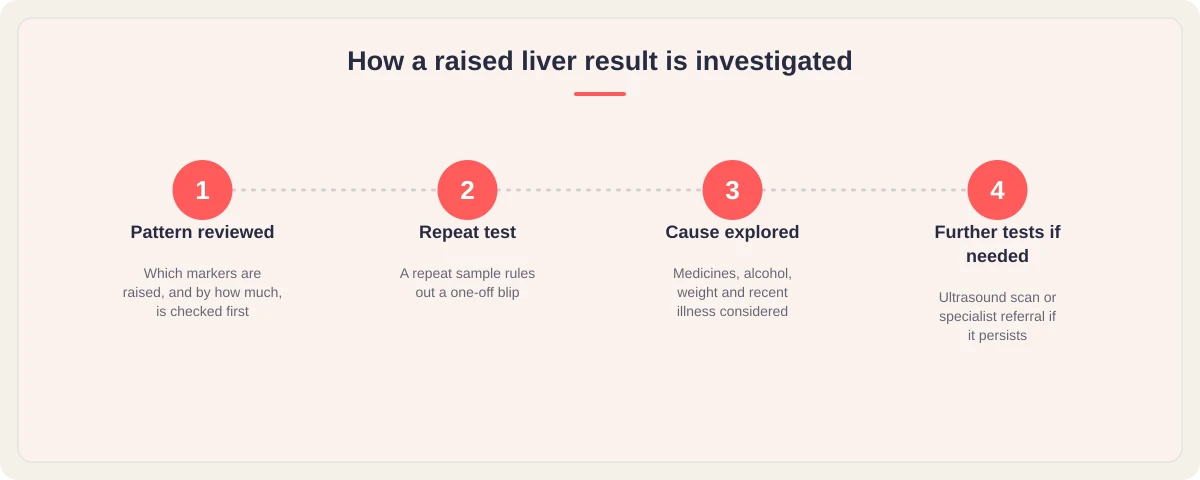
Your history, current medicines and supplements, alcohol intake and recent illness are reviewed alongside the pattern of markers, since the combination often narrows down the likely cause more than any single number. If the picture still is not clear, or the result is significantly raised, your GP may arrange an abdominal ultrasound scan to look at the structure of the liver, or refer you to a liver specialist for further assessment.
Many mildly raised results settle on their own once a temporary cause, such as recent alcohol or a course of medicine, has passed, which repeat testing helps to confirm.
Common causes of a mildly raised result
Most people whose result comes back mildly raised do not have serious liver disease. Common, often reversible causes include regular alcohol intake above the recommended limits, carrying excess weight, certain prescribed medicines, herbal or dietary supplements, and recent infections such as a common cold or flu.
Fatty liver disease, where fat builds up in liver cells, is one of the more common findings behind a mildly raised result in the UK and is closely linked to body weight, diet and activity levels. For many people it can improve with sustained lifestyle changes, which is often the first thing a clinician discusses if this is thought to be the cause.
Less commonly, a raised result can point to viral hepatitis, an autoimmune condition affecting the liver, gallstones affecting bile flow, or other liver conditions, which is why a persistent or significantly raised result is followed up rather than dismissed.
When to speak to a pharmacist or GP
It is worth speaking to a pharmacist or GP if you have symptoms such as persistent tiredness, loss of appetite, itching, yellowing of the skin or eyes, dark urine, pale stools, or discomfort on the right side of your abdomen under the ribs, whether or not you have already had a blood test.
If you are taking a medicine known to affect the liver, your clinician will usually set a monitoring schedule, often checking again some weeks or months after starting or changing the dose, then periodically after that. If lifestyle changes such as reducing alcohol or losing weight are the main plan, a repeat test after a few months is typical to see whether the changes have made a measurable difference.
If you have never had a liver function test and are simply curious, or want a baseline before starting a new supplement or medicine, a private blood test is a reasonable way to get a starting point without needing a specific symptom or referral.
Frequently asked questions
Do I need to fast before a liver function test?
Usually not. A standard liver function test does not normally require fasting, so you can eat and drink normally beforehand unless you have been told otherwise as part of a wider blood test panel.
What does a mildly raised ALT result mean?
A mildly raised ALT often reflects a temporary or reversible cause, such as recent alcohol, a common infection, a medicine or supplement, or carrying extra weight, rather than serious liver disease. A clinician usually reviews the wider pattern and may suggest a repeat test before drawing any conclusions.
Can alcohol affect my liver function test results?
Yes. Alcohol, particularly in the days before a test, can temporarily raise markers such as GGT and ALT even in people who do not drink heavily on a regular basis. If you have been asked to prepare for a test, it is worth checking whether you should avoid alcohol beforehand.
Can I get a liver function test without seeing a GP first?
Yes. A private blood test is available without a GP referral if you want a result for reassurance, to check before starting a new supplement or medicine, or simply as part of a wider health check.
How often should liver function be monitored if I'm on a medicine that can affect it?
This depends on the specific medicine and your individual risk, so your clinician will usually set a monitoring schedule for you, often with a check some weeks or months after starting or changing the dose and periodically after that.
What happens if my liver function results stay raised on a repeat test?
A result that stays raised is usually investigated further, which may include an abdominal ultrasound scan to look at the structure of the liver, additional blood tests to look for specific causes, or referral to a liver specialist.