
Kidney function tests: what your results mean
Quick answer
A kidney function test, often called U&Es, measures creatinine and electrolytes in your blood and uses these to calculate your eGFR, an estimate of how well your kidneys filter waste. A single low eGFR does not automatically mean kidney disease; a clinician looks at the pattern, your history and, usually, a repeat test before deciding what it means.
What a kidney function test actually measures
A kidney function test, often requested as "U&Es" (urea and electrolytes), is a small panel of blood markers rather than one single measurement, and each part tells a different part of the story about how your kidneys are working.
Creatinine is a waste product made by normal muscle activity at a fairly steady rate. Healthy kidneys filter it out of the blood and into urine, so the amount left in your blood reflects how well that filtering is working. Your eGFR, or estimated glomerular filtration rate, is then calculated from your creatinine level, age and sex using a standard formula, and is reported as a number that estimates roughly how much blood your kidneys filter each minute. Urea is another waste product removed by the kidneys, and sodium and potassium are electrolytes that healthy kidneys help keep in a steady balance; a shift in either can sometimes point to how the kidneys, or other factors such as hydration or medicines, are affecting the body.
Because each marker reflects a different part of kidney function, a clinician reads them together as a pattern rather than judging any single figure on its own.
How and where you can get tested
A kidney function test is a standard blood sample, usually taken from a vein in your arm, and most laboratories can process it alongside other routine blood tests.
On the NHS, a GP typically requests one when there is a specific reason: monitoring an existing condition such as diabetes or high blood pressure, checking before or during certain medicines known to affect the kidneys, investigating symptoms such as swelling in the legs or ankles, or following up another abnormal blood result. There is no blanket NHS screening programme that checks kidney function in every healthy adult without a reason, so it is not routinely included in every general check-up.
A private blood test is a straightforward alternative if you would like a result without waiting for a GP appointment, have a family history of kidney disease, take a medicine that can affect the kidneys, or simply want a baseline as part of a wider health screen.
Making sense of your eGFR and creatinine results
Every laboratory prints its own reference range alongside each marker on your report, and creatinine ranges vary slightly by lab, though typical adult ranges are roughly 60 to 110 micromol per litre for men and 45 to 90 micromol per litre for women.
eGFR is usually easier to interpret because it is banded into stages: 90 or above is considered normal kidney function, 60 to 89 is usually normal too if there is no other sign of kidney damage, 45 to 59 and 30 to 44 suggest a mild to moderate reduction, and anything below 30 is a more significant reduction that is followed up more closely. A single reading in the 60 to 89 range, on its own, is common and not usually a concern; it is a result that stays lower, especially below 60, on a repeat test some months later that clinicians pay closer attention to.
Your clinician will usually explain which markers were outside range, roughly how far, and what that pattern, together with your history and any symptoms, is most likely to mean, rather than leaving you to interpret the numbers alone.
Why your result can differ from someone else's
Kidney function results are influenced by more than the kidneys themselves, which is one reason two people of the same age can have quite different readings without either having kidney disease.
Muscle mass has a particularly strong effect on creatinine, since it is produced by muscle activity: someone with more muscle tends to produce more creatinine, which can make their eGFR look slightly lower even with perfectly healthy kidneys, while someone with less muscle, including many older adults, can have a falsely reassuring eGFR. Dehydration, a recent high-protein meal, intense exercise in the day or two before a test, and certain medicines, including some painkillers, diuretics and blood pressure tablets, can all temporarily shift the result without reflecting a lasting change in kidney function.
Pregnancy also changes normal reference ranges, and results are generally interpreted more cautiously in older adults, where a gradual, age-related decline is common and does not always indicate disease.
How an abnormal result is investigated
A single low eGFR or raised creatinine rarely leads straight to a diagnosis. Instead, a clinician usually works through a few steps to understand what is behind it before deciding what, if anything, needs to happen next.
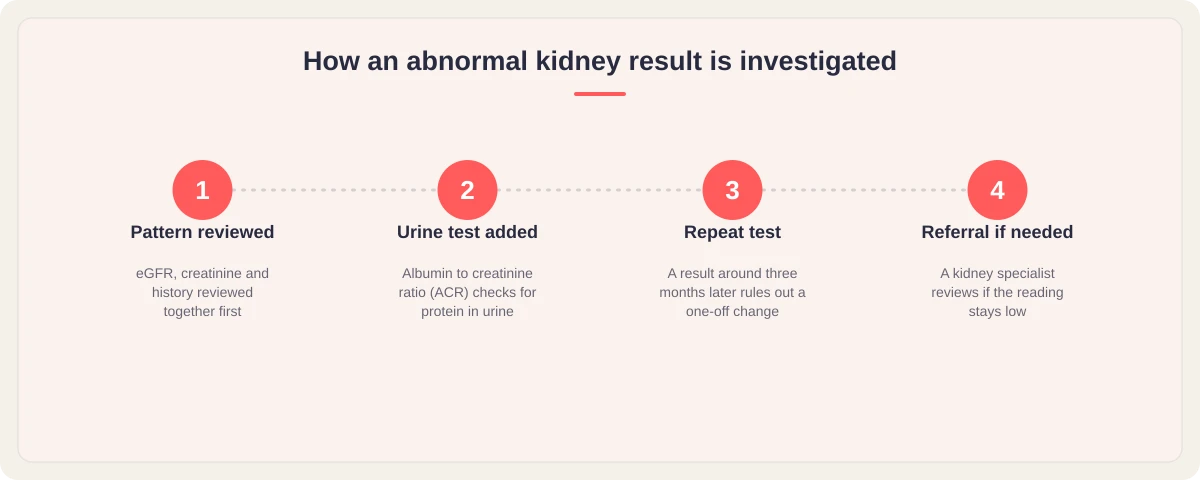
Your history, current medicines and supplements, hydration and any recent illness are reviewed alongside the pattern of markers, since the combination often narrows down the likely cause more than any single number. A urine test that measures the albumin to creatinine ratio, known as ACR, is commonly added at this stage, since protein in the urine alongside a reduced eGFR gives a fuller picture of kidney health than either test alone. Blood pressure is checked too, since it is closely linked to kidney function in both directions.
If the result stays low, or is significantly reduced, on a repeat test around three months later, this is generally what confirms a diagnosis of chronic kidney disease, which may then lead to a referral to a kidney specialist depending on how low the reading is and how quickly it has changed.
Common causes of a lower eGFR or raised creatinine
Most people whose result comes back slightly outside range do not have significant kidney disease. Common, often temporary or manageable causes include dehydration, a recent illness, certain regularly used painkillers, and some blood pressure or diabetes medicines that need dose adjustment rather than stopping altogether.
Long-standing high blood pressure and diabetes are the two most common underlying causes of a persistently reduced eGFR in the UK, which is why kidney function is checked regularly for people managing either condition. A gradual, age-related decline is also common and expected in older adults, and on its own does not necessarily mean disease.
Less commonly, a reduced eGFR can reflect a kidney-specific condition, a blockage in the urinary tract, or the after-effects of a serious infection or dehydration episode, which is why a persistent or significantly reduced result is followed up rather than dismissed.
When to speak to a pharmacist or GP
It is worth speaking to a pharmacist or GP if you notice swelling in your legs, ankles or around your eyes, unusually foamy urine, a change in how often you pass urine, persistent tiredness, or difficulty controlling your blood pressure, whether or not you have already had a blood test.
If you are taking a medicine known to affect the kidneys, your clinician will usually set a monitoring schedule, often checking again some weeks or months after starting or changing the dose, then periodically after that. If you have diabetes or high blood pressure, kidney function is typically checked at least once a year as part of routine monitoring.
If you have never had a kidney function test and are simply curious, have a family history of kidney disease, or want a baseline before starting a new medicine or supplement, a private blood test is a reasonable way to get a starting point without needing a specific symptom or referral.
Frequently asked questions
Do I need to fast before a kidney function test?
Usually not. A standard kidney function test does not normally require fasting, so you can eat and drink normally beforehand unless you have been told otherwise as part of a wider blood test panel.
What does a low eGFR result mean?
A single low eGFR often reflects a temporary factor such as dehydration, a recent illness or muscle mass rather than kidney disease. A clinician usually reviews the wider pattern and arranges a repeat test, often alongside a urine test, before drawing any conclusions.
Can dehydration affect my creatinine result?
Yes. Being dehydrated at the time of your blood test can temporarily raise your creatinine and lower your calculated eGFR, even when your kidneys are working normally, which is one reason a single result is rarely acted on alone.
Can I get a kidney function test without seeing a GP first?
Yes. A private blood test is available without a GP referral if you want a result for reassurance, have a family history of kidney disease, or simply want a baseline as part of a wider health check.
How often should kidney function be monitored if I'm on a medicine that can affect it?
This depends on the specific medicine and your individual risk, so your clinician will usually set a monitoring schedule for you, often with a check some weeks or months after starting or changing the dose and periodically after that.
What happens if my eGFR stays low on a repeat test?
A result that stays low, usually confirmed around three months later, generally supports a diagnosis of chronic kidney disease, which may include a urine test, closer blood pressure monitoring, or referral to a kidney specialist depending on how low the reading is.