Travel vaccinations in the UK: what you may need and when to plan
 Clinically reviewed by Zeenah Araim, GPhC 2077620
·9 November 2026
·7 min read
·Reviews on Trustpilot
Quick answer
Which travel vaccinations you need depends on your destination, trip length and health history. Routine UK vaccines should be up to date, and travel-specific ones, such as typhoid, hepatitis A or yellow fever, may also apply. NHS guidance is to seek advice at least 4 to 6 weeks before you travel, earlier if a multi-dose course is needed.
Which travel vaccinations might you need?
What you need depends on your destination, how long you are travelling for, the activities you have planned and your own health and vaccination history, rather than one fixed list that suits every trip. A sensible starting point is to check that your routine UK vaccinations, including MMR, diphtheria, tetanus and polio, are up to date, since outbreaks of diseases such as measles still occur in parts of the world, and a gap in routine cover is easy to overlook when the focus shifts to travel-specific jabs.
On top of routine cover, travel-specific vaccines are considered for certain regions and types of trip. Common examples include hepatitis A, typhoid, cholera, hepatitis B, rabies, yellow fever, Japanese encephalitis and tick-borne encephalitis. You are unlikely to need all of these for a single trip. A two-week beach holiday in a low-risk country usually needs far less preparation than a long backpacking trip through rural areas, and a travel health assessment is the usual way to work out which, if any, apply to you.
The type of trip matters as much as the country. Staying in a well-run resort with good food and water hygiene carries a different risk profile to backpacking through rural villages, trekking in remote hill country, or working as a volunteer in a local community for several weeks. Longer trips, repeat visits to the same region, and stays in basic accommodation generally raise the number of vaccines worth considering, while a short, well-organised city break usually needs less.
If you are travelling with children, or visiting family and friends in a country with a higher disease risk than your usual holiday destination, it is worth having the conversation earlier rather than later. Family visits are sometimes under-planned for, since the trip can feel more familiar than a typical holiday, even where the health risks are similar or greater, and children may also need a different dosing schedule to adults for some vaccines.
How far in advance should you plan?
NHS guidance is to get travel health advice at least 4 to 6 weeks before you travel, and many GP surgeries and travel clinics ask patients to allow 6 to 8 weeks where possible. This is not only about appointment availability. Several vaccines need more than one dose spread several weeks apart, and some need time after the final dose before full protection builds up.
If your trip is sooner than that, it is still worth seeking advice rather than assuming it is too late. Some protection is better than none, and a clinician can prioritise what matters most for your itinerary and the time you have left, even if a full multi-dose course is not possible before you leave.
Planning your travel vaccinations, step by step
Working through your travel health needs in a sensible sequence helps you avoid last-minute gaps, particularly if your trip includes more than one country or a multi-dose course. The outline below shows the typical process, from checking your destination to travelling with the right proof in hand.
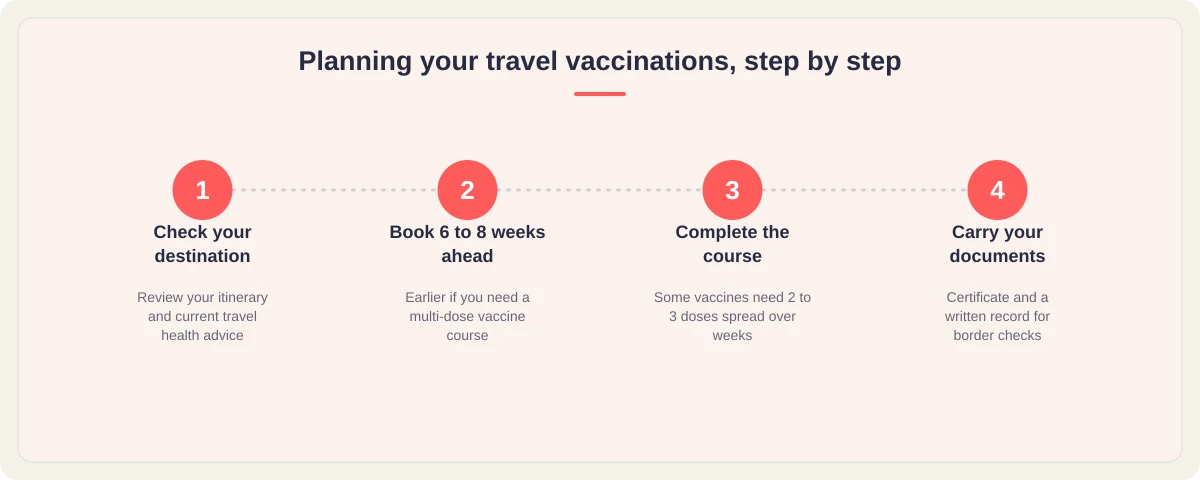
Keeping a simple note of what you have had, and when, is useful for future trips too, since some vaccines give protection for years and will not need repeating every time you travel.
Which vaccines are free on the NHS, and which are private?
Some travel vaccines are available free of charge through a GP practice in the UK: typhoid, hepatitis A, cholera and a diphtheria, tetanus and polio booster, largely because they protect against diseases that carry a wider public health risk if brought back into the country. Not every GP surgery offers this service, so it is worth asking your practice whether they provide free NHS travel vaccinations, or whether they will direct you to a local pharmacy or travel clinic instead.
Other travel vaccines are not available on the NHS and are charged privately wherever you have them. These typically include hepatitis B, rabies, yellow fever, Japanese encephalitis, tick-borne encephalitis and meningococcal ACWY. Pricing and availability vary between providers, so it is worth checking with whichever service you use before you book, and asking whether a combined course (such as hepatitis A with typhoid) might reduce the number of appointments and injections you need.
Checking what you need for your destination
The UK's standard reference for destination-specific travel health advice is TravelHealthPro, run by the National Travel Health Network and Centre (NaTHNaC), which lists current vaccine recommendations, disease outbreaks and entry requirements by country. GOV.UK also publishes country-by-country travel advice covering safety and health alongside visa and entry rules.
It is worth checking both your final destination and any countries you pass through en route, since a layover or overland crossing can carry its own entry requirements, particularly for yellow fever. Your planned activities matter too. Visiting rural areas, caves, animal sanctuaries or farms, or spending time around bats or monkeys, can change your rabies risk compared with staying in a city centre for the whole trip.
Food and water hygiene, bite prevention and sun safety are worth planning alongside vaccines rather than instead of them, since no vaccine covers every travel health risk. A clinician can talk through practical steps for your specific trip, such as insect repellent and net use in malaria risk areas, alongside deciding which vaccines are actually relevant to where you are going.
The yellow fever certificate, and other proof you may need
Yellow fever is the vaccine most likely to come with a paperwork requirement. If it is recommended or required for your destination, it can only be given at a designated yellow fever vaccination centre in the UK, and you will be issued an International Certificate of Vaccination or Prophylaxis (ICVP) as proof. Under current international health regulations, a single dose is considered to give lifelong protection for most people, though you should still check the entry rules for your specific destination, since some border checks still ask to see the certificate itself.
A small number of other countries ask about meningococcal or polio vaccination status at the border, particularly around religious pilgrimages or specific regional outbreaks at the time of travel. If you are ever unsure, carry a simple written record, in English, of what you have had and when, in case you are asked at immigration.
Who should take extra care when planning
Some travellers need a more tailored assessment before any vaccines are given. This includes people who are pregnant or breastfeeding, anyone with a weakened immune system, for example from certain medicines or health conditions, infants and young children, and people with a history of severe allergic reactions to previous vaccines. Live vaccines, which include yellow fever, are generally avoided or need specific caution in some of these groups, so it is worth flagging your situation clearly when you book.
Older travellers and people with long-term health conditions are not automatically excluded from travel vaccines, but it is worth allowing extra time to discuss your health history and current medicines, and to think through how a trip to a hotter climate, higher altitude or more remote area might affect your usual condition and how you manage it day to day.
Frequently asked questions
How far in advance should I book travel vaccinations?
NHS guidance is to seek travel health advice at least 4 to 6 weeks before you travel. Many clinics prefer 6 to 8 weeks, since some vaccines need more than one dose spread over several weeks. Book sooner if your trip includes yellow fever or other vaccines only available at certain centres.
Are travel vaccinations free on the NHS?
Some are. Typhoid, hepatitis A, cholera and a diphtheria, tetanus and polio booster are usually free through a GP practice that offers this service, though not every surgery does. Others, including hepatitis B, rabies, yellow fever, Japanese encephalitis and tick-borne encephalitis, are charged privately.
What if I am travelling at short notice?
It is still worth seeking advice rather than assuming it is too late. A clinician can help you prioritise what matters most for your destination and the time available, even if a full multi-dose course is not possible before you leave.
Do I need a yellow fever certificate?
You only need one if yellow fever vaccination is recommended or required for your destination. It is given only at designated UK centres, and you receive an International Certificate of Vaccination or Prophylaxis (ICVP) once vaccinated, which some countries ask to see at the border.
Can I have travel vaccinations if I am pregnant or have a health condition?
Many travel vaccines can still be considered, but some, particularly live vaccines such as yellow fever, need extra caution. A clinician will review your health history and current medicines before deciding which vaccines, if any, are suitable and how to plan safely around them.