
Vitamin B12 injections: who needs them and how they work
 Reviewed by the My London Pharmacy clinical team
·20 October 2026
·7 min read
·Reviews on Trustpilot
Quick answer
Vitamin B12 injections are used when the body can't absorb enough B12 from food or tablets, most often due to pernicious anaemia. They correct deficiency faster than tablets, usually starting with a loading course then maintenance injections every two to three months. A blood test confirms whether you need them before treatment starts.
What vitamin B12 does in the body
Vitamin B12 (cobalamin) is a nutrient the body needs to make healthy red blood cells, keep the nervous system working properly, and produce DNA. It occurs naturally in animal-based foods such as meat, fish, eggs and dairy, and is added to some fortified foods, including certain cereals and plant milks.
B12 also plays a part in maintaining the protective sheath around nerve fibres, called myelin. When levels fall too low for too long, that sheath can be affected, which is part of why a prolonged deficiency can cause nerve symptoms rather than just tiredness. The vitamin works closely alongside folate (vitamin B9) in producing new cells, and the two are often checked together for this reason.
The liver stores several years' worth of B12, so a deficiency usually develops slowly, often over months or years rather than days. By the time symptoms appear, levels may have been falling for some time, which is one reason a blood test matters more than guessing based on symptoms alone.
Who is at risk of a vitamin B12 deficiency
Some people are more likely to run low on B12 than others:
- Pernicious anaemia: an autoimmune condition in which the body stops making enough intrinsic factor, the protein needed to absorb B12 from food. It is the most common cause of B12 deficiency in the UK.
- Diet: vegans, and some vegetarians, who eat little or no animal produce without taking a supplement or regularly eating fortified foods.
- Digestive conditions: Crohn's disease, coeliac disease, or previous stomach or bowel surgery can all reduce how much B12 the gut absorbs.
- Certain medicines: long-term use of metformin or proton pump inhibitors (PPIs) can lower B12 levels over time.
- Age: absorption tends to become less efficient after around 60, even without any other underlying condition.
Long-term PPI use and metformin reduce absorption in different ways: PPIs lower stomach acid, which the body needs to release B12 from food, while metformin appears to interfere with absorption further along the gut. Neither means the medicine should be stopped; it simply means B12 is worth monitoring if you take either one for an extended period.
If more than one of these applies to you, it is worth asking a pharmacist or GP whether a blood test is a sensible next step, rather than waiting for symptoms to appear.
Signs and symptoms of low B12
Early signs can be easy to put down to a busy life: persistent tiredness, low energy, or breathlessness on exertion. As a deficiency progresses, other symptoms can appear, including:
- Pins and needles, numbness or tingling in the hands and feet
- Pale or yellowish skin
- A sore, red tongue or mouth ulcers
- Low mood, irritability, or problems with memory and concentration
- Unsteadiness or difficulty walking, in more advanced cases
Nerve-related symptoms matter because, left untreated for long enough, some of the nerve damage caused by B12 deficiency can become permanent. This is one reason a confirmed low result is treated promptly, rather than left to resolve on its own.
How a B12 deficiency is diagnosed
A simple blood test measures the amount of B12 in the blood. If the result is low, or borderline alongside typical symptoms, a clinician may also check:
- Intrinsic factor antibodies: to help confirm or rule out pernicious anaemia
- Folate levels: folate and B12 deficiency can overlap, and folic acid is not usually started until B12 has been checked, since treating folate alone can occasionally mask an underlying B12 problem
- Full blood count: B12 deficiency can cause red blood cells to become unusually large, known as macrocytic anaemia
Testing first, rather than starting treatment on the basis of symptoms alone, matters because fatigue and low mood have many possible causes. A result confirms whether B12 is actually the issue before anything is treated.
B12 injections vs tablets: which is used when
Both routes raise B12 levels, but they are not interchangeable, and which one suits you depends on the likely cause of the deficiency.
B12 tablets, or an oral spray alternative, rely on the gut absorbing the vitamin in the usual way. They work well for a mild, diet-related deficiency, or as ongoing prevention once levels have already been corrected. For pernicious anaemia or another absorption problem, however, swallowing more B12 does not help much, because the issue is absorption rather than intake, and the gut cannot take up enough of an oral dose.
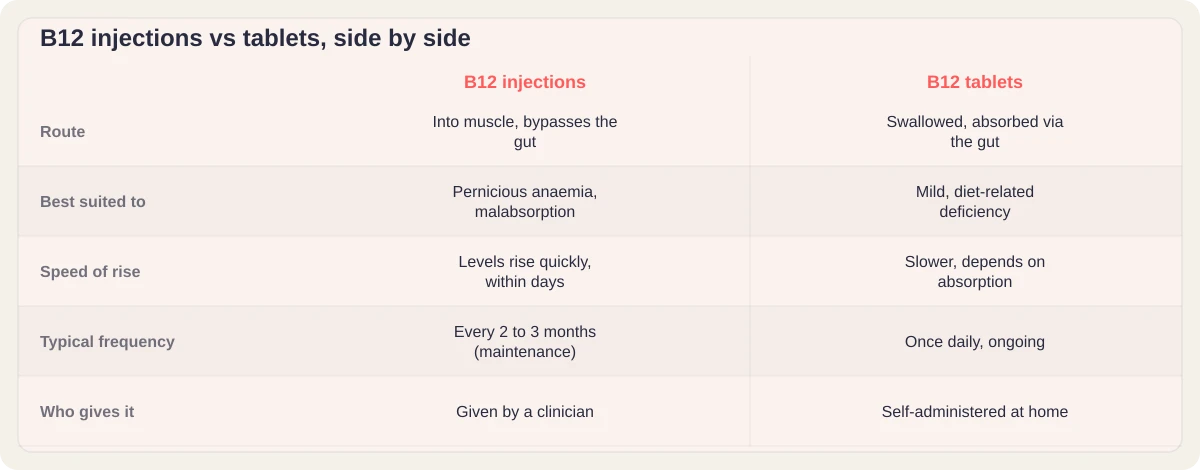
B12 injections (hydroxocobalamin) bypass the gut entirely, delivering the vitamin directly into muscle. This makes them the standard treatment where absorption is the problem: pernicious anaemia, significant malabsorption, or neurological symptoms, where a faster and more reliable rise in levels is wanted.
In short, tablets suit a straightforward dietary shortfall, while injections suit a confirmed absorption problem or a more pronounced deficiency. A clinician will usually base the choice on your test results and likely cause, rather than on personal preference alone.
You may also see B12 injections offered privately as a general wellbeing or energy boost, outside of a diagnosed deficiency. There is no good evidence that extra B12 raises energy in someone whose levels are already normal, so a test result showing a genuine shortfall is the sensible starting point before any injection, rather than treating a tired day as reason enough on its own.
How often are B12 injections given
Where injections are needed, treatment typically starts with a loading course: an injection every other day for around two weeks, or until symptoms stop improving. Where there are no nerve-related symptoms, this initial course is sometimes shorter.
After the loading course, most people move onto maintenance injections. For pernicious anaemia, or another lifelong cause, this usually means one injection every two to three months, often continued indefinitely, since the underlying absorption problem does not go away on its own. Where the cause was dietary and has since been corrected, a clinician may review whether ongoing injections are still needed, or whether tablets and dietary advice are now enough.
Follow-up tends to be straightforward once a maintenance schedule is agreed: a repeat blood test from time to time to check levels are holding steady, and a quick review of symptoms at each appointment. Most people on long-term maintenance injections settle into the routine quickly, booking each one in much the same way as any other short appointment.
Possible side effects of B12 injections
B12 injections are generally well tolerated. The most common effect is mild soreness, redness or itching at the injection site, which usually settles quickly. Allergic reactions are rare, though they are one reason the first dose is normally given under clinical supervision rather than without any oversight.
Because B12 is water-soluble, any excess the body does not use is simply passed out in urine, so there is no established risk of toxicity from having too much. This differs from fat-soluble vitamins, which can build up if taken to excess. That said, an injection is still a prescription-only medicine in the UK when given for a diagnosed deficiency, and it should follow a test result and clinical advice, not self-diagnosis.
Frequently asked questions
Can I have a B12 injection without a blood test first?
Usually not, and for good reason. A blood test confirms whether you are actually deficient and helps identify the likely cause (pernicious anaemia, diet, or another absorption issue), so treatment is based on an actual result rather than a guess.
How quickly will I feel better after a B12 injection?
Many people notice an improvement in energy within a few days to a couple of weeks of starting treatment, though nerve-related symptoms such as tingling can take longer to settle, and any nerve damage present before treatment may not fully reverse.
Is B12 deficiency linked to a vegan or vegetarian diet?
It can be. B12 occurs naturally in animal products, so anyone eating little or no meat, fish, eggs or dairy without a supplement or fortified food is at higher risk, though diet is only one of several possible causes.
Can you take too much vitamin B12?
There is no established upper limit that causes harm, since B12 is water-soluble and any excess is passed out in urine. This differs from vitamins that can build up in the body, though injections are still only given on prescription for a diagnosed need.
Do B12 injections hurt?
Most people describe them as a brief sting followed by mild soreness at the injection site, similar to other routine injections, rather than anything significantly more uncomfortable.
How long do B12 injections take to show on a blood test?
Because an injection adds B12 directly to the bloodstream, levels typically rise quickly, often within days, which is why a blood test to check for deficiency is usually done before starting injections rather than afterwards.