
Minoxidil side effects: what is common, what is rare and when to stop
Quick answer
Most minoxidil side effects are mild and settle with continued use: scalp irritation and a temporary rise in shedding during the first weeks are common. Oral low-dose minoxidil can also cause fluid retention or unwanted hair growth. Rare but serious signs, chest pain, a fast heartbeat, sudden swelling or fainting, mean you should stop and get medical advice promptly.
Common side effects of topical minoxidil
Topical minoxidil, applied as a liquid or foam directly to the scalp, is generally well tolerated. The side effects most people notice are local ones at the application site rather than anything affecting the rest of the body.
Scalp itching, dryness, flaking and mild redness are the most commonly reported issues, particularly in the first few weeks of use. The liquid formulation contains propylene glycol, which is more likely to irritate sensitive skin than the foam, so switching formulation is often enough to settle things down.
Unwanted hair growth on the forehead or face can occur if the product spreads beyond the scalp, usually from not washing your hands after application or from the liquid running during sleep. Applying it carefully, allowing it to dry fully and washing your hands afterwards reduces this risk considerably.
Minoxidil shedding: why it happens and when it stops
An increase in shedding in the first two to eight weeks of use is one of the most common reasons people worry minoxidil isn't working, or is making things worse. In fact, it's usually the opposite.
Minoxidil pushes resting hairs into a new growth cycle. As older hairs are displaced to make room for new growth, a temporary rise in daily shedding is a recognised and expected response, not a sign of treatment failure.
For most people, this settles within a few weeks as new, finer regrowth starts to appear. If heavy shedding carries on well beyond around twelve weeks with no sign of new growth, it's worth checking in with a pharmacist or clinician, since other causes of hair loss can sometimes be at play alongside it.
Common side effects of low-dose oral minoxidil
Low-dose oral minoxidil is increasingly used, off-label, for hair loss. It was originally developed as a blood pressure medicine, and because it works systemically rather than at the scalp alone, its side-effect profile is a little different from the topical version.
The most commonly reported effects are mild fluid retention, with some puffiness around the ankles, hands or face, headache, and lightheadedness, especially when standing up quickly. A modest increase in heart rate and more noticeable unwanted hair growth on the face or body are also reasonably common, and tend to be dose related.
Clinicians prescribing oral minoxidil for hair loss usually start at a low dose and review how it's tolerated before considering any increase, which helps keep these effects manageable for most people.
Rare but serious side effects: when to stop and seek help
Both topical and oral minoxidil carry a small risk of more serious reactions. These are uncommon, but it's important to know what to watch for.
- Chest pain or a fast, irregular heartbeat
- Sudden swelling of the face, hands, feet or lower legs
- Unexplained, rapid weight gain
- Fainting or severe dizziness
- Signs of an allergic reaction: facial swelling, breathing difficulty or a widespread rash
If any of these occur, stop using minoxidil and get medical advice promptly rather than waiting to see if it passes. NHS 111, your GP, or A&E for severe symptoms are the right places to go, depending on how serious it feels.
Topical vs oral minoxidil side effects at a glance
Because the two forms are absorbed so differently, their side-effect profiles don't fully overlap. The table below sets out how they tend to compare, though your own history and any other medicines you take will shape what's most relevant for you.
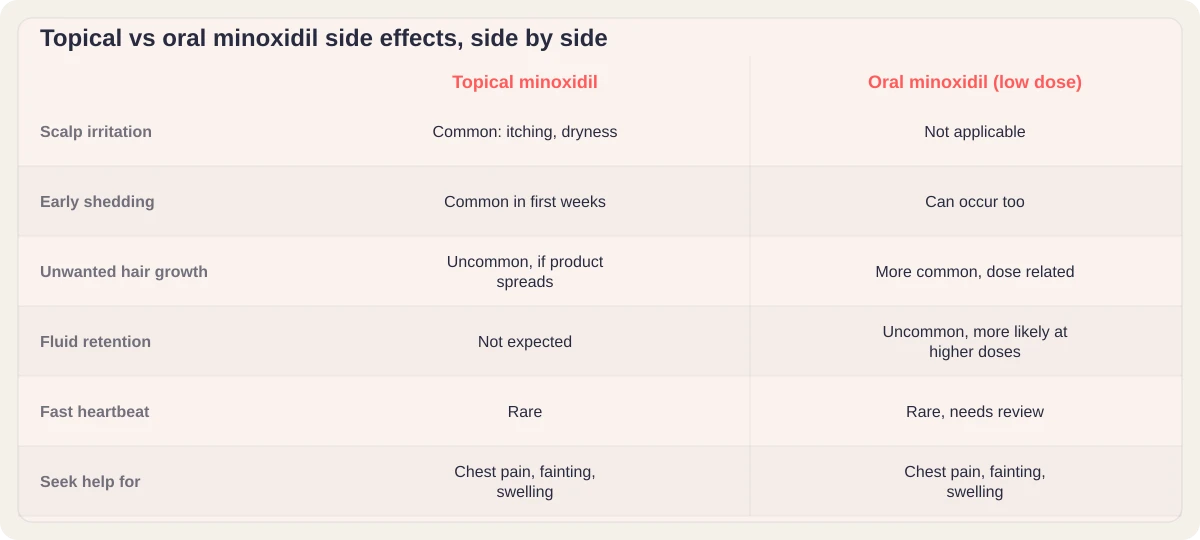
In short: topical minoxidil's side effects are mostly local to the scalp, while oral minoxidil's side effects are mostly systemic. Neither is automatically the better choice; it depends on what suits your skin, routine and medical history.
Unwanted hair growth from minoxidil (hypertrichosis)
Hypertrichosis, hair growth in places you didn't have it before, is one of the side effects people ask about most. With topical minoxidil, it's usually explained by accidental spread of the product onto the forehead, temples or hands rather than true systemic absorption.
With oral minoxidil, it's more of a recognised, dose-related effect, since the whole body is exposed to the medicine rather than just the scalp. It can appear on the face, arms or back and tends to be more noticeable in some people than others.
It's a cosmetic effect rather than a dangerous one, and it typically fades over weeks to months after stopping or lowering the dose. For some people, this is simply a reason to switch formulation or discuss the dose with their clinician.
Is minoxidil safe to use long-term?
Minoxidil has been used for hair loss for decades, and for most people, long-term topical use is well tolerated, with side effects that stay mild and local to the scalp.
One thing worth planning for either way: minoxidil's benefit is only maintained while you keep using it. Stopping typically means any gains gradually fade over the following months as hair returns to its natural pattern.
Oral low-dose use for hair loss is a newer, still-growing area of practice, so ongoing monitoring, sometimes including blood pressure and heart rate checks, alongside a clinician is a sensible precaution, particularly for anyone with an existing heart or blood pressure condition. Always tell your clinician about any other medicines or health conditions before starting.
Frequently asked questions
Is minoxidil shedding normal?
Yes. An increase in shedding during the first two to eight weeks is a common and expected response as minoxidil pushes resting hairs into a new growth cycle. It usually settles on its own as new growth appears.
What does unwanted hair growth from minoxidil look like?
It can appear as finer hair on the forehead, face or hands with topical use, usually from accidental spread of the product, or more widely on the face and body with oral use, where it is dose related. It's cosmetic and usually fades after stopping or adjusting the dose.
What is the difference between oral and topical minoxidil side effects?
Topical minoxidil mainly causes local scalp effects such as irritation, dryness and early shedding. Oral minoxidil acts throughout the body, so its more common effects include fluid retention, a faster heart rate and more noticeable unwanted hair growth.
Is minoxidil safe to use long term?
For most people, long-term topical use is well tolerated. Benefits only last while treatment continues, and they gradually fade after stopping. Oral use is a newer approach for hair loss and is usually monitored by a clinician alongside your other health conditions.
When should I stop minoxidil and seek medical help?
Stop and get prompt medical advice if you develop chest pain, a fast or irregular heartbeat, sudden swelling of the face or limbs, fainting, severe dizziness or signs of an allergic reaction such as facial swelling or breathing difficulty.
Can minoxidil cause a fast heartbeat?
It's rare with topical use but more documented with oral minoxidil, particularly at higher doses. A persistent fast or irregular heartbeat should be checked by a clinician rather than monitored at home.